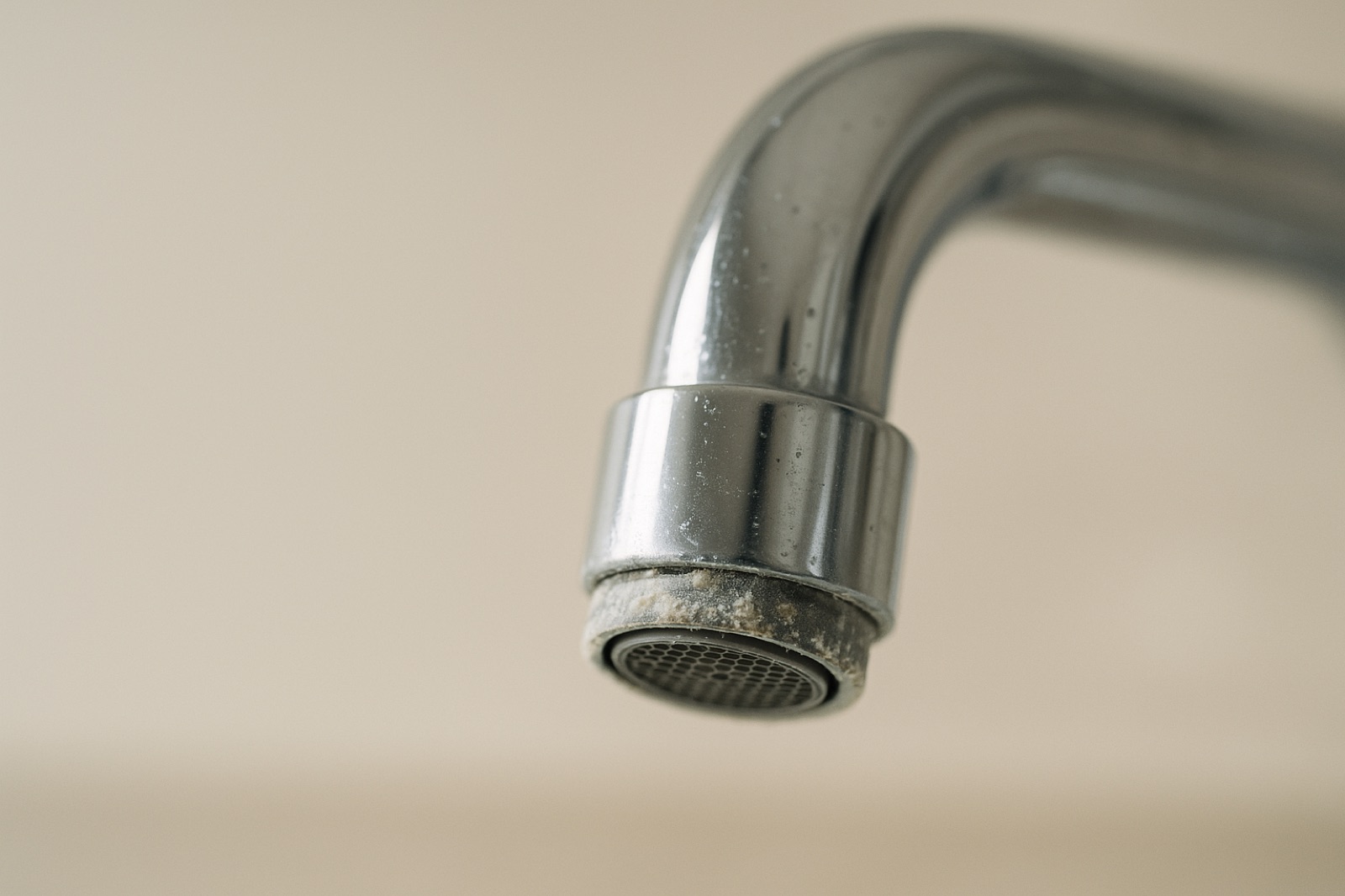
When cloudy glassware, stubborn faucet crust, and disappointing soap suds appear together, a water softener can seem like the obvious answer. It may be the right one, but those symptoms are not equally reliable. Some have convincing lookalikes, and one hardness number cannot explain every change in your water.
That distinction matters when weather or source conditions may be changing. On October 7, 2026, The Guardian reported that California faces a mix of possible natural disasters as El Niño approaches. Its report on California's El Niño preparedness describes water covering an intersection north of San Francisco. That story does not tell you what is coming from your tap. It does offer a useful reminder: unusual conditions are a reason to verify household water problems, not guess at equipment.
Start with the deposit, not the appliance
White spotting is the weakest clue when it appears alone. Dishwasher detergent, rinse aid, hand washing residue, and water droplets left to dry can all cloud a glass. Try wiping one spot with a damp cloth. Loose residue that disappears easily may be a cleaning issue. A firm, chalky deposit that repeatedly forms where water evaporates is more consistent with hardness minerals.
Now compare locations. Check the kettle, showerhead, faucet aerator, and the waterline inside a frequently used pot. Repeated crust in several hot water locations makes hardness more plausible because heating and evaporation leave minerals behind. A mark found only inside the dishwasher points first toward detergent settings, rinse aid, loading, or appliance maintenance.
Color matters too. Orange, brown, blue, green, or black deposits are not proof of hardness. They can point toward corrosion, metals, sediment, or biological growth. A conventional softener should not be chosen from color alone.
Use soap as supporting evidence
Hard water can reduce easy lather and leave a film on tubs, sinks, or skin. But soap performance is easy to misread. Product formulation, the amount used, water temperature, and low water flow can change how washing feels.
Make a controlled comparison. Use the same soap, quantity, container, and water temperature with two water samples. If you already have bottled water with a known mineral analysis, it can serve as a rough comparison, though it is not a laboratory control. The goal is not to calculate hardness from bubbles. It is to see whether the household sample consistently behaves differently.
If poor lather appears alongside recurring chalky scale in several fixtures, a hardness test becomes worthwhile. If lather is the only complaint, test before shopping.
Read the hardness unit before reading the sales pitch
A test may report hardness in milligrams per liter as calcium carbonate, often written mg/L as CaCO3, or in grains per gallon, written gpg. One grain per gallon is about 17.1 mg/L as CaCO3. To convert mg/L to gpg, divide by 17.1. To convert gpg to mg/L, multiply by 17.1.
Record the unit with the number. A bare result such as “10” is ambiguous because 10 mg/L and 10 gpg describe very different mineral levels.
Test untreated cold water near where the supply enters the house when possible. If you test downstream from an old softener, cartridge, or scale control device, the result may describe the equipment rather than the incoming water. For a professional check, confirm hardness and size the right system from an untreated sample and your household's actual water use.
Watch for false positives
A hardness strip can be affected by storage, age, timing, lighting, and an imprecise color match. Retest when the result conflicts with what you see. A drop titration test generally gives a clearer endpoint, while a laboratory analysis can identify calcium and magnesium separately and investigate additional concerns.
Do not treat a hardness result as a safety test. It does not rule out bacteria, nitrate, lead, arsenic, or other contaminants. If water suddenly changes in color, odor, or taste after flooding, utility work, or a source disruption, contact the utility or arrange testing directed at that change.
Match the response to the confirmed problem
Choose repair when deposits are isolated to one appliance, flow is weak at one fixture, or a water heater and aerators need maintenance. Choose filtration when testing identifies sediment, taste, odor, or a specific contaminant that an appropriate filter is certified to reduce. Choose softening when measured hardness agrees with recurring scale and soap problems throughout the home.
The useful diagnosis is a pattern: persistent mineral deposits, repeatable soap effects, and a hardness result with a known unit. When all three agree, you can evaluate a softener with confidence. When they do not, the disagreement is valuable. It can keep you from buying equipment for the wrong water problem.