Stand in the filtration aisle, or scroll the online equivalent, and you will meet two completely different philosophies wearing the same word. One says filter every drop that enters the house. The other says filter only the water you actually drink. Both are legitimate. Buying the wrong one for your situation is how homeowners end up overspending, or solving a problem they never had while ignoring the one they did.
The good news: choosing between them is not a matter of taste. The answer falls straight out of what is wrong with your water and where you notice it.
Whole-house: treat every drop at the door
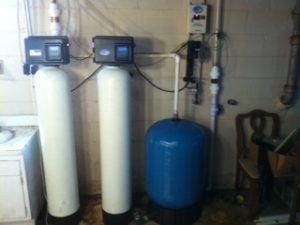
A whole-house system, called point-of-entry in the trade, installs where the main water line enters your home. Every fixture downstream gets treated water: showers, laundry, toilets, the water heater, the ice maker, all of it.
That reach is exactly what you want when the problem itself is whole-home. Sediment that clogs aerators and scratches fixtures, chlorine taste and smell strong enough to notice in the shower steam, or iron that leaves orange stains in every tub and toilet: you experience these problems at every tap, so treating one tap would be pointless.
The trade-offs follow from the size of the job. Point-of-entry equipment has to keep up with your home's full flow rate, so the hardware is bigger, installation is usually a plumber's job, and the filter media is doing the whole household's work, showers included.
Point-of-use: concentrate the effort where you drink
A point-of-use system, whether an under-sink unit, a countertop filter, or a reverse osmosis system feeding the kitchen tap, treats only the last few feet of the journey, right before the glass.
That focus is its superpower. Because it only processes the few gallons a day you drink and cook with, a point-of-use unit can afford far more intensive treatment than would ever be practical for a whole house. Reverse osmosis is the clearest example: excellent at reducing a broad range of dissolved drinking-water contaminants, and entirely impractical to run for your laundry.
Decide by problem, not by product
The reliable method is boring, and it works: identify the problem first, then buy the tool shaped like the problem. That starts with information, either your utility's annual water quality report plus a tap test to see what your own plumbing adds, or a full lab test if you are on a well.
The decide-by-problem worksheet
- What did the test actually find, and is it an aesthetic complaint or a health-based one?
- Do you notice the issue at every fixture, or only in the drinking glass?
- Does it affect skin, laundry, and appliances, or just taste and smell?
- Who will change the filters, and how often are you honestly willing to do it?
- What does a year of replacement cartridges cost, not just the upfront hardware?
Read your answers back and the decision usually makes itself. Every-fixture, comfort-and-appliance problems point to point-of-entry. Drinking-and-cooking concerns, especially anything health-related the test turned up, point to point-of-use at the kitchen tap.
The layered answer most homes land on
Here is the part the aisle signage never mentions: this is not really an either-or question. Plenty of homes do both, in layers. A sediment and carbon setup at the point of entry handles grit and chlorine for the whole house, while a point-of-use unit at the kitchen sink does the fine-grained work on drinking water. Each layer stays smaller, simpler, and cheaper to maintain because neither is being asked to do the other's job. Start with the test, fix what it found, and add a layer only when a real problem asks for it. ●