Water treatment is getting attention far beyond the basement. Circle of Blue reporter Brian Bienkowski recently covered new federal tax guidance for gas extracted from livestock manure. That story concerns energy and agricultural waste, not household hardness. Still, it offers a useful reminder: water carries different materials from different sources, and one treatment process does not solve every problem.
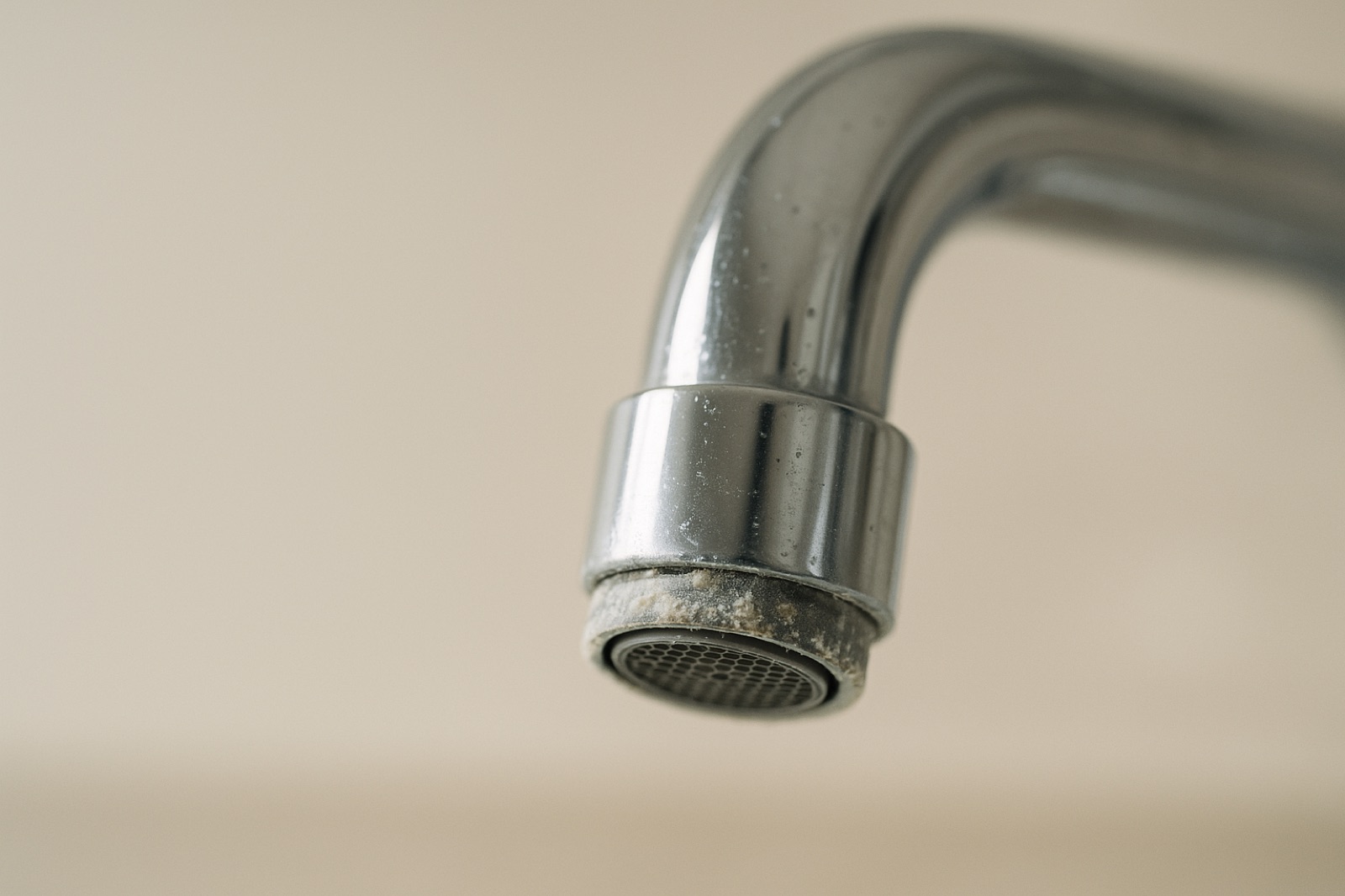
That matters when you already own a water softener but still see white spots on glasses, faucets, or shower doors. The easy conclusion is that the softener has failed. Sometimes it has. Just as often, the residue is a look-alike clue that needs a different response.
Start with what a softener actually changes
A conventional softener exchanges hardness minerals, primarily calcium and magnesium, for sodium or potassium ions. It is intended to reduce scale formation and improve how soap performs. It is not a general-purpose filter for sediment, disinfectants, dissolved salts, iron, or every substance that can remain after a drop of water evaporates.
This explains an apparent contradiction: softened water can test very low for hardness and still leave a visible mark. Evaporation can concentrate materials that remain dissolved in the water. Cleaning products can also dry on glass and resemble mineral spotting.
Do not judge the system from appearance alone. First determine whether the residue is accompanied by other hardness symptoms.
Read the cluster, not one clue
A softener problem becomes more plausible when several changes appear together. Soap suddenly produces less lather. A chalky crust forms around hot-water fixtures. The kettle or showerhead accumulates firm scale. Laundry feels different. These observations still do not prove hardness, but the pattern is more meaningful than one spotted glass.
If soap performs normally and deposits wipe away easily, the softener may still be working. Dishwasher detergent, rinse aid, excess hand soap, or water droplets drying in place can all produce misleading residue. Orange, brown, or black staining points away from an ordinary hardness-only diagnosis and toward testing for other water characteristics.
Get a number from the right locations
Test total hardness at an untreated tap and a softened cold-water tap. An outdoor faucet may bypass the softener, but plumbing layouts vary, so confirm the route rather than assuming. Avoid sampling immediately after regeneration or after water has sat unused for a long period.
Hardness is commonly reported as grains per gallon, abbreviated gpg, or milligrams per liter, abbreviated mg/L. Parts per million is numerically comparable to mg/L for this purpose. To convert mg/L to gpg, divide by about 17.1. A result of 171 mg/L is therefore about 10 gpg.
A total dissolved solids meter is not a hardness test. It responds broadly to dissolved ions, including the ions left after softening. A high reading can therefore create a false positive even when calcium and magnesium have been removed. Use hardness test strips, a drop-count kit, or laboratory analysis designed to measure hardness.
Match the response to the evidence
If untreated water is hard and you do not have a softener, persistent scale and poor soap performance may justify considering one. Before buying, confirm hardness and size the right system using the household's water use, hardness level, plumbing needs, and any additional test results.
If hardness is low after an existing softener, do not replace it merely because glassware spots. Review detergent amounts, rinse settings, and drying habits. A filter may be relevant when testing identifies sediment, taste, odor, iron, or another specific target, but filtration should be selected for that target rather than for a generic promise of better water.
If the softened tap still measures nearly as hard as the untreated tap, move to repair checks. Confirm that the bypass valve is in service position, salt is present, the brine has not formed a hard bridge, and the unit has power and the correct time. Then consider valve operation, resin condition, regeneration settings, or professional service. Repair is often the sensible first step when the equipment once worked and the failure appeared suddenly.
What reader activity can and cannot tell us
The Home Water Report recorded 3,210 page views, 1,068 visitors, 1,258 search crawls, and 2,876 AI crawls in the available snapshot. Those totals show that water guidance is being visited and indexed, but the feed contains no query-level evidence or conversion data. It cannot tell us which symptom brought an individual homeowner here or whether that person ultimately needed equipment.
Your own decision should rest on better evidence: the kind of deposit, soap behavior, hardness results from correctly chosen taps, and the performance history of any existing system. White spots are a reason to investigate. They are not, by themselves, a verdict on your softener.