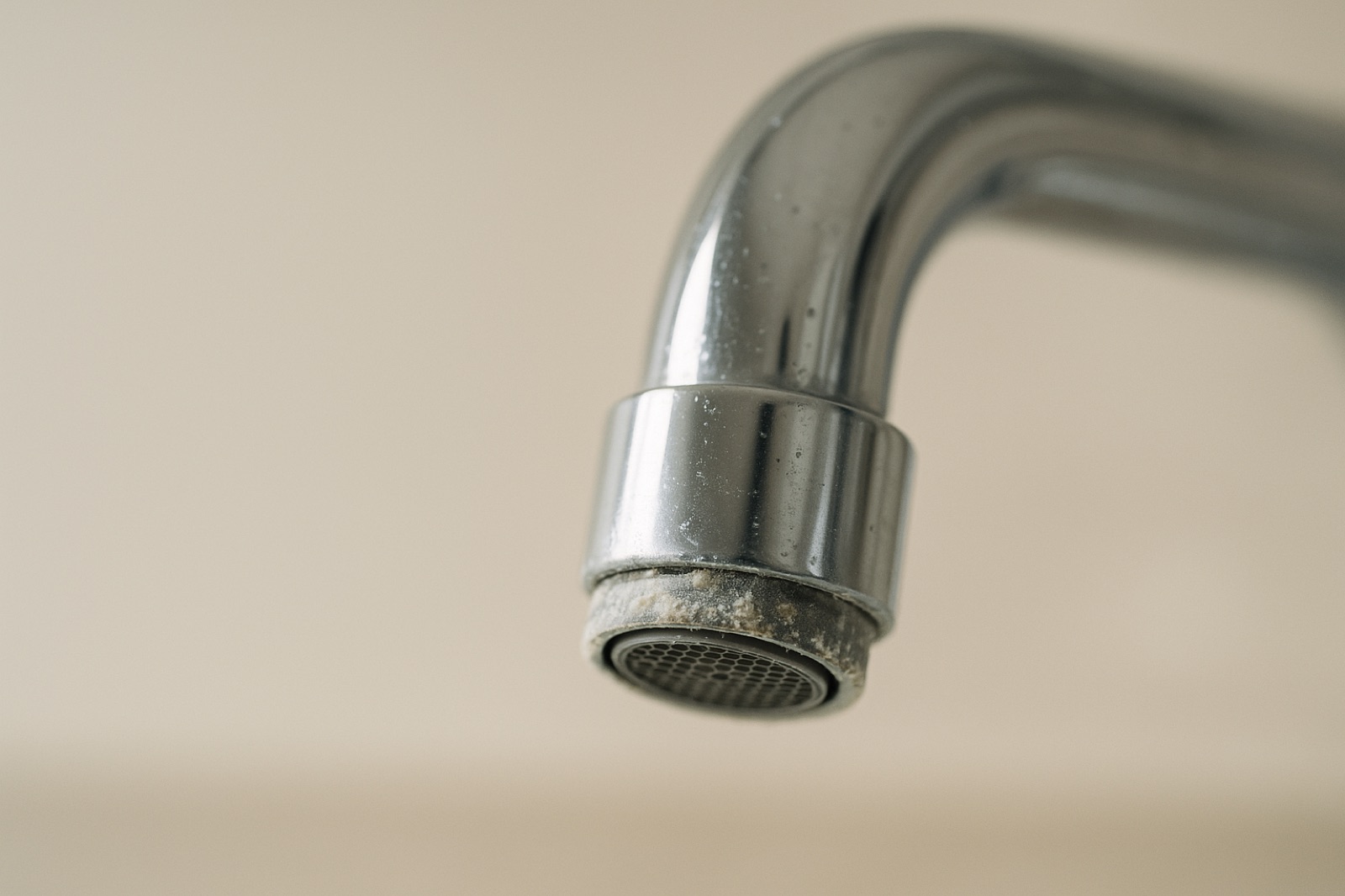
White marks on a faucet can make a water softener seem like the obvious purchase. But similar-looking residue can come from hardness minerals, detergent, salt, or other dissolved material left behind when water evaporates. Before you buy equipment, treat that film as a clue, not a verdict.
This distinction matters as water systems collect more information. In a September 2026 article, Water Finance and Management described how utilities have adopted tools including smart metering, asset management systems, GIS, and SCADA. Its look at the next phase of utility digital transformation shows how much operational data can exist behind water service. Yet utility data still cannot tell you exactly what dried on your shower door or whether a softener inside your house is working. That diagnosis begins at the tap.
Start with the texture, not just the color
Hard-water scale usually builds where water is heated, sprayed, or repeatedly allowed to dry. Look around faucet aerators, showerheads, kettle interiors, and the heating surfaces of appliances. A firm, crusty deposit that returns after cleaning strengthens the hardness case.
Flat spots on glasses or countertops are less decisive. They may be mineral residue, but they can also reflect too much dishwasher detergent, rinse aid settings, cleaning products, or water droplets that were simply left to evaporate. Soap scum adds another false positive because it combines soap with minerals and body oils. It can make a shower look heavily scaled even when the underlying mineral deposit is modest.
Try cleaning a small area completely, then watch how it changes over several normal uses. If a chalky crust reforms fastest near hot water, hardness becomes more likely. If the film appears only after a particular cleaner or dishwasher cycle, investigate that process first.
Use soap as supporting evidence
Hard water can reduce lather and leave soap feeling harder to rinse from fixtures, fabrics, or hair. That pattern is useful when it appears throughout the house. It is not a hardness measurement, however. Soap formulation, detergent dose, water temperature, and personal preference all affect how suds behave.
A sudden change deserves special attention. If soap performance was acceptable last week and poor today, an existing softener may have run out of salt, lost power, entered bypass, or failed to regenerate. That points toward inspection or repair before replacement.
Make the test answer the right question
Ask for total hardness reported in milligrams per liter, parts per million, or grains per gallon. For hardness in ordinary water testing, milligrams per liter and parts per million are commonly treated as equivalent. One grain per gallon is about 17.1 milligrams per liter.
Do not use a total dissolved solids meter as a substitute. TDS combines many dissolved substances and does not isolate the calcium and magnesium responsible for hardness. A high TDS result does not prove you need a softener, and a spot on glass does not identify what the meter detected.
Test cold water from a frequently used tap. If you already own a softener, compare water entering the unit with water leaving it after a normal regeneration. A hard incoming sample and a much softer outgoing sample suggest the equipment is doing its main job, even if some spotting remains. Similar readings on both sides point toward bypass, settings, regeneration, resin, or another service issue.
Match the response to the finding
Choose repair when confirmed hardness is passing through equipment that previously softened the water. Check salt level, power, bypass position, time settings, and whether the unit has regenerated before assuming the resin tank is finished.
Choose softening when a hardness test confirms a meaningful mineral load and recurring scale or soap problems affect the home broadly. Household water use, hardness, iron, and peak flow all influence sizing. Lakeview readers can confirm hardness and size the right system rather than selecting equipment from spotting alone.
Choose filtration when the actual complaint is sediment, chlorine-related taste or odor, or a specifically identified contaminant. A standard filter is not automatically a softener, and a conventional softener is not a general contaminant filter. Some homes need both, but each device should have a separately defined job.
Why this question keeps coming up
The Home Water Report recorded 3,210 page views, 1,068 visitors, 1,258 search crawls, and 2,876 AI crawls. Those numbers show attention around the site, but the feed lacks query-level evidence and conversions. It cannot prove which symptom brought any one homeowner here or whether that reader ultimately needed equipment.
Your own evidence can be better. Combine the deposit pattern, whole-house soap behavior, and a hardness result with clear units. That small file of observations turns a vague complaint into a practical decision: clean the residue, adjust a wash routine, repair existing equipment, filter a different problem, or soften genuinely hard water.