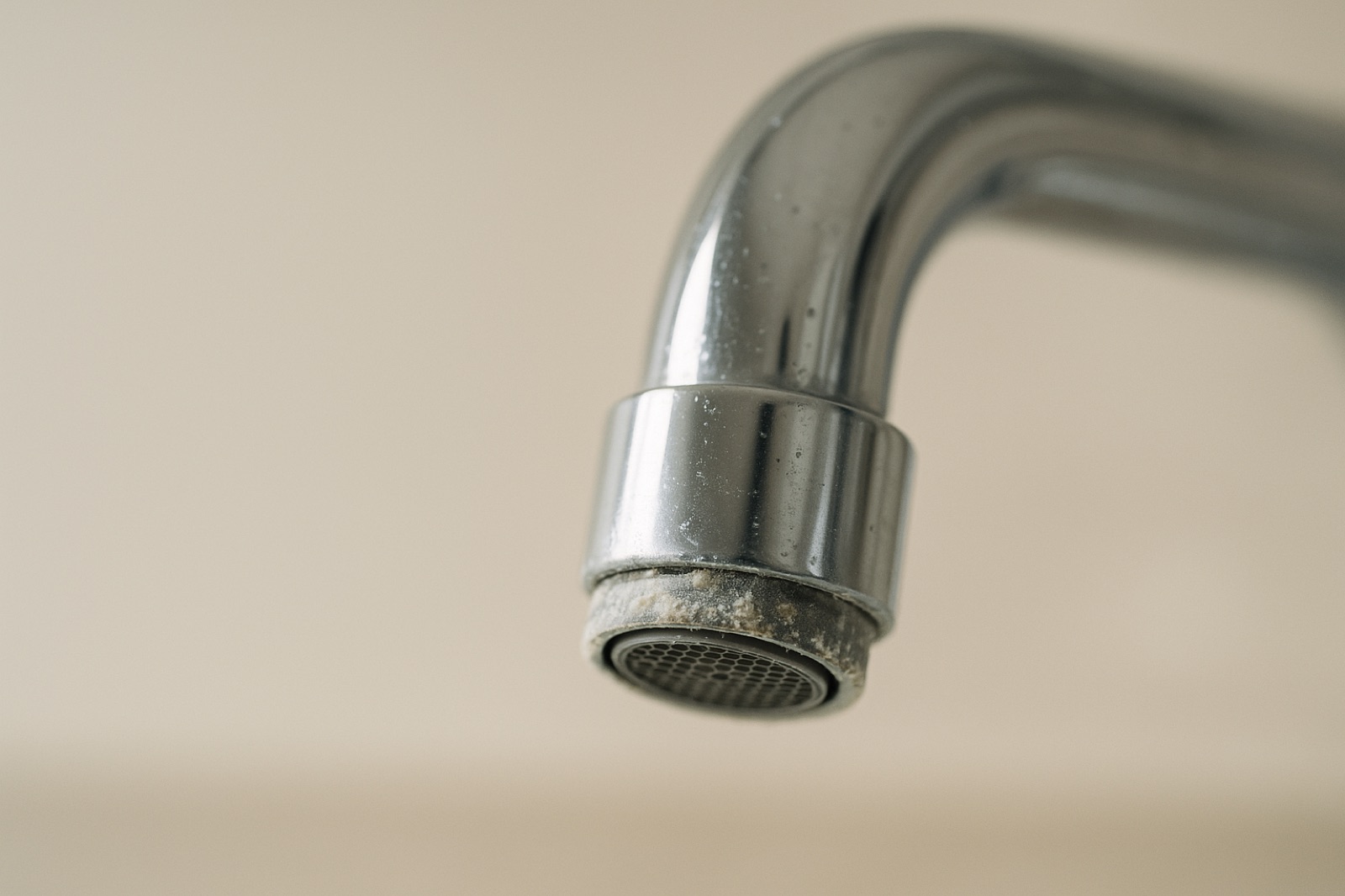
A crusty showerhead and a glass of water that smells unusual are both water problems, but they should not send you shopping for the same equipment. One is often a useful clue about minerals. The other may have several possible causes that look or smell alike.
The practical question is not simply whether you need a softener or a filter. It is whether the symptom gives you enough evidence to choose anything yet.
That distinction matters as activity around agriculture, energy, and waste continues to change. Circle of Blue recently reported that new IRS guidance allows gas extracted from livestock manure to qualify for a federal clean fuel tax credit. The Circle of Blue report on manure-based gas and the tax credit does not establish anything about your household water. It does illustrate why nearby land uses and waste-management practices should be treated as changing context, not as proof of what is in your tap.
Start by sorting the symptom by confidence
Some clues are strongly associated with a particular water condition. White mineral deposits on faucets, recurring scale in a kettle, and soap that performs poorly all support investigating hardness. A hardness test can confirm the level and help size a softener.
Other clues are less specific. A metallic taste could involve plumbing, the water source, or both. Orange staining often suggests iron, but color alone cannot tell you its concentration or form. A rotten-egg odor may appear only in hot water, only at one fixture, or throughout the house. Those patterns lead to different next steps.
Invisible contaminants are a separate category. Water can look, taste, and smell normal while still containing something you would want identified. You cannot select treatment for lead, nitrate, arsenic, PFAS, bacteria, or another contaminant based on appearance alone.
The softener-versus-filter matrix
| What you notice | Likely first step | Possible treatment path |
|---|---|---|
| Scale, spots, stiff laundry, poor soap performance | Test hardness | A properly sized ion-exchange softener if hardness is confirmed |
| Chlorine-like taste or odor throughout the house | Compare hot and cold taps, then review source information | Activated carbon filtration when the target is appropriate for carbon |
| Orange, brown, or black staining | Test for iron, manganese, pH, and related conditions | A contaminant-specific filter, sometimes paired with a softener |
| Odor at one faucet | Inspect and clean that fixture before buying equipment | Local maintenance may solve it |
| Odor only from hot water | Evaluate the water heater and test as needed | Water-heater service or targeted treatment |
| Concern about an invisible contaminant | Use a suitable laboratory test | Treatment chosen for the confirmed contaminant and concentration |
A softener and a filter are not interchangeable. A conventional softener primarily addresses hardness minerals through ion exchange. A filter works according to its media or membrane, and no filter removes everything. Some households need both because they have two verified problems. Others need neither, even when a salesperson can demonstrate that the water contains dissolved material.
Use a testing checklist before requesting bids
Write down where the problem occurs, whether it affects hot water, cold water, or both, and whether it is constant or intermittent. Note changes after plumbing work, a water-heater adjustment, heavy rain, or a period when a well was unused. These observations do not replace testing, but they help you select the right tests and avoid treating the whole house for a single-fixture problem.
If you use municipal water, review the utility's water-quality report and ask whether your concern could originate in household plumbing. If you use a private well, you are responsible for arranging appropriate testing. In either case, match the sampling method and laboratory panel to the suspected problem. A broad store test strip should not be expected to answer every contaminant question.
Before approving equipment, ask for the measured result, the treatment target, the proposed capacity, required maintenance, expected replacement schedule, and a plan for confirming performance afterward. If the recommendation cannot connect each piece of equipment to a measured condition, pause and schedule a professional water assessment.
What the audience numbers do and do not show
The Home Water Report recorded 3,226 page views, 1,068 visitors, 1,265 search crawls, and 2,891 AI crawls for the supplied reporting period. No assist or CRM data was supplied. Those figures show that people and automated systems are reaching the site, but they do not reveal which treatment readers ultimately choose or whether it solves their problem. For Erica and any homeowner comparing options, the useful standard remains simpler: identify the symptom, confirm the cause, and buy only the treatment that matches the evidence.