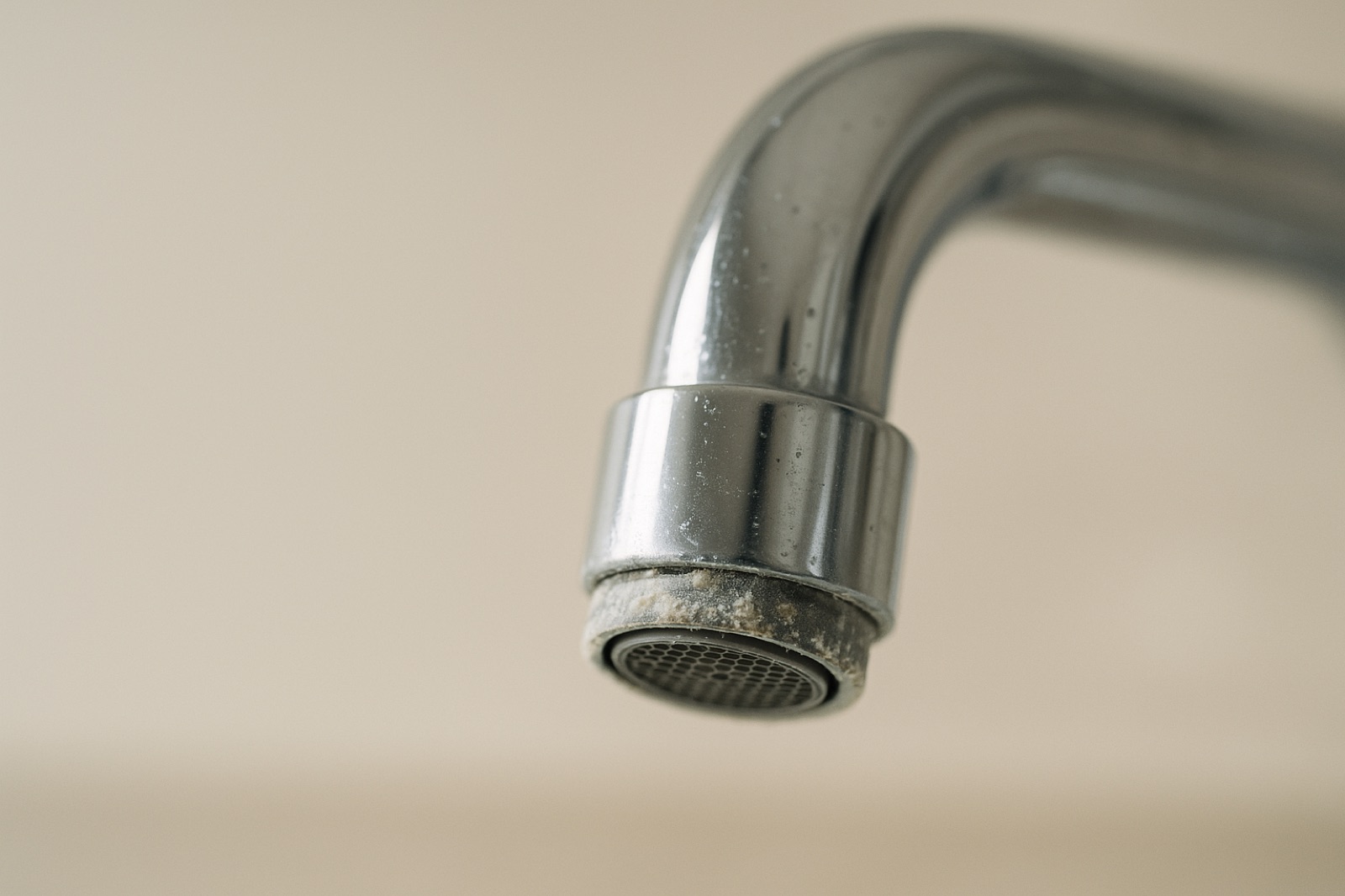
Cloudy glasses, crust around a faucet, and shampoo that seems difficult to rinse can make a water softener feel like the obvious answer. Those clues matter, but none proves on its own that hardness is the problem. Before you buy equipment, separate repeatable hard-water symptoms from lookalikes, then confirm what is actually in your water.
This matters whenever household infrastructure is being upgraded. Water Finance and Management reports that Cadillac, Michigan, selected Schneider Electric and Budderfly for a project intended to modernize municipal infrastructure, lower energy costs, and improve resilience against power disruptions. The municipal infrastructure project in Cadillac is not evidence about any household's water hardness. It is a useful reminder, though, that an upstream system and the equipment inside your home do different jobs. A city improvement does not tell you whether your particular house needs softening, filtration, plumbing repair, or no treatment at all.
Start with scale, not spots alone
Hard water contains dissolved calcium and magnesium. When water evaporates or is heated, those minerals can remain as a pale, chalky deposit. Repeated buildup on a showerhead, kettle, hot-water fixture, or heating element is a stronger hardness clue than a few marks on one drinking glass.
Spots create false positives because several things can leave them behind. Dishwasher detergent, rinse aid, incomplete drying, glass etching, and residue from cleaning products can all affect how glassware looks. Try wiping a fresh spot with diluted white vinegar on a surface that tolerates acid. If the deposit dissolves, minerals are plausible. If the cloudiness remains, the glass may be etched or the residue may have another cause. This check narrows the possibilities, but it does not measure hardness.
Do not let soap make the diagnosis
Hard water can reduce lather and contribute to soap film, so using more soap than expected is relevant. It is still weak evidence by itself. The product formula, dispenser setting, wash temperature, laundry load, and your own preference for suds can change what you observe.
A simple comparison is more useful than a one-time impression. Use the same soap and amount in two equal containers, one filled with your tap water and one with distilled water. Shake them equally and compare the lather and residue. A clear difference supports further hardness testing. It does not identify the hardness level or tell you what size softener to buy.
Read the number in the correct unit
A laboratory report or reliable hardness test may use milligrams per liter, parts per million, or grains per gallon. For hardness in water, milligrams per liter and parts per million are commonly treated as equivalent. One grain per gallon is approximately 17.1 milligrams per liter.
That conversion matters because a reading of 120 parts per million is not 120 grains per gallon. It is about 7 grains per gallon. Mixing up the units can make moderate hardness sound extreme and lead to an oversized purchase.
Test strips can be useful for screening, but color matching, expired supplies, storage conditions, and testing technique can distort a result. If the number will drive a significant equipment decision, confirm it with a more precise test. Private-well households may also need broader testing because hardness does not reveal whether microorganisms, nitrate, metals, or other constituents are present.
Match the fix to the confirmed problem
Choose repair when the issue is isolated or mechanical. A clogged aerator, failing water heater, detergent dispenser problem, or corroding fixture will not be corrected by whole-house treatment.
Choose filtration when testing identifies something a suitable filter is designed to reduce, or when the complaint involves sediment, taste, odor, or a specific constituent. A standard filter generally does not soften water unless it uses a process specifically intended for hardness.
Choose softening when a confirmed hardness result lines up with recurring scale, soap performance problems, or maintenance burdens throughout the home. Sizing should account for measured hardness, household water demand, and any relevant iron or manganese result. For Lakeview-area help, you can confirm hardness and size the right system before committing to equipment.
The Home Water Report is addressing this question because readers are looking for practical diagnostic guidance. Current site totals show 3,210 page views, 1,068 visitors, 1,258 search crawls, and 2,876 AI crawls. Those numbers show activity, but the available feed lacks query-level evidence and conversion data, so they cannot prove exactly which symptom brought each reader here. The homeowner-first answer remains the same: treat patterns as clues, test for a number, check the unit, and buy only the equipment that matches the verified problem.