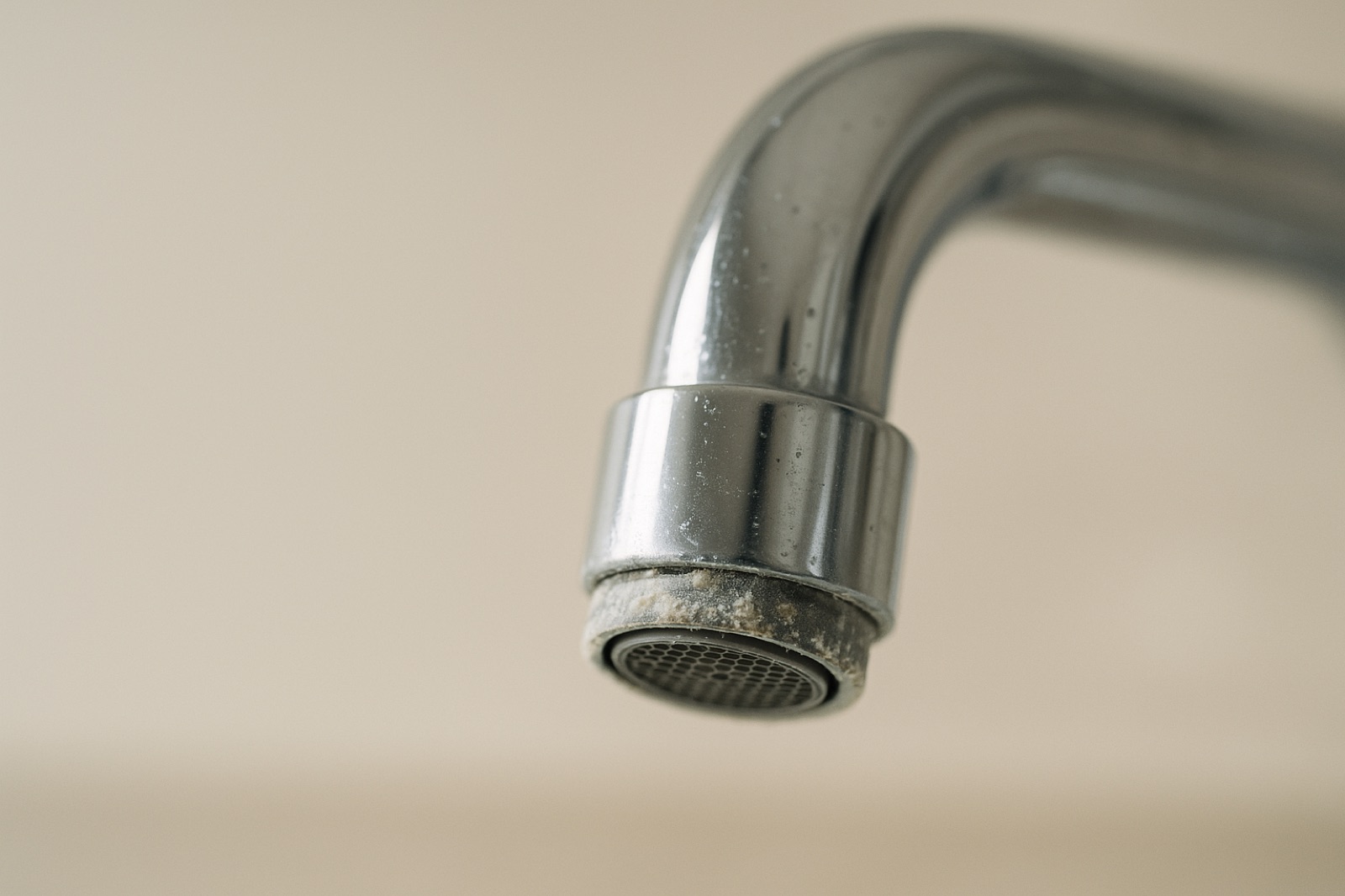
A crusty faucet may suggest hard water. So may cloudy glasses, stiff laundry, or soap that seems reluctant to lather. But any one of these clues can mislead you. The stronger case for a water softener comes from a pattern: mineral deposits in several places, repeatable hardness readings, and symptoms that make sense together.
This matters as water systems consider increasingly varied sources and treatment strategies. Water Finance and Management, in a report by WFM Staff, says the WateReuse Association has released a guidebook for developing state-specific water reuse regulations. That is a utility and regulatory story, not evidence that anything changed at your faucet. It does underline a useful homeowner principle, however: the source and treatment context matter, while the diagnosis inside your house still requires observations and measurements from your own water.
Start by separating scale from removable residue
Hardness comes mainly from dissolved calcium and magnesium. As water evaporates or is heated, those minerals can leave firm deposits. Look at showerheads, faucet aerators, the rim of a kettle, and heating elements you can safely inspect. Chalky material that returns after cleaning is more persuasive than one spotted glass.
Spots alone are a weak signal. Dishwasher detergent, rinse aid, drying method, and leftover food film can all affect glassware. Run a simple comparison: wash two similar glasses, rinse one thoroughly by hand, and dry it immediately with a clean towel. Let the other air-dry. If the towel-dried glass stays clear while the other spots, evaporation is concentrating something in the water, but you still need a hardness test to identify the likely cause.
Also check whether the marks dissolve in ordinary white vinegar. Mineral scale often responds to mild acid. Greasy or slippery film points more toward soap, detergent, or cleaning product residue. Never mix vinegar with bleach or another cleaner.
Treat soap performance as supporting evidence
Hard water can reduce soap lather and encourage soap curd, but product choice matters. A low-lather detergent may be working as intended, and using too much soap can leave its own film. Compare performance with the same soap, the same amount, and similar water temperature. If you change three variables at once, the result tells you very little.
A useful clue should also appear in more than one routine. If you notice recurring scale at hot-water fixtures, extra soap use in the shower, and deposits in a kettle, the clues reinforce one another. If the only complaint is cloudy dishes, troubleshoot the dishwasher before pricing a whole-house system.
Read hardness units without getting tripped up
Hardness commonly appears as milligrams per liter, parts per million, or grains per gallon. For household comparisons, milligrams per liter and parts per million are generally treated as equivalent. One grain per gallon is about 17.1 milligrams per liter.
Write down the number and unit exactly as reported. A reading of 10 grains per gallon is very different from 10 milligrams per liter. If a strip gives only a broad color range, repeat it carefully or use a more precise test before using the result to size equipment.
A total dissolved solids meter is another common false positive. It measures the water's overall ability to conduct electricity, not hardness specifically. A high reading does not prove that calcium and magnesium are the problem, and a softener may not reduce that reading much because ion exchange swaps charged minerals rather than simply removing everything dissolved in the water.
Test on both sides of the plumbing
If you already own a softener, collect one sample before the unit and another from a softened cold-water tap. Confirm that the bypass valve is in its normal service position. Hard water on both sides can point to an exhausted salt supply, salt bridging, incorrect settings, a valve problem, or depleted resin. That calls for inspection or repair before replacement.
If only hot water shows heavy scale or debris, investigate the water heater and its maintenance history. If both hot and cold water test hard throughout the house, softening becomes a more logical option. When that evidence lines up, Lakeview can help you confirm hardness and size the right system.
Choose the fix that matches the finding
Repair is appropriate when an existing softener is bypassed, misconfigured, out of salt, or failing to regenerate. Filtration is the better category when the complaint involves sediment, taste, odor, or a specifically identified contaminant. A conventional filter is not a substitute for a softener simply because the water leaves spots.
Softening makes the strongest practical case when a repeatable hardness result agrees with recurring scale and poor soap performance across the home. Testing for iron, manganese, and pH can also matter before equipment is selected, especially on a private well, because those conditions may change the treatment plan.
The Home Water Report recorded 3,210 page views, 1,068 visitors, 1,258 search crawls, and 2,876 AI crawls in the available reporting period. Those totals show attention, not homeowner outcomes. Without query-level evidence or conversion data, they cannot tell us which symptom brought a reader here or whether anyone needed a softener. Your decision deserves better evidence: a repeatable number, the correct unit, and several clues that point to the same job.