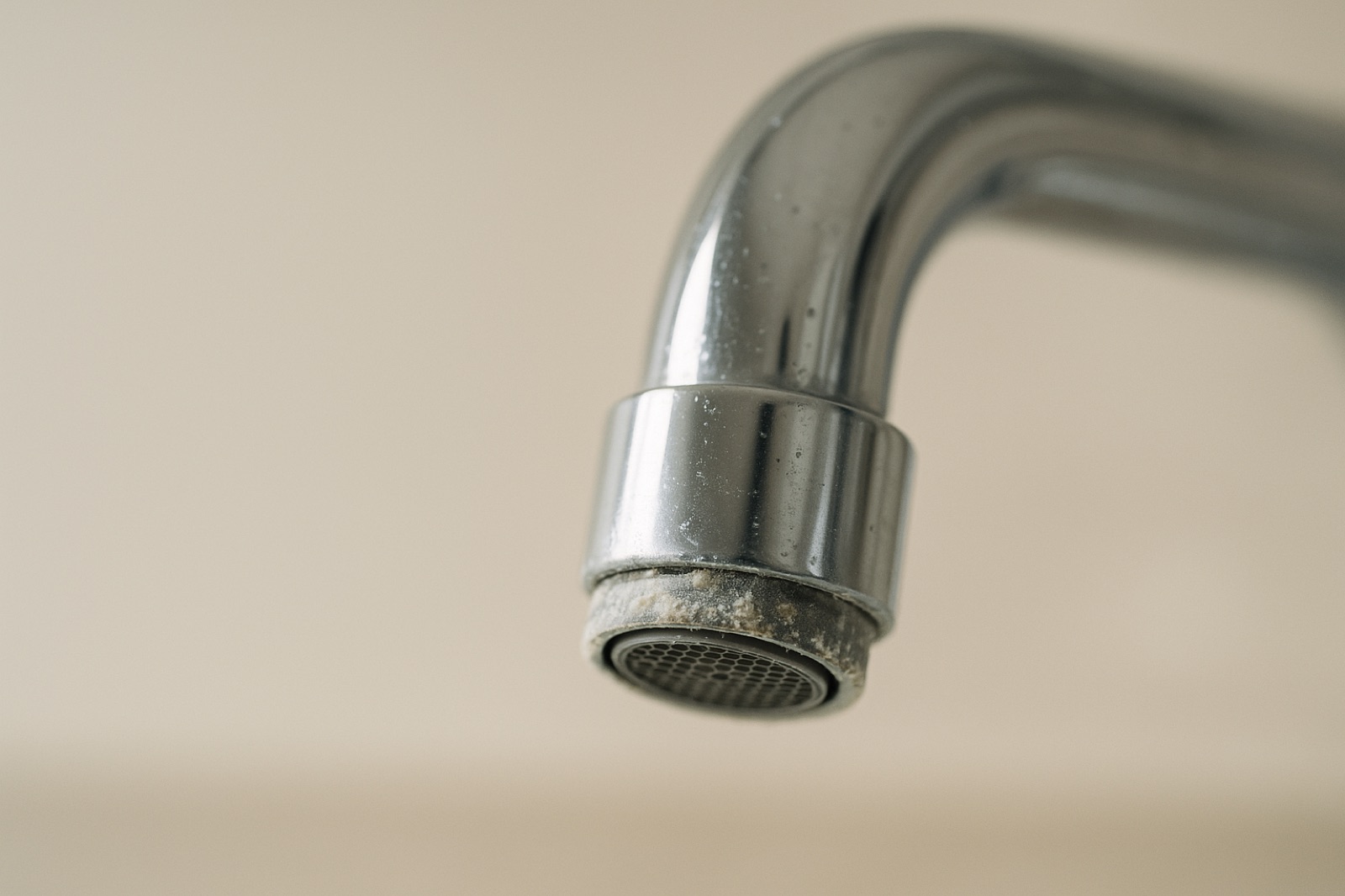
Your water leaves clues, but those clues do not all point to the same equipment. White crust around a faucet suggests a different job from a musty taste, orange sink stains, or concern about a chemical you saw in the news. Before you price a softener or filter, sort the problem into two buckets: conditions you can observe and substances you can confirm only through testing.
That distinction is especially useful when a contaminant enters the headlines. Circle of Blue, in a story by Carey Gillam, reports that federal officials are expanding a scientific review of the widely used weedkiller glyphosate. The report on the expanded glyphosate review is a reason to ask better questions about your water source. It is not evidence that glyphosate is present at your tap, and it does not tell you which device to buy.
Start with the symptom, then identify the treatment job
Scale usually points you toward hardness testing. Look for chalky deposits on shower doors, faucet aerators, kettles, and heating elements. A conventional ion exchange softener is designed to reduce hardness minerals throughout the home. That can make cleaning easier and protect water using equipment, but it is not a general contaminant filter.
Taste and odor are more complicated. If the issue appears at every cold water tap, a whole house condition or the incoming supply deserves attention. If it occurs at one faucet, inspect that fixture and its local plumbing first. If it appears only in hot water, include the water heater in your investigation. Activated carbon filtration can improve certain tastes and odors, but the correct filter depends on what is causing them.
Staining also needs its own lane. Orange or reddish stains may prompt testing for iron. Dark staining can justify checking for manganese. Blue-green marks can be associated with plumbing corrosion. A softener may help with limited amounts of some dissolved minerals, but significant staining can require dedicated treatment. Do not make the equipment salesperson guess from a photograph alone.
Contaminant concerns begin with source-specific testing, not with a shopping cart. Your useful test list depends on whether you receive municipal water or use a private well, where you live, nearby land uses, plumbing materials, and any known local problems. A broad filter label such as “removes chemicals” is not enough. You need to compare the identified substance, its measured level, the device certification, the rated capacity, and the replacement schedule.
Use this softener versus filter matrix
White scale and poor soap performance: Test hardness. A softener is the leading candidate if hardness is confirmed.
Chlorine-like taste or odor across cold taps: Review your utility information and consider targeted testing. Carbon filtration may fit, depending on the cause and your desired flow rate.
Orange, black, or blue-green stains: Test for the minerals or corrosion conditions suggested by the stain. Treatment might involve a specialty filter, corrosion control, plumbing work, or a combination.
A named contaminant: Test through an appropriate laboratory before choosing equipment. Select a filter certified for that specific reduction at the conditions found in your home.
More than one confirmed problem: You may need both softening and filtration, installed in an order that protects performance. Ask the provider to explain what each stage does and what it does not do.
Take this checklist into the buying conversation
Record which taps show the symptom, whether it affects hot water, cold water, or both, and whether it is constant or intermittent. Photograph deposits and stains before cleaning them. Obtain your water utility report if you are on a public system. For a private well, gather previous laboratory results and service records. Then list every proposed device beside the exact problem it is supposed to solve.
Ask for the test result supporting each recommendation, the applicable certification or performance documentation, expected water use during regeneration or maintenance, replacement costs, warranty terms, and a plan for verifying performance after installation. If you do not yet have reliable results, schedule a professional water assessment before committing to equipment.
This decision guide answers a clear reader need. The Home Water Report recorded 3,226 page views and 1,068 visitors, alongside 1,265 search crawls and 2,891 AI crawls. No assist or customer relationship management data was supplied, so those figures show attention, not purchases or treatment outcomes. For you as a homeowner, the practical takeaway is simpler: match each device to a measured job, and do not pay one machine to solve a problem it was never designed to handle.