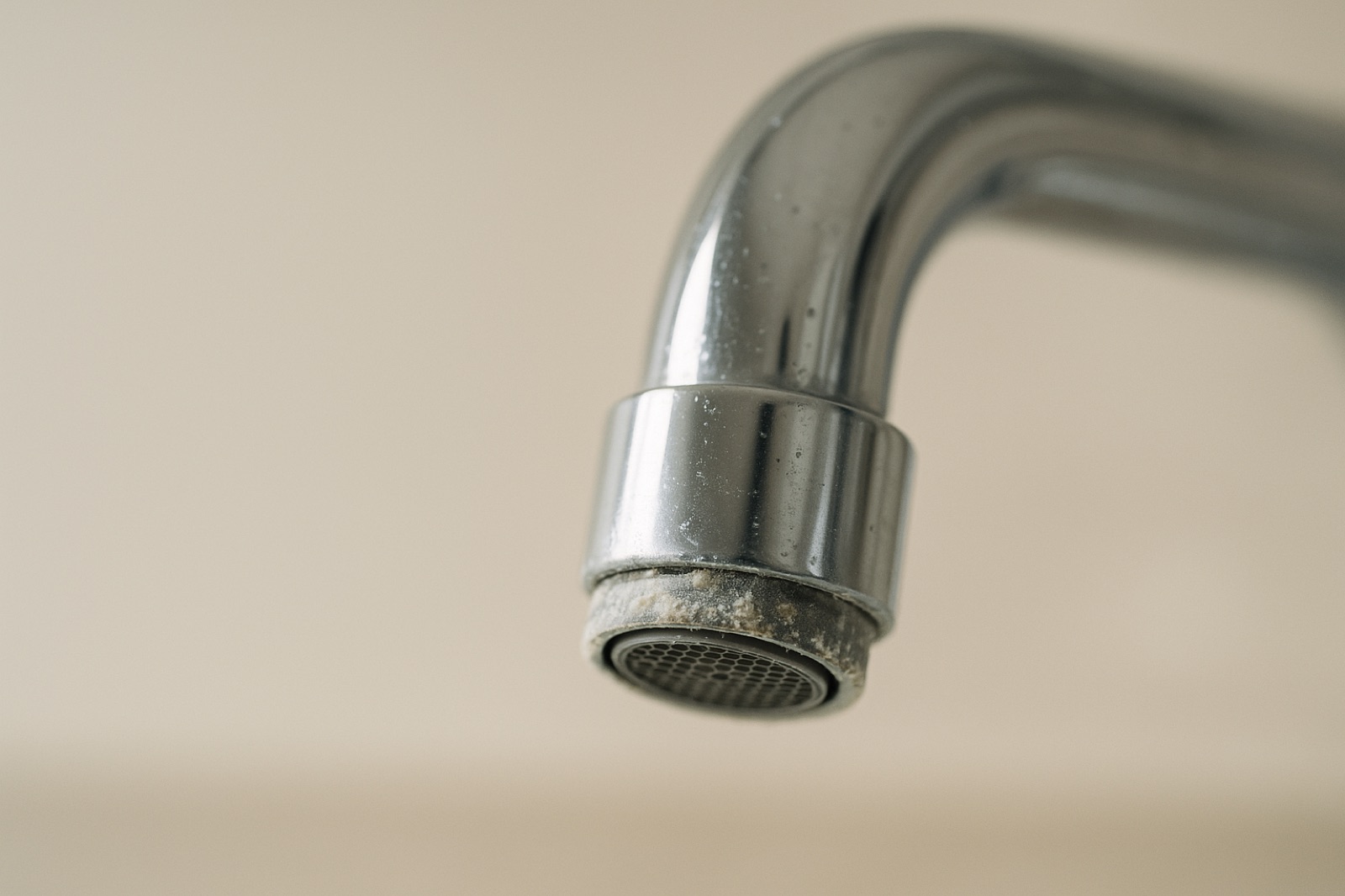
Your water leaves crust on the faucet, tastes strange, smells unpleasant, or stains the sink. Which problem should guide your purchase?
Start with the symptom that affects your household most, but do not let that symptom make the final decision. Scale can point toward a softener. Taste and odor may call for filtration. Staining can have several causes. A contaminant concern requires testing and a treatment certified for the specific substance.
That distinction matters when water news raises an urgent concern. Circle of Blue, in reporting by Brett Walton, says provisional CDC data show Legionnaires' disease rising again, with the 2025 case rate reaching its second-highest level on record. The illness spreads through inhaled contaminated water droplets. That does not mean your home has the bacteria, and it does not make an ordinary softener or general-purpose filter a solution. It means a suspected microbial hazard belongs in a different decision category from hard-water scale.
Use the symptom to choose your next step
| What you notice | Likely first step | Possible treatment | What not to assume |
|---|---|---|---|
| White scale on fixtures or heating elements | Test hardness | Water softener | White residue alone does not identify every dissolved mineral |
| Unpleasant taste or chlorine-like odor | Compare hot and cold water, then review your utility report or test | Contaminant-specific filter | A softener is not a general taste or odor treatment |
| Rotten-egg odor | Check whether it appears in hot water, cold water, or both | Treatment depends on the source | Buying carbon media before identifying the cause may miss the problem |
| Orange, brown, blue, or green stains | Test for relevant metals and check plumbing conditions | Filter, oxidation treatment, corrosion correction, or another targeted fix | Color does not prove which substance is present |
| Concern about bacteria or another contaminant | Use an appropriate laboratory test and follow local guidance | A system certified for the identified hazard | Clear, good-tasting water is not proof that it is free of contaminants |
When a softener fits
A softener is designed primarily to reduce hardness minerals through ion exchange. It can make sense when a hardness result agrees with a household pattern such as recurring scale, poor soap performance, and mineral buildup in water-using appliances.
It is not the default answer for every stain, smell, or safety concern. Before buying, ask for the tested hardness level, the proposed capacity, expected salt and water use, and an explanation of how the unit addresses your documented problem.
When a filter fits
Filtration is a broad category, not a single treatment. Carbon, sediment filters, reverse osmosis systems, and specialty media do different jobs. Your test result or utility report should name the target before a salesperson names the equipment.
Also decide where treatment is needed. A drinking-water issue may be handled at one kitchen tap. Sediment or odor throughout the house may justify treatment where water enters the home. Some households need both a softener and a filter, but each device should have a separate, clearly stated assignment.
Your pre-purchase testing checklist
- Write down the symptom, its color or odor, and when it appears.
- Compare hot and cold water.
- Check more than one faucet to see whether the issue is local or house-wide.
- Note whether you use municipal water or a private well.
- Read your current utility water-quality report if one is available.
- Choose tests that match the symptom and water source.
- Use a qualified laboratory when the result will drive a health-related or expensive treatment decision.
- Ask for performance certification covering the exact contaminant or reduction claim.
- Include replacement filters, salt, maintenance, and wastewater in the ownership cost.
If the symptoms overlap or the proposed system has several jobs, schedule a professional water assessment before committing to equipment.
What the audience numbers do and do not tell us
The Home Water Report recorded 3,226 page views, 1,068 visitors, 1,265 search crawls, and 2,891 AI crawls in the supplied snapshot. Those figures show that water information is being discovered, but no assist or CRM data was supplied. They cannot tell us which treatment a homeowner ultimately needed or purchased. For Erica and any homeowner facing the same choice, the useful evidence remains local: the symptom pattern, a suitable water test, and a treatment claim that matches the result.
The simplest buying rule is this: soften confirmed hardness, filter a clearly identified target, and test before treating a possible contaminant. If one device cannot explain exactly what it will remove or reduce, it has not yet earned a place in your home.