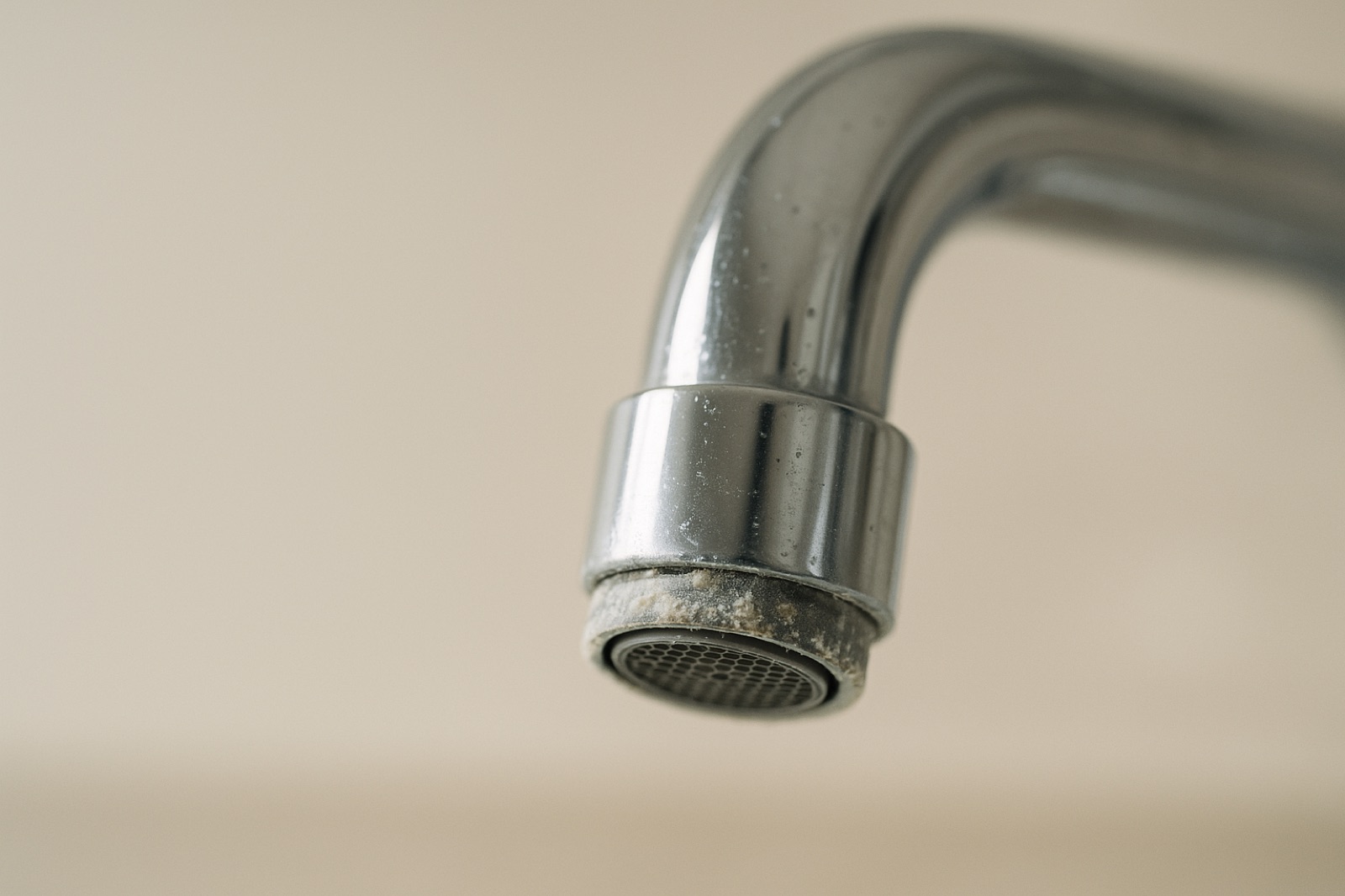
A chalky faucet, metallic stain, or strange taste can point you toward a water problem, but it cannot identify the cause with certainty. That distinction matters when you are deciding between a water softener and a filter. Each type of equipment handles different problems, and some concerns should send you to testing before you shop.
The need for that measured approach is especially clear after a September 8, 2026 report from The Guardian. Oliver Milman described violations or alleged pollution involving wastewater from US data centers, including cases associated with rare bacteria and chemicals commonly called PFAS. The report on data center wastewater concerns does not establish a problem in your household water. It does show why contaminant questions deserve evidence instead of assumptions based on appearance, taste, or headlines.
Start with the symptom, but do not stop there
Scale is the strongest everyday clue that hardness may be involved. Look for a crusty white deposit on faucets, shower doors, kettles, and heating elements. Soap that seems difficult to rinse and laundry that feels stiff can support that suspicion. A softener is designed to address hardness minerals. A typical household filter is not a substitute for that job.
Taste and odor lead to a different branch. A carbon filter may improve certain objectionable tastes and odors, but the right response depends on the source. First check whether the issue affects every cold-water tap, only one fixture, or only hot water. A problem isolated to one faucet may be local to that fixture. A hot-water-only odor may call for inspection of the water heater rather than immediate purchase of a whole-house system.
Staining also needs interpretation. Orange or reddish marks may suggest iron or corrosion. Dark staining can point toward other water chemistry issues. Blue-green marks can be associated with copper plumbing corrosion. These clues can help you select test parameters, but color alone cannot tell you the concentration, source, or appropriate treatment.
Suspected contaminants are the clearest reason to test first. Many contaminants have no dependable taste, smell, or visible signature. A glass that looks clear is not proof that the water is free of a particular substance, and an unpleasant flavor does not establish that the water is unsafe.
The softener versus filter matrix
Visible scale across the house: Test for hardness. If the result confirms a meaningful hardness problem, compare softeners.
Dry mineral residue but no unusual taste: A softener is the more relevant category. Confirm that the residue is mineral scale before choosing equipment.
Chlorine-like taste or odor at multiple cold taps: Investigate filtration, often beginning with carbon-based options. Verify what your water supplier uses and make sure the proposed filter is rated for the target.
Sediment or particles: Identify whether the material comes from the water supply, water heater, aging plumbing, or a single fixture. A sediment filter may help, but it will not correct the source of pipe deterioration.
Orange, black, or blue-green stains: Test before selecting treatment. A softener might help with limited iron under some conditions, but staining can require different equipment or plumbing work.
A named contaminant concern: Obtain a test suited to that contaminant, then choose a filter with documented reduction certification for it. Do not treat a broad label such as whole-house filter as proof of performance.
More than one symptom: You may need both softening and filtration, installed in an order that fits the water chemistry and equipment. One appliance should not be expected to solve unrelated problems.
A testing checklist before you request quotes
Write down where each symptom appears, when it began, whether it affects hot water, cold water, or both, and whether neighbors notice the same issue. Record whether your home uses a private well or a public supply. If you receive a utility water-quality report, keep it with your notes, while remembering that conditions inside your plumbing can still affect water at the tap.
Next, match the test to the decision. Hardness results help size and configure a softener. Iron, manganese, pH, and related measurements can clarify staining or treatment compatibility. A specific contaminant concern requires an appropriate laboratory method, not a generic strip that happens to test something else. Preserve the report so competing vendors work from the same facts.
If the symptoms are persistent, widespread, or difficult to interpret, you can schedule a professional water assessment before committing to equipment.
Why this decision guide matters
The Home Water Report recorded 3,226 page views and 1,068 visitors, alongside 1,265 search crawls and 2,891 AI crawls. No assist or customer relationship management data was supplied, so those numbers cannot show how many readers bought equipment or solved a water problem. They do show substantial interest in accessible water guidance. For Erica and every homeowner facing the same choice, the useful conclusion is simple: treat scale with softening, treat a verified filtration target with the right filter, and test whenever the symptom leaves room for doubt.