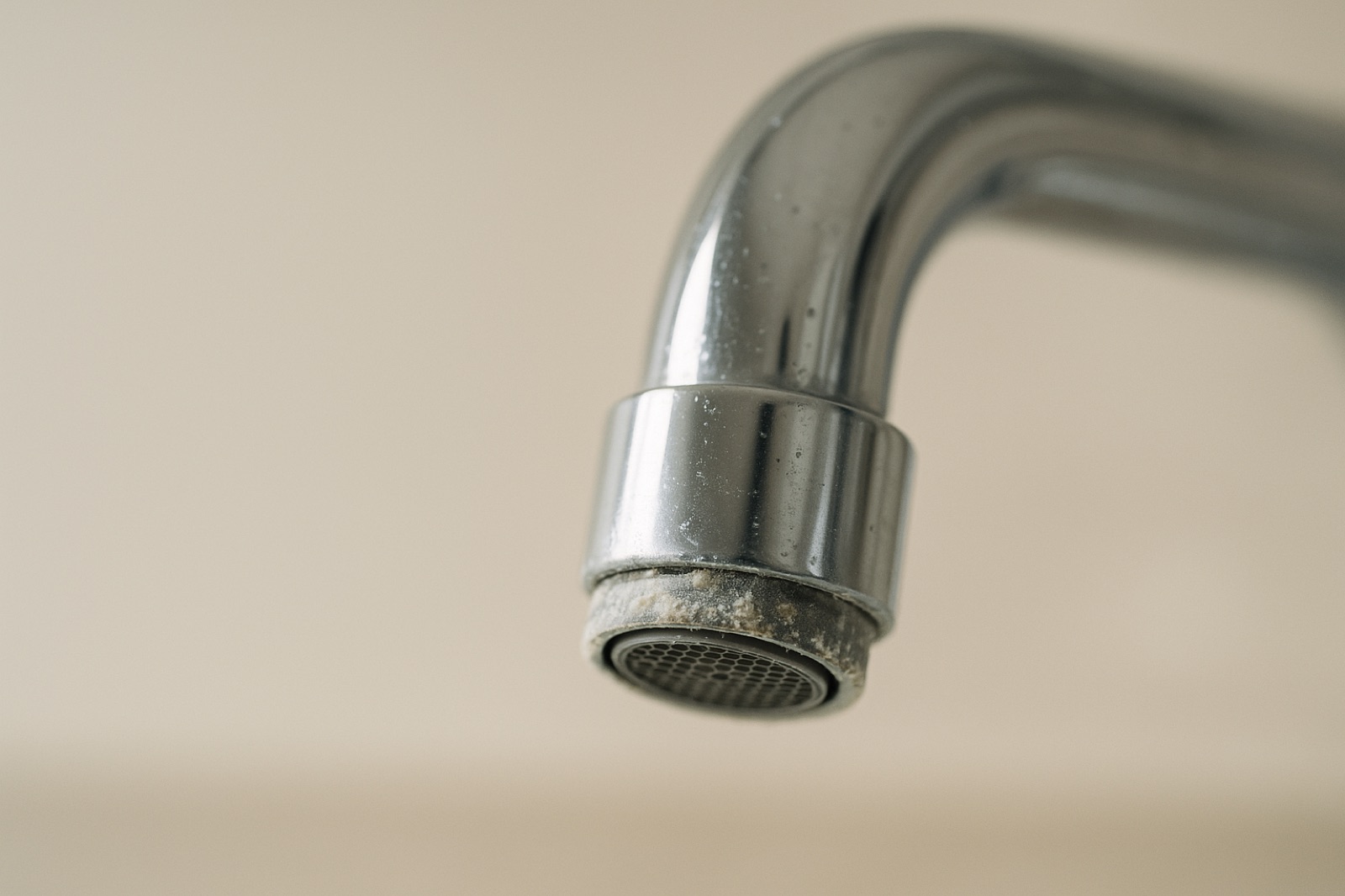
Your water leaves white crust on the showerhead, tastes unpleasant at the kitchen sink, or stains the toilet bowl. Which problem deserves a softener, and which calls for a filter?
That distinction matters because water treatment equipment is not interchangeable. A softener primarily addresses hardness minerals. A filter is selected for particular substances, tastes, odors, or particles. Some households need both, while others need neither until testing identifies the cause.
This homeowner-level decision has a wider context. In Circle of Blue, Keith Schneider's September 2026 story about Wendell Berry's water intelligence connects water with the way land is managed. For your household, the practical lesson is smaller but related: water carries evidence of the conditions it has encountered. Your job is to read that evidence without treating a symptom as a diagnosis.
White scale on fixtures and appliances
Chalky buildup around faucets, showerheads, kettles, and humidifiers strongly suggests hard water. You may also notice soap that lathers poorly or glassware that emerges from the dishwasher with mineral residue.
A conventional ion-exchange softener is the usual equipment category to investigate. It reduces calcium and magnesium, the minerals chiefly responsible for hardness scale. A sediment or carbon filter generally will not soften water, even if a salesperson describes it as improving overall water quality.
Before shopping, measure hardness through a laboratory, water professional, or reliable test designed for that purpose. Ask for the result in grains per gallon or milligrams per liter, and use that number when sizing equipment.
Unpleasant taste or chlorine-like odor
If the concern appears mainly in drinking water, begin at the kitchen tap. An activated carbon filter may improve certain tastes and odors, including those associated with disinfectants used in public water systems. A point-of-use filter can be more economical than treating every gallon entering the house.
Do not assume every odor has the same source. Compare hot and cold water. An odor limited to hot water can point toward the water heater or plumbing rather than the incoming supply. An odor at every fixture deserves broader investigation. A softener is not a general taste-and-odor device.
Orange, brown, blue-green, or black stains
Color provides a clue, not a final answer. Orange or brown staining can be associated with iron or sediment. Blue-green marks can relate to copper corrosion. Black staining can have several possible causes, including manganese.
These problems require testing because treatment depends on the substance, its concentration, water chemistry, and whether particles are dissolved or suspended. Options might include sediment filtration, an iron-specific treatment system, corrosion correction, or plumbing work. Buying a softener solely because a stain looks mineral-related can leave the underlying problem untouched.
A contaminant named in a report or test
If a utility notice, local advisory, or laboratory result identifies a contaminant, shop by the contaminant and the verified performance of the treatment device. Look for certification to a standard that covers the specific reduction claim. The word filter on a package is not enough.
Reverse osmosis, activated carbon, ion exchange, ultraviolet treatment, and specialty media solve different problems. The right choice also depends on whether exposure occurs mainly through drinking and cooking or whether whole-house treatment is justified.
Softener versus filter matrix
| Symptom or evidence | First category to investigate | What to confirm |
|---|---|---|
| White scale and poor soap performance | Water softener | Hardness level |
| Unwanted taste or disinfectant odor | Activated carbon filter | Whether the issue affects one tap or the whole house |
| Visible grit or cloudy particles | Sediment filter | Particle size and source |
| Colored staining | Cause-specific treatment | Iron, manganese, copper, pH, and related chemistry |
| Named contaminant | Certified contaminant-reduction system | Lab result and certification claim |
| Scale plus a separate taste or contaminant issue | Softener and filter, each with a defined job | Correct order, sizing, and maintenance |
Your testing checklist
Write down the symptom, its color or odor, where it occurs, whether it affects hot water, cold water, or both, and when it began. Photograph stains before cleaning them. Note whether neighbors report the same issue, but do not use their experience as a substitute for your own results.
For a private well, choose tests based on local conditions and the well's history. For public water, review the supplier's water quality report, then test at the tap when the question could involve your home's plumbing. If the symptoms overlap or the equipment decision remains unclear, schedule a professional water assessment.
The interest in this decision is measurable at The Home Water Report: 3,226 page views came from 1,068 visitors, alongside 1,265 search crawls and 2,891 AI crawls. No assist or CRM data was supplied, so those figures show content activity, not equipment purchases or household outcomes.
Your best buying question is not, Which machine does the most? It is, What evidence shows that this machine addresses my specific water problem? Start with the symptom, confirm the cause, and give every proposed piece of equipment one clearly defined job.