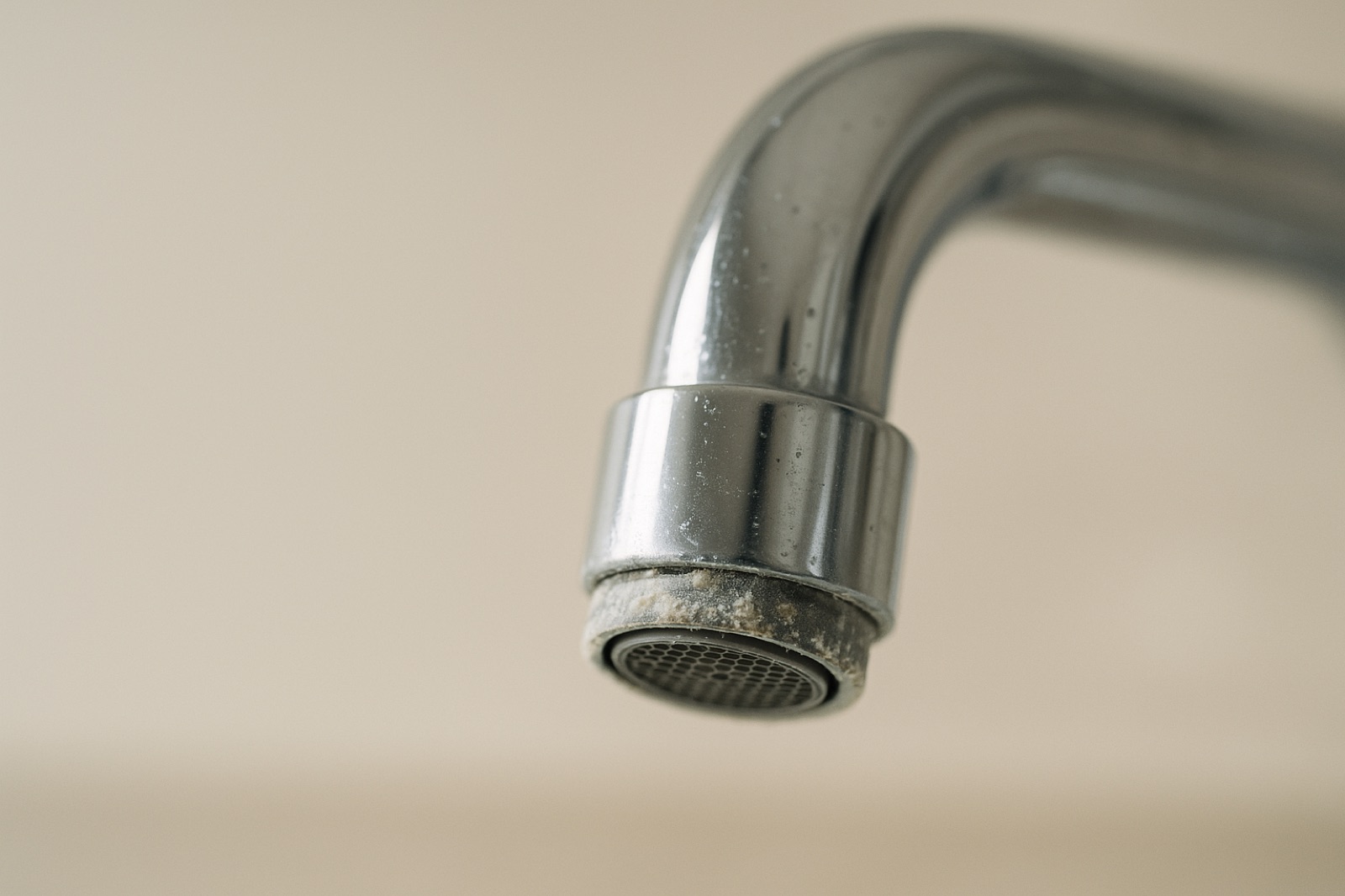
A chalky faucet, metallic-tasting water, and an orange toilet stain can appear in the same house. That does not mean one machine will solve all three problems. Your better starting point is the combination of symptoms, where they occur, and whether testing confirms a cause.
This distinction becomes especially important after disruptive weather. On September 27, 2026, The Guardian reported that a nor’easter brought flooding, damaging winds, hazardous ocean conditions, and power outages along the East Coast. Its report on the East Coast storm said about 110,500 households from North Carolina to New England remained without power. The story does not establish that any particular household's water became unsafe. It does offer a timely reason to distinguish an equipment question from a possible water safety question.
Start with the symptom combination
A softener primarily addresses hardness minerals. Filtration is a broad category covering different media and technologies for different targets. Neither label tells you whether a product is appropriate until you know what you want it to remove or change.
| What you notice | Likely next step | What treatment may fit |
|---|---|---|
| White crust, spotted glassware, and soap that performs poorly | Test hardness | A softener if hardness is confirmed and the symptoms justify whole-home treatment |
| Unpleasant taste or odor at one drinking tap | Compare cold water from several taps, then test for the suspected cause | A targeted drinking-water filter may be enough |
| Orange, brown, blue-green, or black staining | Document the color and location, then test before selecting equipment | A contaminant-specific filter, corrosion correction, or another targeted response |
| A confirmed contaminant above the level you are prepared to accept | Match the result to a certified treatment method | Point-of-use or whole-home filtration, depending on exposure and water use |
| Scale plus a separate taste, odor, or contaminant problem | Test each issue independently | A softener and a filter may both be appropriate |
The important word is “may.” White deposits can support a hardness investigation, but they do not identify every dissolved substance in your water. An odor can help you describe a problem, but it cannot tell you whether the water is safe. Stain color is useful evidence, not a laboratory result.
Decide whether the problem is local or house-wide
Check the same symptom at the kitchen cold tap, a bathroom cold tap, and an outdoor faucet that bypasses treatment, if your plumbing has one. A taste found at only one faucet may point toward that fixture, its aerator, or nearby plumbing. Scale across showers, faucets, and water-using appliances is more consistent with a whole-home hardness issue.
Also compare hot and cold water. If an odor appears only in hot water, the water heater belongs in the investigation. Buying a whole-home filter before making that comparison could leave the actual source untouched.
Use a short testing checklist
- Write down each symptom separately. Record color, taste, odor, residue, location, and whether it affects hot water, cold water, or both.
- Note when it started. Include plumbing work, a treatment service, a power outage, flooding near a private well, or another specific change. Timing does not prove the cause, but it helps define the testing question.
- Identify your water source. Municipal water customers can review their utility's water-quality information. Private-well owners are responsible for arranging appropriate testing.
- Choose tests from the clues and source risks. Hardness testing supports a softener decision. Taste, odor, staining, or safety concerns require tests aimed at plausible causes rather than an all-purpose strip alone.
- Match equipment to the result. Ask what the proposed unit treats, at what capacity, under what water conditions, and what maintenance it requires.
If the symptoms are mixed or the testing menu is unclear, you can schedule a professional water assessment before requesting equipment quotes.
Let evidence set the shopping order
The Home Water Report recorded 3,226 page views, 1,068 visitors, 1,265 search crawls, and 2,891 AI crawls for the supplied reporting period. No assist or CRM data was supplied, so those figures cannot show how many readers bought treatment or solved a water problem. They do show that water guidance is being discovered through several channels, which makes a clear decision method more useful than a blanket product recommendation.
For Erica, the practical rule is simple: treat confirmed hardness with softening, treat a defined taste, odor, stain, or contaminant target with the appropriate filter, and consider both only when the evidence supports two separate jobs. When safety may be in question, testing comes before shopping.