Public water improvements matter, but they do not tell you whether the chalky ring around your faucet justifies buying a water softener. On September 18, 2026, the EPA announced a $251 million loan for improvements to several drinking water treatment plants in Los Angeles and Ventura Counties, according to Water Finance and Management's report on the WIFIA loan by WFM Staff.
That investment concerns public treatment infrastructure. Your question is narrower and more personal: What is happening after water reaches your house, and which equipment, if any, matches the problem?
You can get surprisingly close to an answer by separating strong hard-water evidence from symptoms that merely look similar.
Start with the symptoms that travel through the house
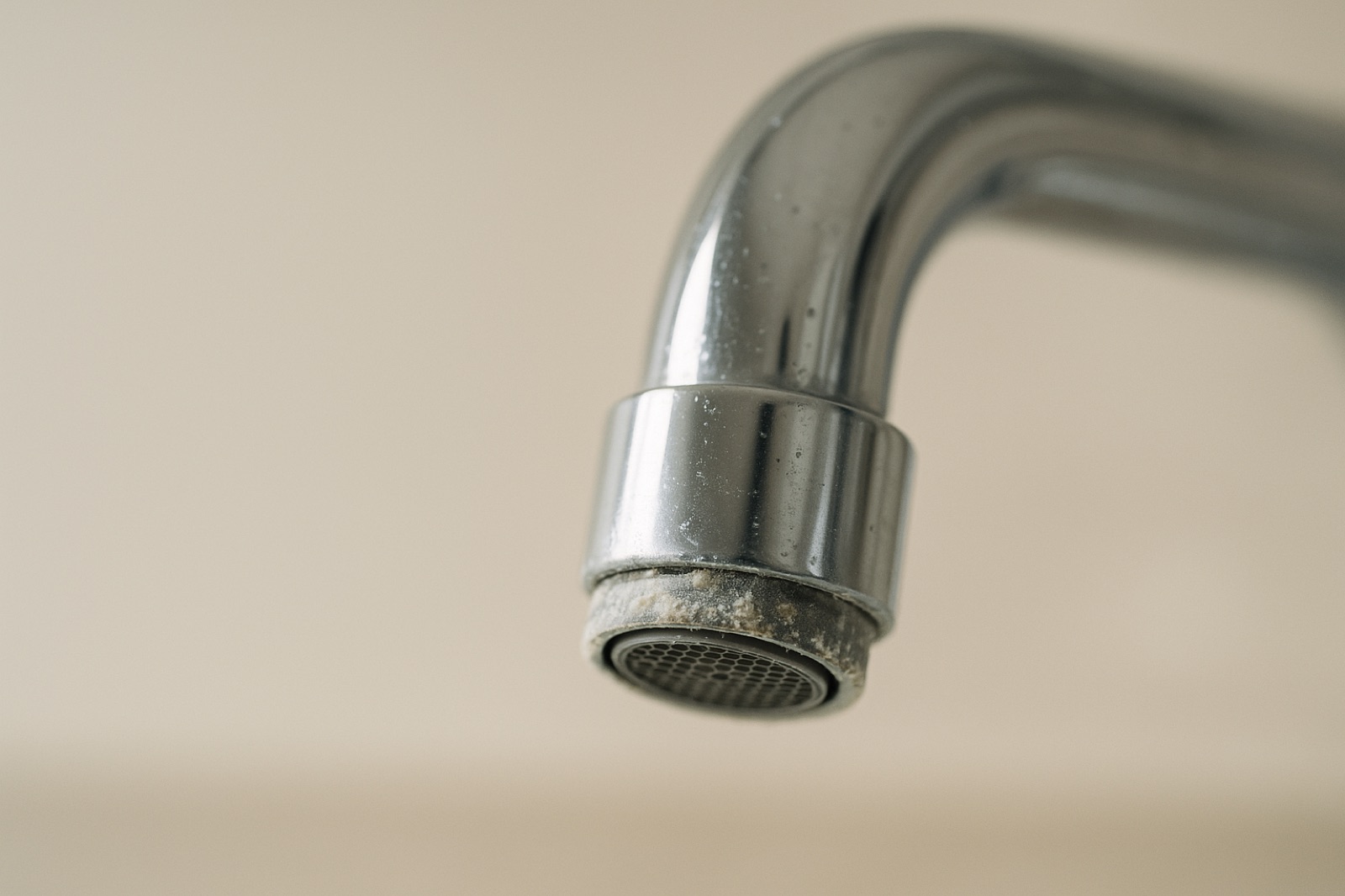
Hard water contains dissolved calcium and magnesium. As water evaporates or is heated, those minerals can leave deposits behind. The most persuasive household pattern is repeated scale in several places: crust on faucet aerators, buildup on showerheads, a ring in the kettle, and deposits around fixtures supplied by both hot and cold water.
A single spotted glass is weaker evidence. Dishwasher detergent, rinse settings, drying conditions, excess detergent, and residue already inside the appliance can all affect glassware. Likewise, one slow faucet may have a clogged aerator rather than a whole-house hardness problem.
Map the symptoms before shopping. Check two bathrooms, the kitchen, the water heater area, and any appliance that heats water. A widespread, recurring pattern supports whole-house investigation. A problem confined to one fixture usually supports cleaning or repair first.
Treat the soap test as a clue, not a verdict
Hard water can make soap feel less effective and can contribute to film. Yet weak suds alone do not prove hardness. The soap formula, the amount used, water temperature, and even your expectations can change what you notice.
There is another potential false positive after a softener is installed. Softened water can feel unusually slippery because soap rinses differently when hardness minerals are removed. That sensation does not necessarily mean soap remains on your skin or that the softener is malfunctioning.
Use soap performance to support a larger pattern. If weak lather appears alongside measurable hardness and scale throughout the house, the case for softening becomes stronger. If soap is the only complaint, test before buying equipment.
Put the hardness number into usable units
A basic hardness test commonly reports results in milligrams per liter, parts per million, or grains per gallon. For hardness in water, milligrams per liter and parts per million are generally used as equivalent expressions. One grain per gallon is about 17.1 milligrams per liter.
Do not rely on a vague label such as moderately hard when comparing systems. Record the number, unit, sample location, and date. If you use a test strip, follow its timing and color-reading instructions closely. A laboratory or properly performed in-home test can provide a more useful baseline when the strip result is unclear or the purchase would be substantial.
Test untreated water if possible. Sampling only from a softened faucet tells you how the equipment is performing, not the hardness entering the house. If you already own a softener, comparing water before and after it can separate a source-water issue from a maintenance or equipment problem.
Choose repair, filtration, or softening by job
Choose repair when the evidence stays local. A blocked aerator, leaking valve, poorly heating dishwasher, or heavily scaled showerhead may need cleaning or replacement without adding a treatment system.
Choose filtration when the confirmed target is sediment, an unwanted taste or odor, or a specific substance addressed by a suitable filter. A conventional filter is not automatically a hardness treatment, and clearer-looking water is not proof that calcium and magnesium have been removed.
Consider softening when testing confirms meaningful hardness and the effects are widespread enough to bother you, damage fixtures, or create repeated cleaning and appliance problems. System sizing should reflect measured hardness and household water demand, not simply the number of visible spots. Homeowners who want help interpreting the result can confirm hardness and size the right system through an in-home assessment.
Let the diagnosis earn the purchase
The demand for a clear answer is visible in The Home Water Report's own audience data: 3,210 page views, 1,068 visitors, 1,258 search crawls, and 2,876 AI crawls. Those totals show activity, but the feed lacks query-level evidence and conversions, so they cannot reveal which exact symptom brought each homeowner to the site or whether anyone ultimately needed a softener.
Your household decision deserves better evidence than traffic totals or a frustrating afternoon of scrubbing. Confirm the hardness number, look for a whole-house pattern, and rule out isolated repair issues. Then you can buy the treatment that performs a defined job, or confidently decide that cleaning and maintenance are enough.