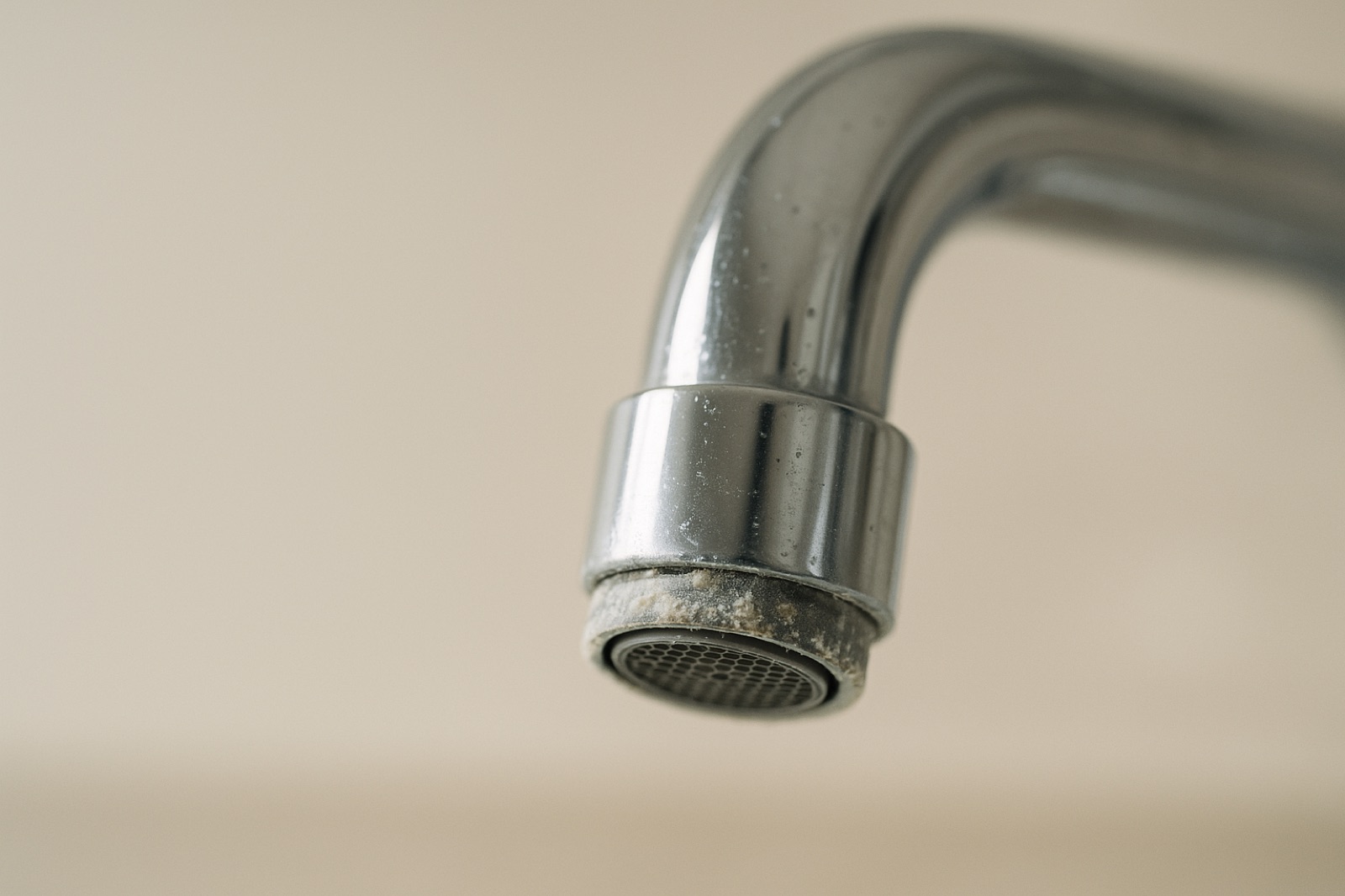
A water problem can arrive as a white crust on the faucet, a metallic taste in a drinking glass, an unpleasant smell, or a stain in the sink. Those clues may appear together, but they do not necessarily share one cause. That is why choosing between a softener and a filter is easier when you divide the decision into two lanes: household performance and possible exposure.
The distinction matters beyond your kitchen. On October 1, 2026, Circle of Blue reported that a proposed U.S. mine has raised drinking-water concerns for a Canadian border town. The story says Fort Frances, Ontario, is preparing for a worst-case scenario that could dramatically change its water supply. That community-scale uncertainty offers a useful household lesson: a nearby concern is a reason to identify what should be tested, not proof that a particular contaminant has reached your tap.
Lane one: Is the problem mainly scale or cleaning performance?
White or chalky deposits on fixtures, recurring scale in a kettle, and soap that seems difficult to rinse are classic reasons to investigate hardness. A hardness test can tell you whether dissolved calcium and magnesium are present at a level that supports buying a softener.
A conventional ion-exchange softener is designed for that job. It exchanges hardness minerals for sodium or potassium ions. It can reduce scale and make washing easier, but it should not be treated as a general contaminant filter. If your concern is lead, nitrate, arsenic, microbes, or another specific substance, a hardness result does not answer it.
Lane two: Does the clue point toward taste, odor, color, or a contaminant?
Start by observing when and where the symptom appears. If an odor occurs only at one sink, inspect and clean that drain and faucet aerator before blaming the incoming water. If it appears only in hot water, the water heater deserves attention. If every cold-water tap has the same taste or odor, testing and treatment at the point where water enters the home may be more relevant.
Stains also need interpretation. Orange or reddish marks can justify testing for iron, while dark staining can justify checking manganese. Blue-green marks may involve plumbing corrosion. These clues help you choose test targets, but color alone cannot establish the cause.
For a contaminant concern, use a certified laboratory and select the test panel according to your water source, local conditions, plumbing, and any official notice. A filter should then be chosen for the substance confirmed or reasonably targeted. Carbon, reverse osmosis, sediment filtration, and specialty media perform different jobs. The product claim should name the contaminant and provide a relevant certification or verified performance standard.
The softener-versus-filter matrix
| Your main clue | First check | Likely treatment category |
|---|---|---|
| Scale, crust, poor soap performance | Laboratory or reliable hardness test | Softener |
| Chlorine-like taste or odor | Confirm it occurs in incoming cold water | Appropriately certified carbon filter |
| Orange or dark stains | Test for iron, manganese, hardness, and related water conditions | Filter or specialty treatment selected from results |
| Blue-green stains | Evaluate pH, corrosion indicators, and plumbing | Corrective treatment based on the diagnosis |
| Named contaminant concern | Targeted certified-lab test | Filter certified or verified for that contaminant |
| Hardness plus a confirmed contaminant | Separate test results for both problems | Softener and filter, in a planned sequence |
Your before-you-buy testing checklist
Write down the symptom, the affected taps, whether it occurs in hot water, cold water, or both, and whether it is constant or intermittent. Identify whether you receive utility water or use a private well. Review any current utility notice or water-quality report, then list the exact questions that remain unanswered.
Next, test for hardness if scale is the issue and use a certified laboratory for health-related contaminants. Ask any equipment seller to connect each recommended device to a result, explain what it will not remove, identify replacement or salt needs, and show the applicable performance documentation. If the clues overlap or the proposed system has several stages, you can schedule a professional water assessment before committing to equipment.
The practical rule is simple: soften verified hardness, filter a defined taste, odor, staining, or contaminant problem, and use both only when the evidence supports two separate jobs. Your symptoms begin the investigation. Your test results decide what belongs in the house.