Water treatment works best when the remedy matches the water, not merely the most visible symptom. That principle is gaining wider attention as communities consider new water sources and treatment rules. Water Finance and Management, in a report by WFM Staff, says the WateReuse Association has released a guidebook for developing state-specific water reuse regulations. The larger homeowner lesson is useful: water conditions vary, so a solution should begin with evidence that applies to the water in front of you.
If you are wondering whether hard-water symptoms justify a softener, do not start with the spots on a drinking glass. Start with two hardness readings: one from water before any treatment and another from water after the softener. That comparison tells you far more than a sink full of cloudy glassware.
First, identify a hardness pattern
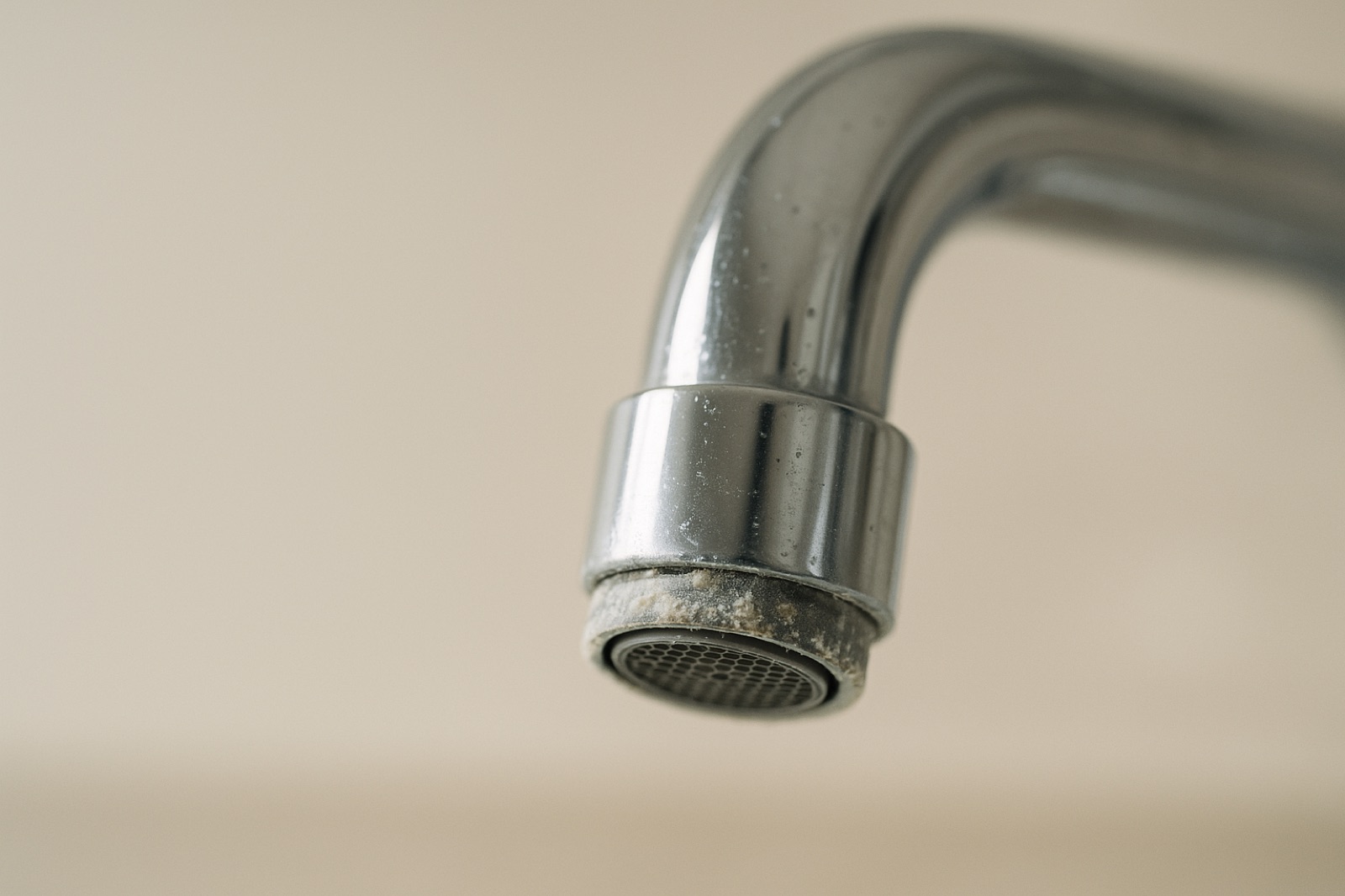
Hard water contains dissolved calcium and magnesium. As water evaporates or is heated, those minerals can leave scale. The most persuasive household pattern is not one isolated mark. It is recurring crust around faucets, buildup in a kettle, stiff residue on shower surfaces, and steadily declining flow through aerators or showerheads.
Soap performance can add supporting evidence. Hardness minerals react with traditional soaps, so you may notice more curd-like residue and need more product to get the result you expect. But this is a weak test by itself. Detergent formulation, water temperature, the amount used, and even your washing machine settings can change suds and rinsing. Plenty of foam does not prove the water is soft, and limited foam does not prove it is hard.
Know what spotting can and cannot tell you
White spots are often treated as a shortcut diagnosis, but evaporation leaves behind whatever the water was carrying. A softener exchanges hardness minerals for sodium or potassium ions. It does not make water free of all dissolved material. That means softened water can still leave a light, wipeable residue, especially when droplets dry on glass or dark fixtures.
Cleaning products can also create look-alike evidence. Dishwasher detergent, rinse aid, overspray, and incomplete rinsing may leave films that resemble mineral deposits. Before buying equipment, wash one glass by hand, rinse it thoroughly, and let half air-dry while drying the other half with a clean towel. If only the air-dried side spots, evaporation is involved, but the experiment still does not identify hardness by itself.
Take the readings in the right places
Use a hardness test strip, drop-count kit, laboratory test, or a qualified water professional. Results are commonly reported as milligrams per liter as calcium carbonate or grains per gallon. One grain per gallon is approximately 17.1 milligrams per liter. Check the kit instructions and expiration date, and avoid sampling hot water because the water heater adds another variable.
For the untreated reading, use a tap that is known to be upstream of the softener, such as a correctly plumbed outdoor faucet. Do not assume every outdoor spigot is untreated. For the second reading, sample cold water from an indoor fixture after running it long enough to clear water that has been sitting in the pipe.
A single strip can mislead you if the sample location is wrong, the color is read too late, or the test range is too broad. When a result conflicts with what you see, repeat it. If possible, use a second method. The goal is not laboratory theater. It is to avoid spending money on a false positive created by sampling or interpretation.
Let the comparison choose the next step
If the untreated water is hard and the treated water is substantially lower, the softener is probably doing its central job. Remaining spots may call for better drying, adjusted dishwasher products, fixture cleaning, or point-of-use treatment for dissolved material rather than a larger softener.
If both readings are similarly hard, inspect the existing softener before replacing it. Confirm that it is not bypassed, that salt is available beneath any crusted bridge, and that regeneration settings match household use. Persistent hardness after those checks may justify service for a control, injector, valve, or exhausted resin problem.
If the untreated reading is not hard, a softener is unlikely to solve the complaint. Sediment calls for particle filtration. Taste and odor concerns require identification before choosing filtration media. A drinking-water reverse osmosis system may reduce a broad range of dissolved substances at one tap, but it is not a substitute for diagnosing the source. A local assessment can help you confirm hardness and size the right system without treating every white mark as proof that you need new equipment.
Your decision should follow the paired readings: soften verified hardness, repair a system that is failing to reduce it, and investigate another cause when hardness is not present. Two small samples can keep a cosmetic nuisance from turning into the wrong purchase.