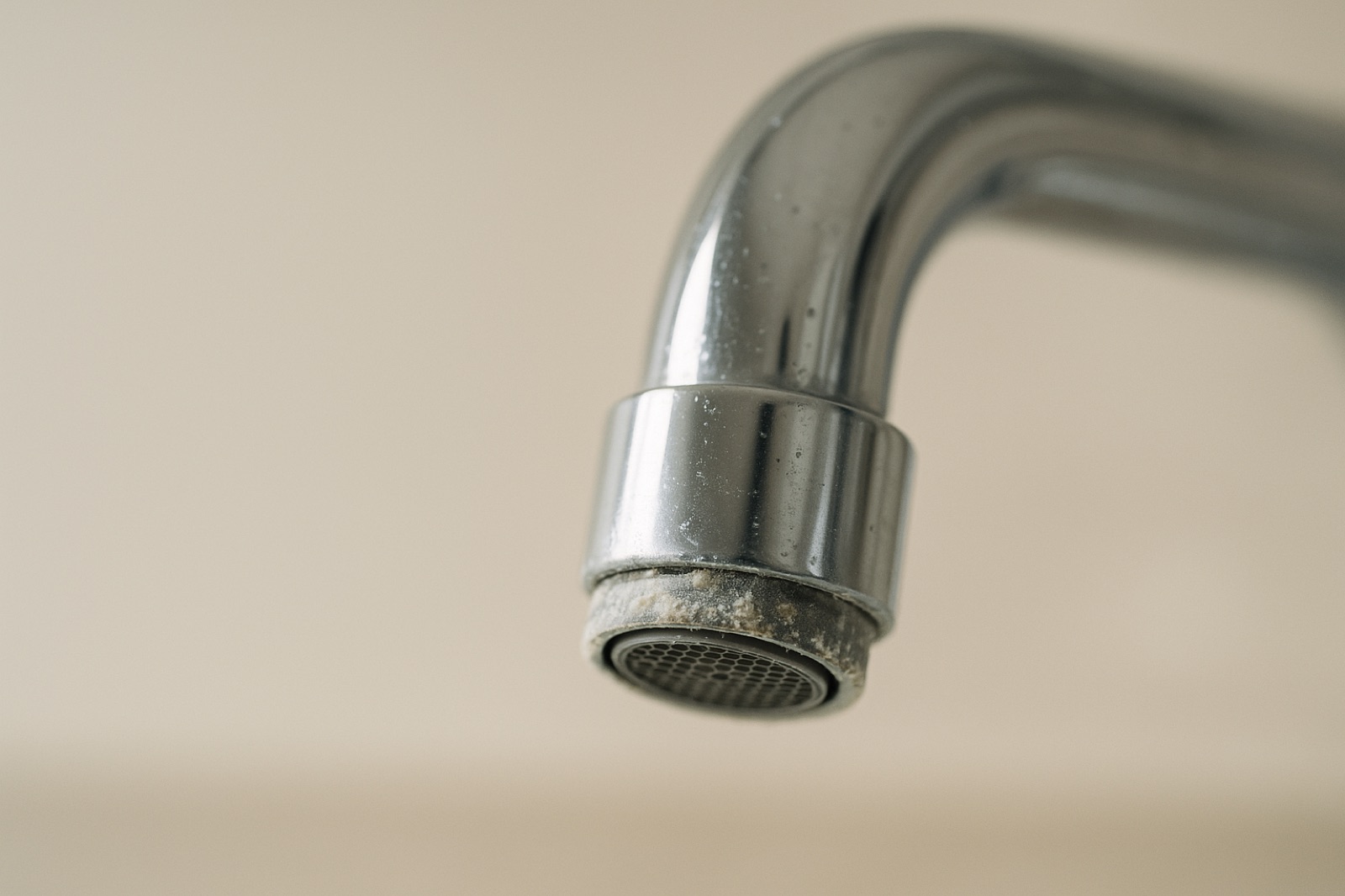
A summer of extra showers, laundry and outdoor water use can make every water complaint feel more urgent. That does not necessarily mean your water changed. It may simply mean you are seeing more of what was already there.
The Guardian reported on September 11, 2026, that the United States experienced a summer of record heat and rolling heat domes. The story also asked readers about power cuts. For homeowners, those conditions offer a useful diagnostic lesson: heavier water use can reveal scale and spotting faster, while an outage can disrupt the clock or settings on an existing softener.
Before spending money, work through the evidence in the right order.
Start with the deposits
Hard water commonly leaves a chalky white or gray crust where water is heated or allowed to evaporate. Check showerheads, faucet aerators, the rim of a kettle and the area around a humidifier. A deposit that returns repeatedly after cleaning is more persuasive than a few spots on one drinking glass.
Not every mark is scale. Dishwasher detergent, rinse aid, air drying and glass etching can all produce cloudy-looking dishes. Try hand-washing one glass, rinsing it thoroughly and drying it immediately. If it clears, your dishwasher routine may be the culprit. If the haze is permanent and does not respond to ordinary cleaning, the glass itself may be etched.
Colored stains point elsewhere. Orange or reddish marks can suggest iron or corrosion. Blue-green staining can accompany copper corrosion. Black particles may come from deteriorating rubber components or treatment media. Those clues call for testing or plumbing inspection, not an automatic softener purchase.
Use soap as supporting evidence
Hardness minerals react with soap, so hard water can require more soap and leave a film on tubs or shower doors. Yet poor lather alone proves little. Soap formulation, water temperature, product quantity and even the condition of your washing machine can change the result.
Run a simple comparison with equal amounts of water and the same soap. Better still, compare your tap water with bottled distilled water. A noticeable difference supports the case for hardness, but it does not measure hardness or size equipment.
Get the units straight
A hardness result is usually reported as milligrams per liter, parts per million, or grains per gallon. For household comparisons, milligrams per liter and parts per million are treated as approximately equivalent when the result is expressed as calcium carbonate. To convert that number to grains per gallon, divide by about 17.1.
That conversion matters because utility reports and laboratories often use milligrams per liter, while softener controls and sales literature frequently use grains per gallon. Always confirm that two estimates use the same unit before comparing them.
An inexpensive hardness strip can provide a useful range. A liquid drop kit generally gives a more specific household reading. For a private well, unexplained staining, unusual taste or a broader water-quality concern, use appropriate laboratory testing. A total dissolved solids meter is not a substitute for a hardness test. It responds to many dissolved substances and cannot tell you how much calcium and magnesium are present.
Watch for false positives
Test cold water from a frequently used tap and remove the aerator if debris is present. If you already own a softener, sample both before and after it when possible. Testing only softened water could make naturally hard source water look soft. Testing during regeneration, after a long vacancy or immediately after plumbing work can also produce an unrepresentative snapshot.
Municipal averages are useful background, but they do not replace a tap measurement. Private-well results may vary over time. If a reading conflicts sharply with what you see around the house, repeat the test before buying equipment.
Match the remedy to the confirmed problem
Choose repair when symptoms began after a valve failure, loss of power, empty brine tank or accidental bypass. Check the softener clock, salt level, bypass position and regeneration history. An older unit that no longer reduces hardness may need service rather than replacement.
Choose softening when a reliable test confirms hardness and the recurring problems are scale, soap inefficiency or mineral spotting throughout the home. Household size, measured hardness, peak flow and regeneration demand all affect equipment selection. A local assessment can help you confirm hardness and size the right system.
Choose filtration when the actual complaint involves sediment, disinfectant taste, odor or a specifically identified contaminant. Filters and softeners perform different jobs, and some homes legitimately need both. If you are also reviewing the financial risk of failures involving plumbing or major equipment, compare the limits and exclusions of any coverage for home systems and appliances.
The reader demand is clear but not perfectly measurable. TheHomeWaterReport.com recorded 3,210 page views, 1,068 visitors, 1,258 search crawls and 2,876 AI crawls. The available feed contains no query-level evidence or conversion data, so those figures cannot show how many readers intend to buy a softener. They do support publishing a practical answer: symptoms justify investigation, while a correctly measured hardness result justifies the equipment decision.