Water supply headlines can make every stain on a faucet feel more urgent. On October 1, 2026, The Guardian reported that Lake Mead was at its lowest level since it was filled nearly 90 years ago, while Lake Powell was also at a historic low. Ben Tracy of Climate Central examined what could follow as the Colorado River continues shrinking.
That story matters to communities and water providers. It does not, however, diagnose the white crust on your showerhead. Water quantity and household water hardness are separate questions. If you want to know whether a softener belongs in your home, you need evidence from your own fixtures and water.
Start with scale, not ordinary spotting
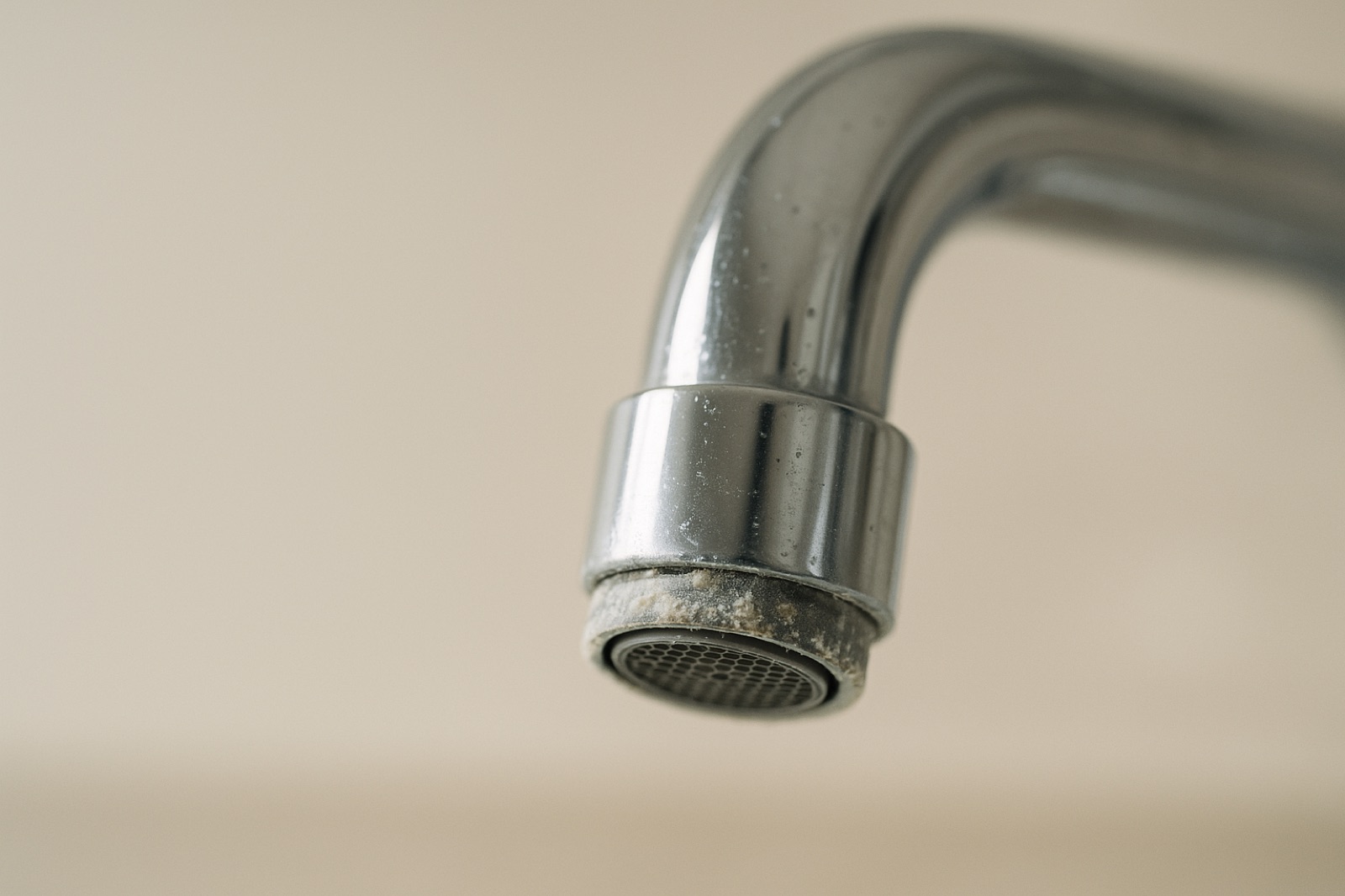
Hard water contains dissolved calcium and magnesium. When water evaporates or is heated, these minerals can remain behind. The most useful visual clue is persistent, chalky scale that builds around faucet aerators, showerheads, kettle interiors, and heating elements.
Flat spots on a glass are weaker evidence. They may be mineral residue, but they can also come from detergent, rinse aid, cleaning products, or water left to dry. Clean one small area with a product appropriate for that surface, rinse it thoroughly, and dry it by hand. If the haze disappears and stays away when you hand-dry the glass, your cleaning routine may be contributing more than the water.
Do not treat orange, blue-green, black, or oily deposits as proof of hardness. Color can point toward other water chemistry, plumbing materials, sediment, or a fixture problem. A softener has a specific job. It should not become the default answer to every visible residue.
Use soap behavior as supporting evidence
Hard water can make soap lather less readily and can leave a film on tubs, sinks, or skin. Yet soap performance is easy to misread. Product formula, dose, water temperature, and washer settings all affect the result.
Try the same soap in two locations and note whether the problem occurs consistently. If only one sink or shower behaves differently, inspect its aerator, showerhead, or local plumbing before blaming the whole-house supply. If poor lather appears throughout the home alongside recurring scale, hardness becomes a stronger suspect.
Get a number you can actually use
A hardness test converts impressions into a treatment decision. Results are commonly reported in milligrams per liter, parts per million, or grains per gallon. For hardness, milligrams per liter and parts per million are generally treated as equivalent. To convert either one to grains per gallon, divide by about 17.1.
Test untreated water when possible. If a softener is already installed, take one sample before the unit and another after it. That comparison tells you more than a single reading from an unknown tap. Follow the test instructions closely, use a clean container, and repeat an unexpected result before purchasing equipment.
A hardness strip is useful for screening, but its broad color bands can be difficult to interpret. A drop-count kit or laboratory result can provide a more precise number when you are sizing equipment or investigating a questionable strip result. A total dissolved solids meter is not a hardness test. It measures conductivity from many dissolved substances and can create a false positive if you assume every elevated reading represents calcium and magnesium.
Match the response to the finding
If an existing softener is followed by hard-water symptoms, start with repair checks. Confirm that the bypass valve is in the service position, salt is present, the unit has power, the clock and hardness setting are correct, and regeneration is occurring. Test before and after the unit. Similar readings on both sides suggest a performance or plumbing problem, not an automatic need for replacement.
If hardness is confirmed in untreated water and the symptoms affect the whole house, softening may be appropriate. Household size, measured hardness, water use, flow needs, and any iron or manganese findings influence selection. Lakeview readers can use the local assessment page to confirm hardness and size the right system.
Choose filtration when the verified problem is something a filter is designed to reduce, such as sediment or a specific taste and odor concern. A conventional filter does not remove hardness simply because it makes water look or taste better. Some homes need both processes, but each unit should have a clearly defined job.
This distinction matters because attention is not the same as evidence. TheHomeWaterReport.com recorded 3,210 page views, 1,068 visitors, 1,258 search crawls, and 2,876 AI crawls. The feed does not provide query-level evidence or conversions, so those figures cannot show exactly what readers intended to solve. Your decision deserves the same restraint: treat symptoms as clues, obtain the right measurement, and buy equipment only when the result identifies its job.