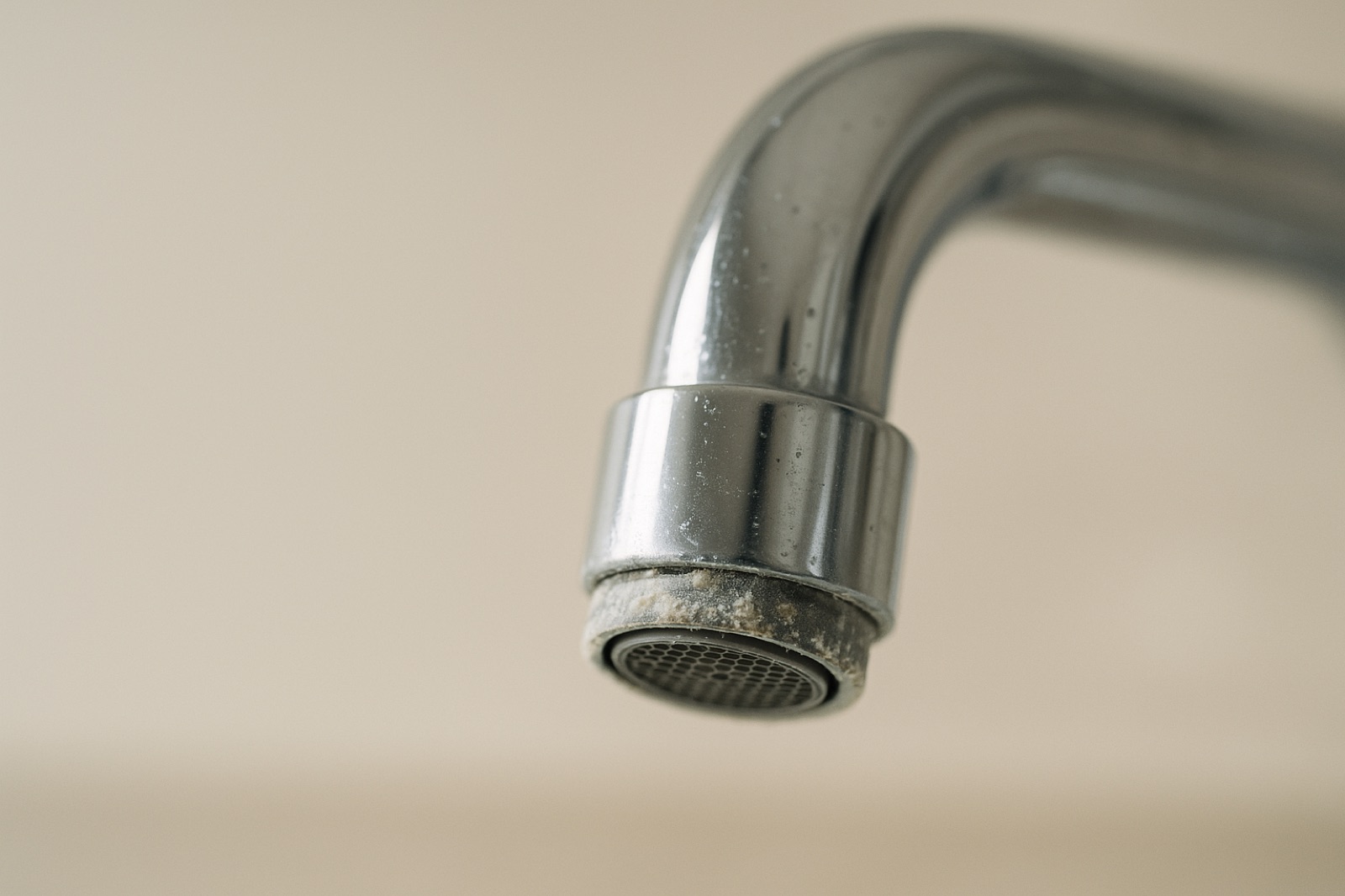
Water treatment decisions are getting more complicated, not less. Water Finance and Management reports that the WateReuse Association has released a new water reuse regulatory guidebook for utilities, regulators, and industry practitioners. Its focus is larger than your kitchen sink, but the homeowner lesson is useful: water should be evaluated according to its source, intended use, and the specific problem being addressed.
That matters when you see white crust around a faucet or spots on a glass. Those clues may point toward hard water, but they do not prove that you need a softener. Work through these seven checks before buying equipment.
1. Separate scale from removable spotting
Start with a freshly washed glass. Let a few drops of tap water dry naturally, then wipe the marks with a damp cloth. If they disappear easily, you may be seeing ordinary dried residue rather than stubborn scale. If a chalky deposit repeatedly builds around aerators, showerheads, or heated appliances, hardness becomes a stronger possibility.
Location matters. Deposits concentrated where water is heated or evaporates are more consistent with mineral buildup than a cloudy film spread across every surface.
2. Check whether soap is actually underperforming
Hard water can make soap harder to lather and easier to overuse. Yet soap performance is a noisy diagnostic tool. The product formula, water temperature, load size, and washing machine settings can all change the result.
Compare the same soap under similar conditions at two fixtures. If one behaves differently, investigate that fixture or its plumbing before blaming the household supply. A single informal lather test should not determine a major purchase.
3. Test the untreated water
Use a hardness test strip or, for a clearer reading, a drop-count titration kit. Sample cold water from a tap that is not served by an existing softener. An outside faucet may work, but plumbing layouts vary, so confirm that it is connected before the treatment equipment.
If you use municipal water, your utility report may provide useful background. Your own tap reading still matters because the number used to size a softener should reflect the water entering your house.
4. Read the units before reading the verdict
Hardness commonly appears as milligrams per liter, parts per million, or grains per gallon. Milligrams per liter and parts per million are treated as equivalent for this purpose. To convert either one to grains per gallon, divide by 17.1.
For example, a result of 171 parts per million equals about 10 grains per gallon. Keep the original result and unit in your notes. A number without its unit can lead to a badly programmed or incorrectly sized system.
5. Look for false positives
White residue is not always hardness. Dishwasher detergent, rinse aid, cleaning products, and dissolved solids left after evaporation can produce similar-looking marks. A whole-house filter also does not automatically solve spotting. Standard sediment and carbon filters target different problems and generally are not substitutes for a softener that removes calcium and magnesium.
If the appearance, taste, or odor is unusual, do not assume hardness explains everything. Test for the concern you actually have instead of using a hardness result as a general water-quality score.
6. Test both sides of an existing softener
If you already own a softener, collect one sample before the unit and another after it. Hard water entering the system and much softer water leaving it suggest the softener is working, even if old deposits or dishwasher residue remain visible.
Similar hardness on both sides points toward bypass position, low salt, a salt bridge, incorrect programming, failed regeneration, exhausted resin, or another service issue. Repair and setup checks make more sense than immediately replacing the entire unit.
7. Match the remedy to the evidence
Choose softening when testing confirms hardness and the symptoms affect enough of the home to justify whole-house treatment. Choose repair when an installed unit is receiving hard water but failing to reduce it. Choose filtration when testing identifies a separate issue that a suitable filter is designed to address. Some homes need both technologies, but each should have its own documented job.
Household size, measured hardness, peak flow, iron where relevant, and expected water use all affect equipment selection. Lakeview readers can confirm hardness and size the right system before committing to equipment.
The demand for this kind of diagnosis is visible, although the available audience data has limits. TheHomeWaterReport.com recorded 3,210 page views, 1,068 visitors, 1,258 search crawls, and 2,876 AI crawls. The feed lacks query-level evidence and conversions, so those figures cannot tell us which symptom brought each reader in or whether anyone bought a softener. They do support a practical conclusion: homeowners need a reliable way to move from a visible clue to a measured result.
Your best buying signal is not a spot, a sales pitch, or a single soap test. It is a repeatable hardness reading, taken from the correct location, followed by a remedy that fits the confirmed problem.