A proposed 68% cut to the Drinking Water State Revolving Fund is drawing attention to the cost of maintaining public water infrastructure. Water Finance and Management reported on the association response following a September 3, 2026, congressional hearing in its coverage of the proposed Drinking Water SRF cut.
That funding debate concerns public systems, not the mineral residue on your shower door. Still, it is a useful reminder that water problems must be identified at the right level. Your utility manages source water and distribution infrastructure. You are responsible for plumbing and treatment inside your home. Before buying equipment, determine which part of that chain explains what you see.
Start with scale, not a single water spot
White spots on a glass can come from hardness minerals, but they can also come from detergent, rinse aid, dishwasher settings, or water that dried without being wiped away. Treat spotting as an invitation to investigate, not proof that you need a softener.
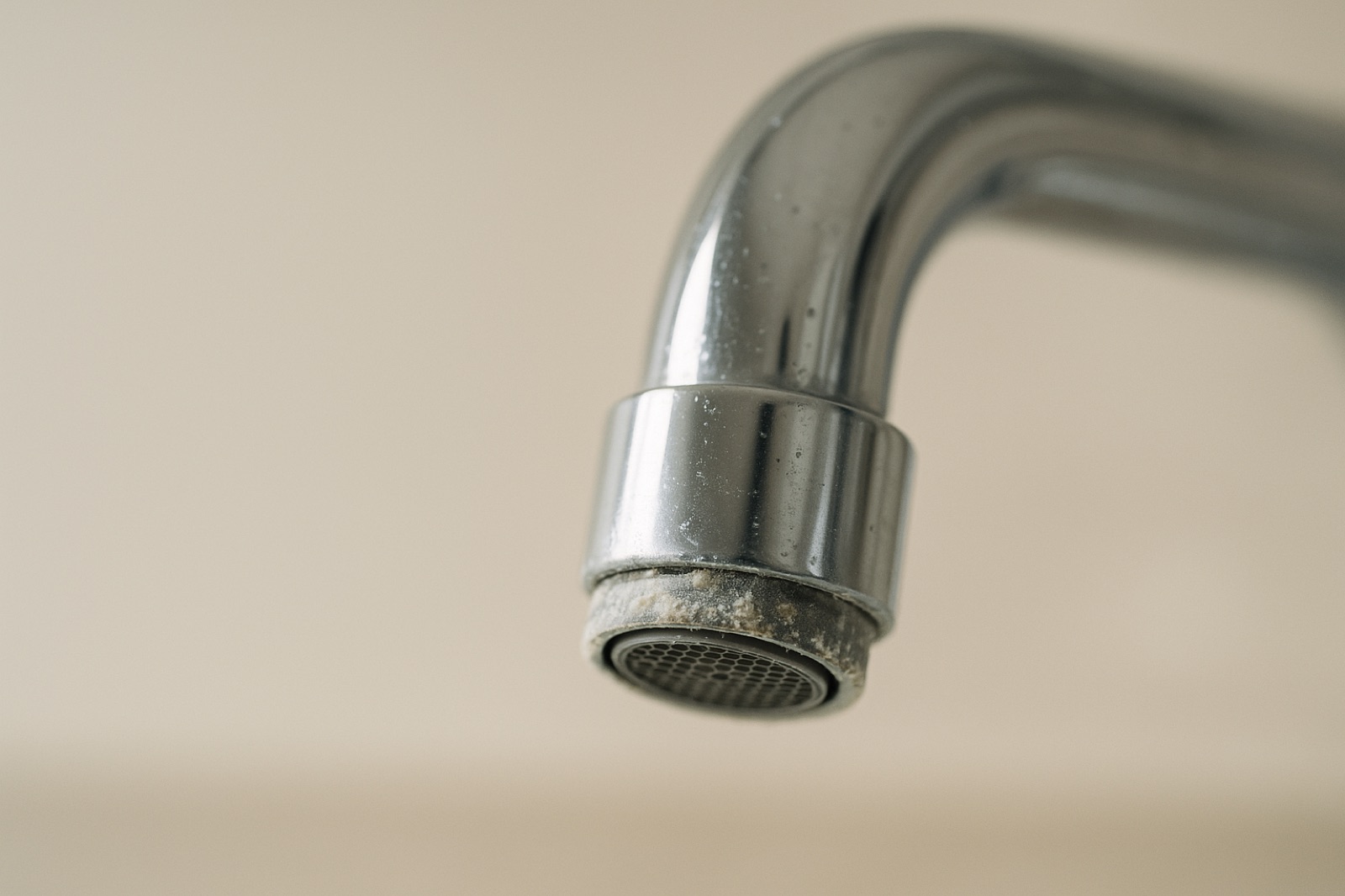
Scale is stronger evidence. Check the showerhead, faucet aerators, kettle, humidifier reservoir, and the heating element or interior of an appliance you can inspect safely. Hard-water scale usually forms a persistent, chalky crust in places where water heats or evaporates.
Try cleaning one test area with an appropriate household descaler. If the deposit dissolves but steadily returns across several fixtures, hardness becomes a more likely explanation. If it appears at only one faucet, first inspect that aerator and nearby plumbing.
Use soap performance as supporting evidence
Hard water can make soap lather less readily and leave a film on tubs, sinks, or glass. Yet soap behavior produces false positives. A new soap formula, excessive detergent, a clogged dispenser, or a washing machine problem can change rinsing and suds.
Compare the same soap and amount at two fixtures. Also note whether the problem affects hot and cold water. A hot-only complaint can point toward the water heater, while a whole-house pattern is more consistent with the incoming water or an existing treatment system.
Test before choosing equipment
A hardness test gives the symptoms a number. Results are commonly reported as milligrams per liter, or parts per million, as calcium carbonate. Installers often use grains per gallon. To convert, divide milligrams per liter by about 17.1. A reading of 171 mg/L is therefore about 10 grains per gallon.
Test strips are useful for a quick range. A liquid drop kit can provide a more precise result for sizing. If results conflict, repeat the test with fresh supplies and sample cold water from a clean tap. Bypass an existing softener if you want to measure untreated incoming water, then test softened water separately to see whether the unit is working.
A total dissolved solids meter does not measure hardness specifically. It responds to dissolved material generally, so a high reading cannot tell you that calcium and magnesium are the cause. Likewise, clear water is not evidence that it is soft.
Match the remedy to the diagnosis
Repair comes first when you already own a softener and symptoms have returned. Check whether the unit has power, salt, an open bypass valve, and the correct time and hardness settings. Salt bridging, exhausted resin, blocked flow, or a failed control valve may require service. Replacing the entire system should not be the automatic first step.
Softening is the appropriate category when testing confirms calcium and magnesium hardness and your goal is to reduce scale and improve soap performance. System size should reflect measured hardness, household water use, and any iron the equipment is specifically designed to handle. If you want local help, Lakeview can confirm hardness and size the right system.
Filtration has a different job. Carbon filters may address certain taste, odor, or disinfectant concerns, while sediment filters capture particles. Neither is a substitute for a conventional ion-exchange softener when the confirmed problem is hardness. Unusual color, odor, or a suspected contaminant calls for targeted testing rather than an assumption that a softener will solve it.
What reader activity tells us, and what it does not
The Home Water Report has recorded 3,210 page views, 1,068 visitors, 1,258 search crawls, and 2,876 AI crawls. Those totals show substantial discovery activity around the site, but the feed does not provide query-level evidence or conversion data. It cannot prove exactly what readers searched for or whether they purchased treatment.
The practical takeaway is simpler: do not let one spot, one soap test, or one sales demonstration make the decision. Look for a whole-house pattern, confirm it with a hardness number, and choose repair, filtration, or softening according to the job your water actually requires.