Higher water costs make every household water decision feel more urgent. On October 6, 2026, The Guardian reported that US households are paying 62% more for drinking water than they did a decade earlier, according to a new study. The report on rising household water costs says those increases have outpaced inflation, grocery prices, and household incomes.
That does not mean a water softener will lower your utility bill. It means you have another reason to diagnose your water carefully before adding equipment that has its own purchase, maintenance, salt, and water requirements. Scale, spots, and disappointing soap performance can support a hard-water diagnosis, but none proves it alone.
Start with scale, not every white mark
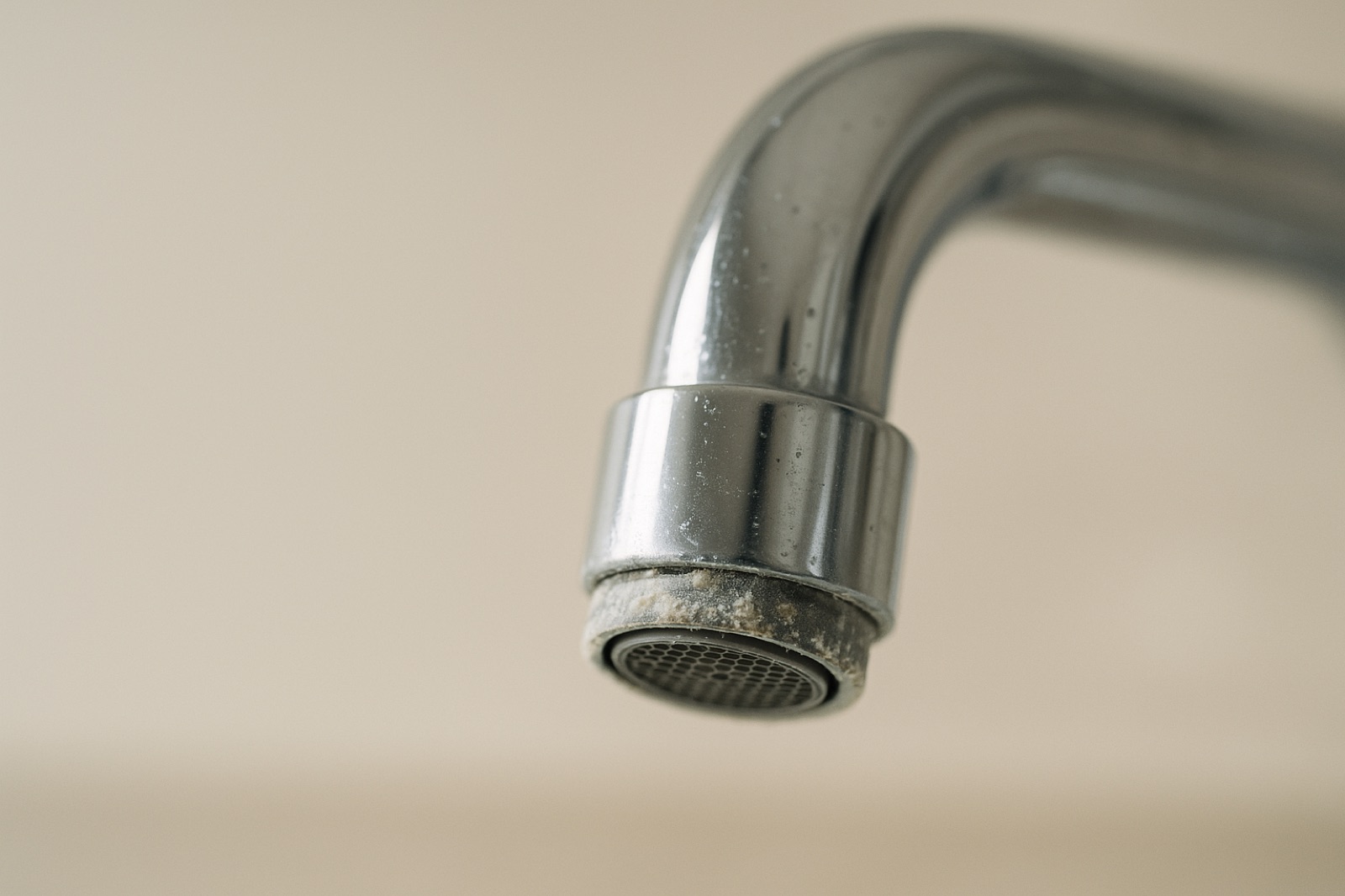
Hard water contains dissolved calcium and magnesium. When water evaporates or is heated, those minerals can remain as a crusty deposit. Look for firm buildup around faucet outlets, showerheads, kettle interiors, and the heating surfaces of appliances. Repeated scale in several places is a stronger clue than one cloudy faucet.
Wipeable spots are less decisive. A drinking glass can show mineral residue after droplets dry, but dishwasher detergent, rinse aid, excess detergent, and incomplete rinsing can produce similar haze. Soap residue can also cling to tile and glass. Before blaming hardness, clean one small area with a suitable household cleaner, rinse it thoroughly, and watch how quickly the deposit returns.
Location matters. Buildup that appears mainly at hot-water fixtures may be intensified by heating. Deposits at both hot and cold taps suggest a whole-house water characteristic. A single clogged aerator may simply need cleaning or replacement.
Treat soap performance as supporting evidence
Hardness minerals react with soap, so you may notice weak lather, a film on tubs, or a need for more product. Yet soap performance has false positives too. Product formulation, water temperature, load size, and detergent dose all change the result.
Try a controlled comparison. Use the same soap, water temperature, and container with water from two locations. If you already have a softener, compare untreated water with a sample taken after the unit. This is not a substitute for a hardness test, but it can show whether the pattern is consistent enough to investigate.
Read the hardness number in the right units
A hardness test should report a number, not merely label the water hard or soft. Results commonly appear as milligrams per liter, usually expressed as calcium carbonate, or grains per gallon. One grain per gallon is approximately 17.1 milligrams per liter.
Confirm which unit appears on the report before comparing results or discussing equipment. A number without its unit is easy to misread. Also note where and when the sample was collected. Test cold water before treatment if you want to understand the incoming supply. Testing only softened water tells you about equipment performance, not the hardness entering the home.
Test strips are useful for screening, but their broad color ranges can be difficult to interpret. A laboratory result or an on-site test with a numerical reading can give you a clearer basis for sizing. Homeowners in the Lakeview area can ask Jones Air & Water to confirm hardness and size the right system. Whichever testing route you choose, keep the result and unit with any proposal so you can compare recommendations.
Choose repair, filtration, or softening by the actual job
Repair comes first when the symptom is isolated. A scaled showerhead, failing water-heater component, clogged aerator, or malfunctioning existing softener may need service rather than another treatment device.
Filtration fits problems involving particles, tastes, odors, or specific substances that an appropriate filter is designed and certified to reduce. A standard filter is not automatically a hardness solution, and a softener is not a general contaminant filter.
Softening becomes the logical choice when a measured hardness level lines up with recurring scale and soap-related problems across the home. Ask how the proposed capacity and regeneration settings relate to your test result, household water use, and number of occupants. Also ask what routine salt filling and maintenance will involve.
The practical standard is simple: several consistent symptoms, a properly located test, and a treatment proposal tied to the measured number. Rising water costs make that discipline more valuable. You are not trying to buy the most equipment. You are trying to solve the problem your water can actually prove.