Water problems in the wider environment can be serious without saying anything specific about the water entering your home. Circle of Blue reports that hundreds of invasive carp have been detected in the Illinois River, about 80 miles from Lake Michigan, the closest they are known to have reached the Great Lakes. That invasive carp report from Circle of Blue concerns ecosystem management, not household water hardness.
That distinction matters whenever a water headline sends you toward the treatment aisle. A softener has a narrow job: reducing dissolved calcium and magnesium. Before buying one, connect what you see around the house with an actual hardness result.
Start with patterns, not one suspicious spot
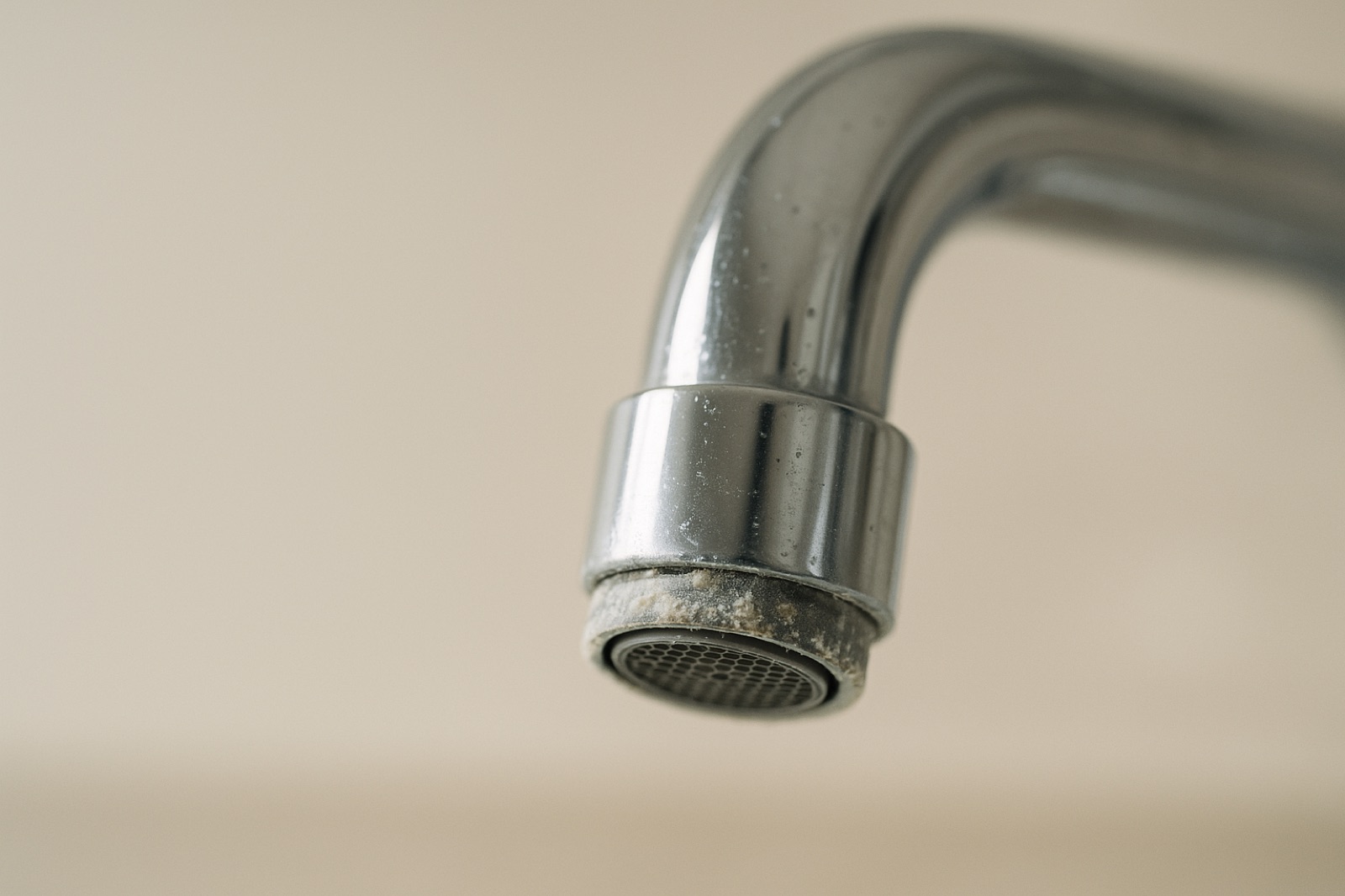
Hard water commonly leaves a rough, pale crust where water repeatedly heats or evaporates. Check showerheads, faucet aerators, the rim of a kettle, and the heating element or interior of a dishwasher. Repeated spotting on glassware can support the same diagnosis, especially when the spots return after careful rinsing.
Soap performance adds another clue. Hardness minerals react with traditional soap, so you may notice stubborn film, less lather, or extra product needed for the same cleaning job. Detergents are formulated differently, however, and low lather alone proves little. Product choice, water temperature, wash settings, and the amount of detergent can all change the result.
Look for agreement across several fixtures and routines. One cloudy glass, one crusty faucet, or one disappointing load of laundry is a reason to investigate, not a verdict.
Know what the hardness number means
A test may report hardness in grains per gallon, written as gpg, or milligrams per liter as calcium carbonate, written as mg/L as CaCO3. These are two ways of expressing the same basic measurement. One gpg is approximately 17.1 mg/L as CaCO3. If a report uses one unit and a softener proposal uses the other, convert them before comparing the recommendation.
Use a fresh sample from the water that would actually pass through the proposed system. If you have an existing softener, test both before and after it when possible. Testing only a softened tap could make the source water appear naturally soft. Testing a refrigerator dispenser may also reflect a small filter that does not represent the rest of the house.
Test strips are useful for a quick range, but lighting, expired materials, timing errors, and ambiguous color blocks can produce false positives or misleading readings. A drop-count titration test generally gives a clearer household hardness number. If iron, unusual staining, odor, or a private well is involved, broader testing may be appropriate because hardness alone cannot identify those issues.
Match the response to the diagnosis
If the hardness result is meaningful and scale, spotting, and soap problems appear throughout the home, a softener may be the appropriate tool. Household water use, measured hardness, iron when present, plumbing layout, and desired reserve capacity all affect sizing. Lakeview readers can use a local assessment to confirm hardness and size the right system rather than choosing by tank appearance or a broad bedroom count alone.
If an existing softener once worked and the symptoms recently returned, investigate repair before replacement. Check whether the unit has salt, whether a salt bridge has formed, whether the bypass valve is in service position, and whether the clock and hardness setting survived a power interruption. A technician may need to inspect the control valve, injector, resin, or drain flow.
Filtration is the better category when testing identifies a different target, such as sediment, chlorine-related taste, or a specific contaminant that a suitable certified filter is designed to reduce. A softener is not a general purifier. Conversely, an ordinary sediment or carbon filter does not remove dissolved hardness minerals.
What reader activity tells us, and what it does not
TheHomeWaterReport.com has recorded 3,210 page views, 1,068 visitors, 1,258 search crawls, and 2,876 AI crawls in the available reporting. Those figures show attention and automated discovery, but the feed provides neither query-level evidence nor conversions. It cannot prove which symptom brought a homeowner here or whether that person needed treatment.
Your own evidence should be stronger. Document where deposits appear, compare hot and cold fixtures, note whether soap behavior changed, and obtain a hardness number in clearly labeled units. Then choose repair, filtration, or softening according to the problem the evidence actually supports.