A troubling water headline can make every cloudy glass or crusty faucet feel suspicious. On October 1, 2026, Circle of Blue reported that Legionnaires’ disease cases are rising again, based on provisional Centers for Disease Control and Prevention data for 2025. The story says the illness spreads when people inhale contaminated water droplets.
That news deserves attention, but it does not turn ordinary hard-water clues into a safety test. White scale cannot tell you whether water contains a disease-causing organism. A hardness strip cannot answer that question either. If your practical concern is whether scale, spotting, or poor soap performance justifies a softener, stay focused on what a hardness test can actually establish.
Start with the deposit, not the equipment
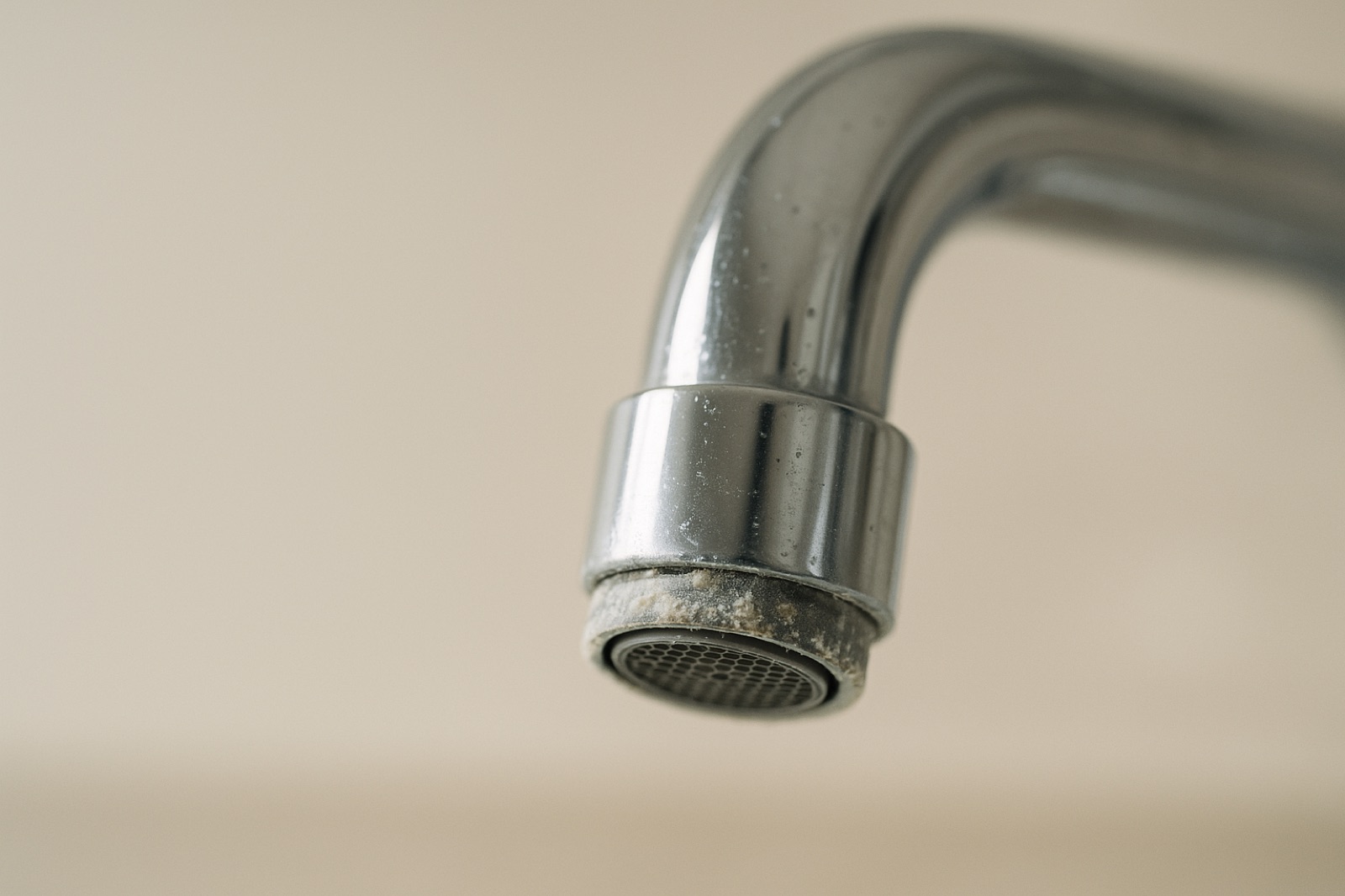
Hardness is mainly a measure of dissolved calcium and magnesium. When water evaporates, those minerals can remain as a pale, chalky deposit. You may see it around faucet aerators, on shower doors, inside kettles, or wherever a small leak repeatedly dries.
Before blaming hardness, wipe the area with a damp cloth. A dry, removable film on glass may be leftover mineral spotting. A crust concentrated at a dripping connection may point to both hardness and a plumbing repair. If the material is orange, brown, green, black, oily, or slimy, do not force it into the hard-water category. Color and texture are reasons to investigate other causes.
Spotting also produces false positives. Dishwasher detergent, too much rinse aid, dirty spray arms, and poor drying can leave dishes looking cloudy. Test one glass by washing and drying it by hand. If it comes out clear while machine-washed glasses do not, check the dishwasher before buying water-treatment equipment.
Use soap as supporting evidence
Hard water can make soap lather less readily and encourage residue. That clue becomes more persuasive when it appears alongside recurring scale and a matching hardness result.
Soap performance alone is weak evidence. Product formulas differ, and people use different amounts. A new shampoo, concentrated detergent, or low-flow fixture can change what you notice. Compare the same soap under similar conditions instead of relying on a single shower or laundry load.
Read both common hardness units
Laboratory reports and utility documents often express hardness as milligrams per liter, usually reported as calcium carbonate. Softener controls and sales materials commonly use grains per gallon, abbreviated gpg.
To compare them, divide milligrams per liter by about 17.1 to get grains per gallon. A result of 171 mg/L is therefore about 10 gpg. The conversion does not change the water. It only puts the same result into another unit.
Check where the sample came from. Water collected after an operating softener tells you how the equipment is performing. Water collected from a correctly identified untreated tap tells you what the softener must handle. Mixing up those locations can make a working unit look unnecessary or a failed unit look effective.
Choose repair, filtration, or softening by the result
If untreated water tests hard and you consistently see scale, spots, and poor soap performance, a softener is the equipment designed for that mineral problem. Lakeview homeowners can use a local assessment to confirm hardness and size the right system. Household water use, measured hardness, available space, and plumbing layout matter more than buying the largest advertised capacity.
If you already own a softener, test before and after it. Hardness on both sides may point to bypass settings, an empty or bridged brine tank, a regeneration problem, valve trouble, or exhausted resin. That calls for diagnosis and possibly repair, not an automatic replacement.
Filtration belongs in a different lane. Sediment, disinfectant taste, odor, and specific tested contaminants require media or equipment chosen for those targets. A standard ion-exchange softener addresses hardness. It should not be treated as a general safety device.
The demand for a clearer diagnosis is visible in this publication’s own traffic: thehomewaterreport.com recorded 3,210 page views, 1,068 visitors, 1,258 search crawls, and 2,876 AI crawls. Those totals do not reveal individual queries or conversions, so they cannot prove exactly what readers bought or needed. They do support a homeowner-first rule: symptoms begin the investigation, but a correctly collected test decides whether a softener belongs in the solution.