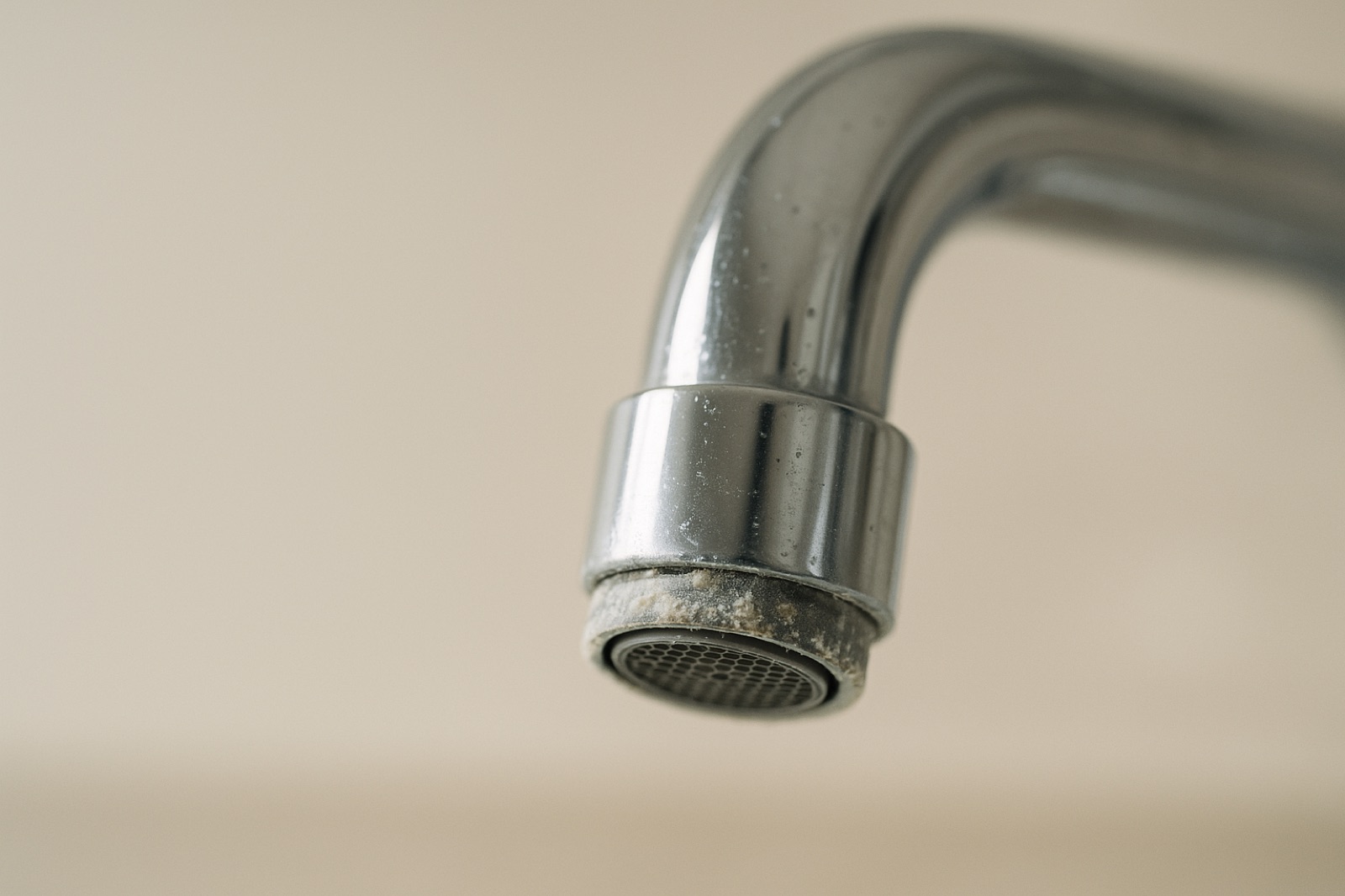
A cloudy shower door can make a water softener feel like an obvious purchase. So can stiff laundry, weak soap lather, or a crusty faucet aerator. But each symptom has plausible look-alikes, and none tells you how large a system should be.
Cost deserves attention too. Water Finance and Management reports that utilities with lean budgets and tight staffing may keep legacy billing systems long past their prime. Its look at billing practices and customer costs is a useful reminder that an unwelcome water bill is not automatically evidence of inefficient plumbing or hard water. Treat the bill and the water as separate diagnostic questions until you have numbers for both.
Start with the deposit, not the equipment
Hardness is mainly a measure of dissolved calcium and magnesium. When water evaporates or is heated, those minerals can leave pale, chalky deposits. Look at a dry faucet, shower glass, kettle, and the hot-water side of a frequently used fixture. Repeated crust in several places is more persuasive than one spotted glass.
Now check for false positives. Dishwasher detergent can leave film. Too much rinse aid can create streaking. Salt spray, construction dust, cleaning products, and residue from a dirty humidifier can all produce pale marks. If a deposit wipes away with plain water, appears only after one appliance runs, or began immediately after you changed a product, investigate that local cause first.
Use soap as supporting evidence
Hard water can make soap less willing to lather and can leave a persistent film. That does not make a sink-side bottle shake a precision hardness test. Soap formulas, water temperature, the amount used, and traces of detergent in the container can change the result.
Use soap performance as a pattern check. If you need noticeably more soap throughout the house and also find stubborn mineral scale, a hardness test becomes the sensible next step. If soap behaves poorly at only one faucet, clean its aerator and check the fixture before considering whole-house equipment.
Get the units straight
A test may report hardness in milligrams per liter, parts per million, or grains per gallon. For ordinary household interpretation, milligrams per liter and parts per million are numerically equivalent. One grain per gallon is about 17.1 milligrams per liter. Divide a result in milligrams per liter by 17.1 to estimate grains per gallon.
That conversion matters because softeners are commonly discussed in grains of capacity. The hardness reading is only one sizing input. Household water use, the number of residents, peak flow needs, iron if present, and the chosen regeneration setting also affect the practical fit. A citywide average can establish context, but it should not replace a result from your home when you are preparing to buy.
Avoid misleading test results
Sample cold water from a regularly used tap after removing or bypassing any treatment device you are trying to evaluate. Follow the kit instructions exactly. Test strips are convenient for screening, but color matching can be subjective. A liquid drop test usually gives a clearer endpoint for sizing decisions. A laboratory test is appropriate when your concern goes beyond hardness or when private-well conditions are uncertain.
Do not use a total dissolved solids meter as a substitute. It estimates the overall concentration of dissolved material but does not identify how much is hardness. Also remember that hardness testing does not establish whether water is safe. Odor, unusual color, suspected contamination, or a sudden change in a private well calls for testing aimed at that specific concern.
Choose repair, filtration, or softening
Repair comes first when the evidence is local: one clogged aerator, one poorly rinsing dishwasher, a leaking water heater, or a softener that no longer regenerates correctly. Filtration fits problems involving particles, taste, odor, or a specifically identified substance, provided the selected filter is certified and configured for that target. A conventional ion-exchange softener fits a confirmed hardness problem when your goal is to reduce scale and improve soap performance throughout the home.
If the symptoms and test result agree, you can ask Lakeview to confirm hardness and size the right system. Bring your hardness result, household size, estimated water use, plumbing size, and any iron result to the assessment. Those facts make the recommendation easier to evaluate.
There is clear interest in this question, but not yet a precise map of reader intent. The Home Water Report recorded 3,210 page views, 1,068 visitors, 1,258 search crawls, and 2,876 AI crawls in the available snapshot. The feed contains no query-level evidence or conversion data, so those figures cannot tell us which symptom led each person here. Your own decision should rest on stronger evidence: recurring symptoms, a correctly collected hardness result, and equipment sized to the household rather than the stain that first caught your eye.