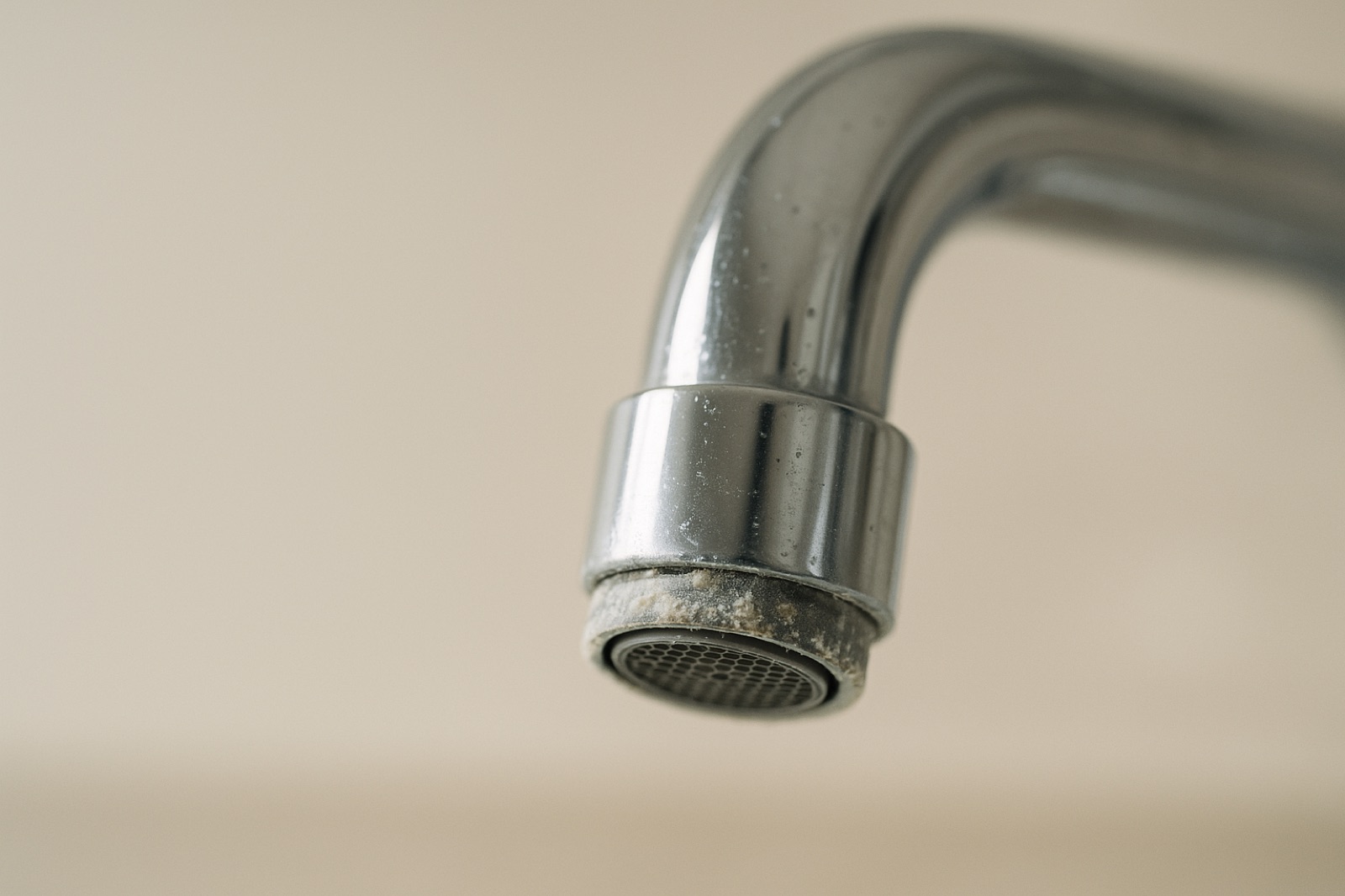
Water news can make almost any change at the tap feel significant. Circle of Blue reports that invasive carp were detected in the Illinois River 80 miles from Lake Michigan, their closest known approach to the Great Lakes. That is an important watershed story, but it does not tell you whether the chalky film on your faucet is hard-water scale.
For that, you need to separate clues from proof. White deposits, spotted glasses and disappointing soap performance can justify a hardness test. They do not automatically justify a new water softener.
Start with the residue
Hard-water scale usually appears as a white or pale crust where water repeatedly evaporates, including faucet aerators, showerheads and the rim of a humidifier tank. Calcium and magnesium stay behind as the water disappears.
Try soaking a removable, manufacturer-approved part in plain white vinegar. If the mineral crust softens or dissolves, hardness is a likely contributor. Check the appliance instructions first, since acidic cleaners are unsuitable for some finishes and components.
Residue with another color points elsewhere. Orange or reddish stains may call for iron testing. Blue-green staining can suggest corrosion involving copper plumbing. Black particles can come from several sources, including deteriorating components. A softener should not be your default response to an unidentified stain.
Read spots carefully
Spots on glassware are a useful clue only when you examine them after washing. A dry mineral film that wipes away with vinegar supports the hard-water theory. A cloudy surface that remains may be etched or damaged, which a softener cannot reverse.
Dishwasher performance can also create false positives. Too much detergent, too little rinse aid, overloaded racks, a clogged filter or weak drying can leave dishes looking like they were washed in hard water. Correct those variables before treating the whole house.
Notice what soap does, but do not rely on feel alone
Hard water can make soap lather less readily and leave a film on tubs or shower walls. You might compensate by using more soap or detergent. Those patterns become more persuasive when they appear alongside scale.
Still, low lather is not a measurement. Soap formulation, water temperature and the amount used all matter. Even the familiar “slippery” feel of softened water is subjective. Treat these observations as reasons to test, not as test results.
Get a number you can interpret
A basic hardness test reports calcium and magnesium together, commonly in milligrams per liter as calcium carbonate or in grains per gallon. One grain per gallon equals about 17.1 milligrams per liter.
Test strips are convenient for screening, but color matching and broad ranges can limit precision. A laboratory report or an on-site titration test can provide a clearer number when you are deciding whether to buy equipment. If you use well water, or if color, odor or staining is part of the complaint, request testing for the specific issue rather than assuming hardness explains everything.
Collect cold water from a frequently used tap, remove or bypass any existing treatment if the goal is to measure incoming water, and follow the test instructions exactly. If results conflict with what you see around the house, repeat the test before spending money.
Choose the response that matches the finding
Repair is the right first step when the symptom is isolated. One crusted showerhead, a malfunctioning dishwasher or a water heater that needs service does not prove that every tap requires treatment.
Filtration is appropriate when testing identifies a filterable concern, or when your goal involves taste, odor, sediment or a specific contaminant. Standard filters generally do not remove the dissolved calcium and magnesium responsible for hardness.
Softening becomes the practical option when measured hardness aligns with recurring scale, spotting and soap problems throughout the home. Household water use, peak flow, plumbing conditions and any iron or sediment will affect equipment selection. A local assessment can help you confirm hardness and size the right system without treating unrelated symptoms as proof.
The Home Water Report recorded 3,210 page views, 1,068 visitors, 1,258 search crawls and 2,876 AI crawls in the available reporting period. Those totals show interest in water guidance, but the feed contains no query-level evidence or conversion data. They cannot tell us how many readers have hard water. Your own test result, paired with symptoms from several fixtures, is the evidence that should guide your decision.