Water conditions begin well beyond your kitchen tap. Circle of Blue reporter Keith Schneider recently described how a Kansas prairie festival highlighted agriculture that protects soil, water, and communities. The story traces The Land Institute to its 1976 founding and its focus on conserving water and managing waste.
That broad connection between land and water matters, but it cannot diagnose your house. A watershed story, utility report, or neighbor's experience may give you a reason to investigate. It cannot establish the hardness at your tap or prove that a softener is the right purchase.
Build a stack of evidence
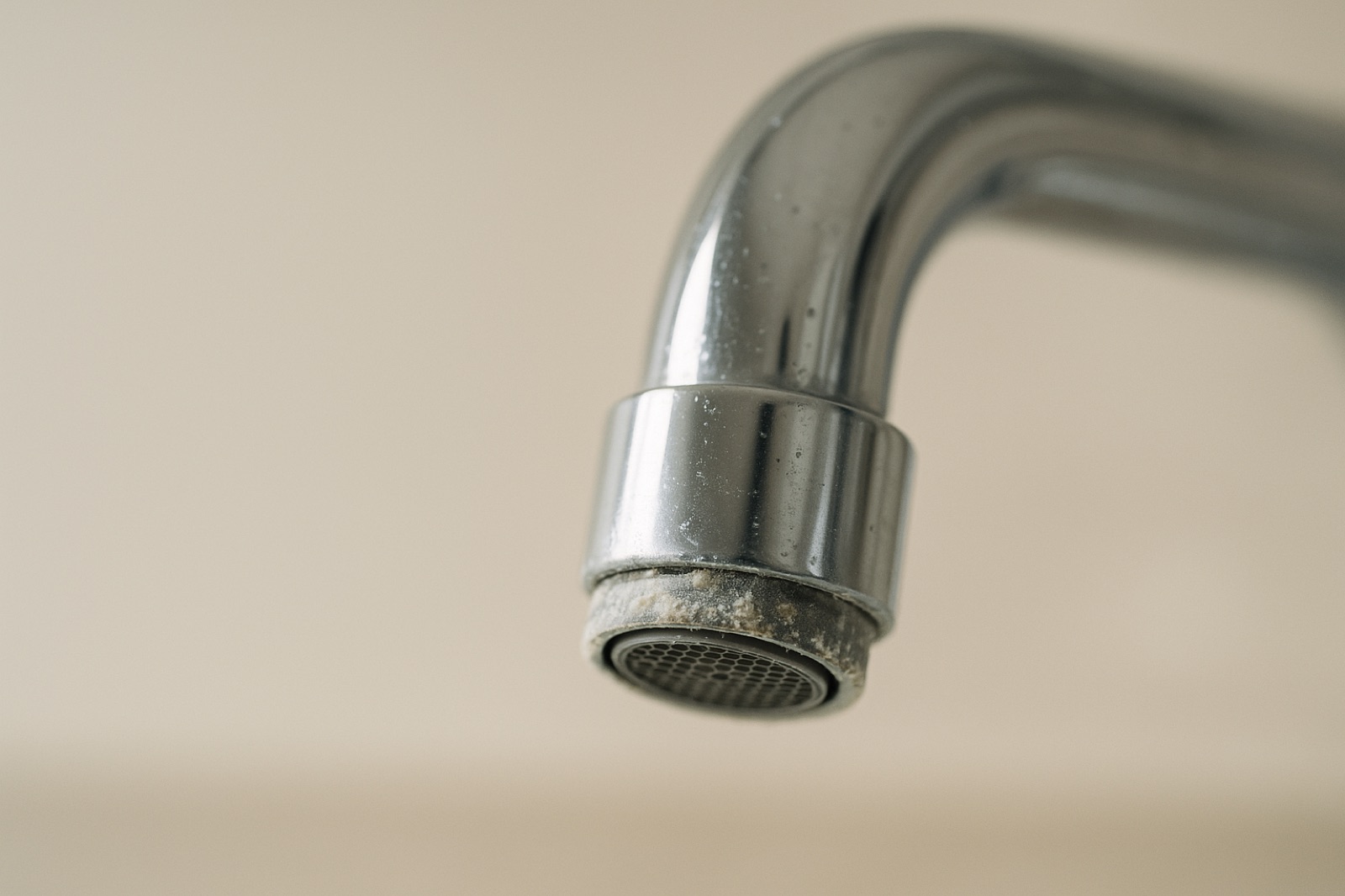
Hard water becomes a persuasive diagnosis when several independent clues point in the same direction. Look for crusty mineral scale where water is heated or repeatedly evaporates, persistent spots after clean water dries, disappointing soap performance, and a repeatable hardness result.
No single clue is decisive. White material around a faucet may be mineral scale, but it may also be cleaner residue. Spots can come from detergent, rinse aid, dishwasher settings, or drying technique. Poor lather can reflect the soap itself. A cloudy glass can be etched rather than coated.
Try to remove the deposit. If diluted vinegar loosens a chalky buildup, minerals are a reasonable suspect. If a glass remains cloudy after cleaning, permanent etching may be responsible. Compare soap performance using the same soap, water volume, and container. These checks are not laboratory tests. They help you decide whether a measured hardness test is worth doing.
Read hardness units without getting lost
A hardness result may be reported in grains per gallon, usually written gpg, or milligrams per liter as calcium carbonate, written mg/L. Parts per million is commonly treated as equivalent to mg/L for this purpose. One gpg equals about 17.1 mg/L.
Convert before comparing results. A reading of 171 mg/L is about 10 gpg, not 171 gpg. Record the unit beside every number, along with the sampling location and date. A bare number on a sales sheet is easy to misunderstand.
Test cold water close to where the supply enters the home, before any existing treatment. Then test a cold tap after the softener, if you have one. The first sample describes incoming hardness. The second helps show whether the equipment is doing its job.
Watch for false positives
Test strips can be useful screening tools, but technique matters. Expired strips, wet fingers in the container, incorrect timing, or matching colors under poor light can distort the result. A sample taken from a softened tap can also create a false impression that the incoming water is naturally soft.
Existing scale creates another trap. Deposits accumulated before a repair or installation do not disappear immediately. Seeing old scale after treatment does not necessarily prove the equipment failed. Clean one fixture, note the date, and watch for new accumulation.
If a result conflicts with what you observe, repeat the test with fresh materials or request a more precise analysis. Ask for the numerical result and unit, not merely a label such as hard or very hard.
Match the remedy to the confirmed problem
Choose repair when incoming water tests hard but water leaving an existing softener also tests hard. First check ordinary causes such as an open bypass, an empty or bridged salt tank, incorrect settings, or a regeneration problem. Replacing the entire unit should not be the automatic first move.
Choose filtration when the complaint is sediment, an unwanted taste or odor, or a specifically identified substance that the selected filter is certified to reduce. A conventional softener exchanges hardness minerals. It is not a general contaminant filter.
Choose softening when measured hardness aligns with recurring scale and soap problems that matter enough to justify salt, regeneration water, and maintenance. Household water use and peak demand then help determine capacity. Lakeview homeowners can confirm hardness and size the right system rather than buying from symptoms alone.
The demand for this distinction is visible in The Home Water Report's own traffic: 3,210 page views, 1,068 visitors, 1,258 search crawls, and 2,876 AI crawls. Those totals do not reveal individual queries or conversions, so they cannot tell us why any one reader arrived. They do reinforce the value of answering the practical question directly: do your hard-water symptoms justify a softener? The most honest answer comes from the proof stack, not the most dramatic spot on a glass.