Michigan's aging water systems returned to the news on October 5, 2026, when Water Finance and Management reported that the Great Lakes Water Authority had released a report calling for a sustainable statewide funding strategy. The GLWA infrastructure funding report concerns the condition and financing of public water infrastructure. It does not tell you whether the water reaching your house is hard or whether you need a softener.
That distinction matters. A systemwide infrastructure problem and a household water-quality symptom may occur at the same time without having the same cause or solution. Before buying equipment, give every hard-water clue a specific job in your diagnosis.
Scale is strong evidence, but location matters
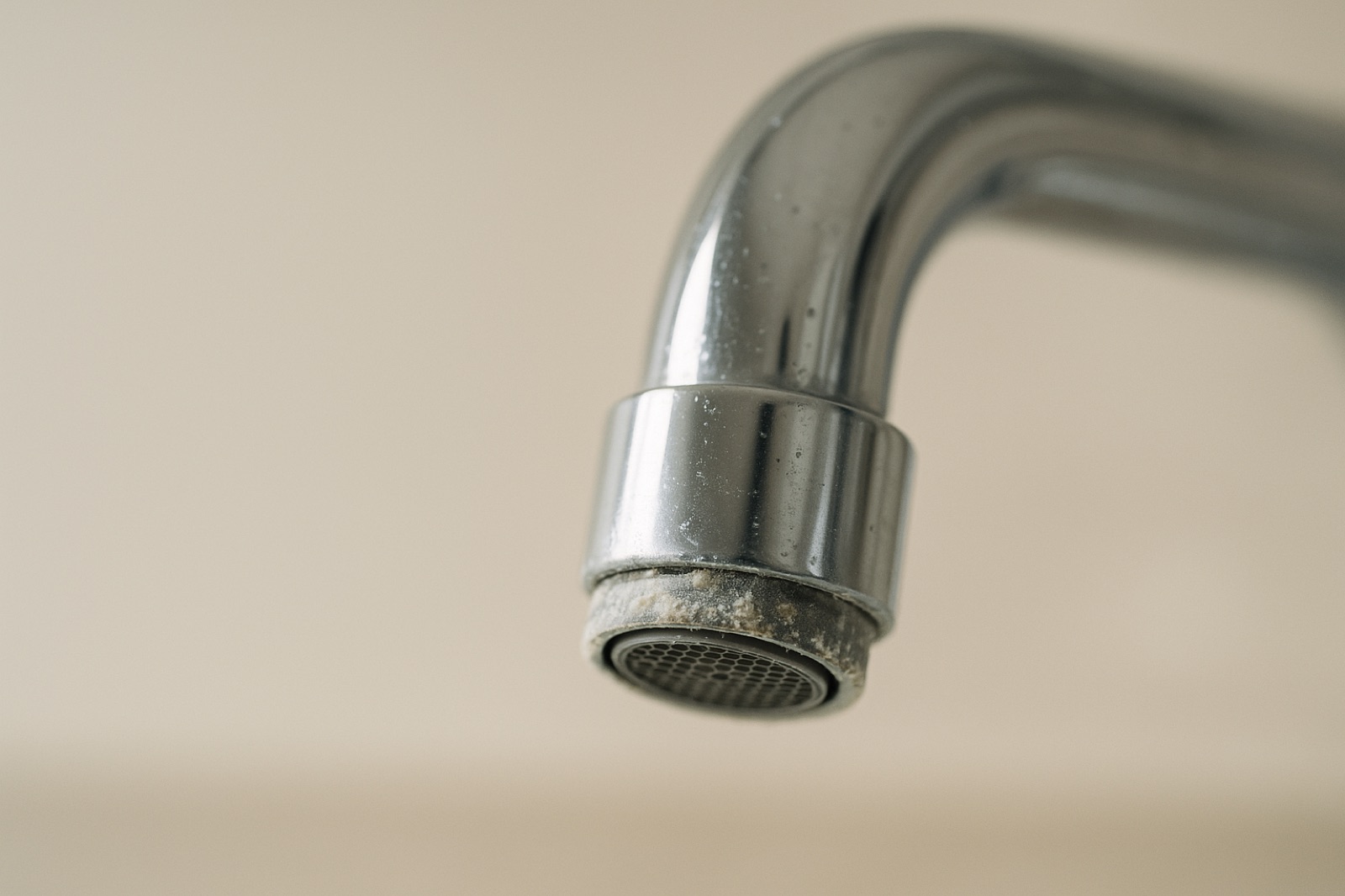
Hardness minerals can leave a rough white or gray deposit where water is repeatedly heated or evaporated. Look at faucet aerators, showerheads, the rim of a kettle, and accessible water-heater connections. Deposits appearing across several hot and cold fixtures make hardness more plausible than residue found in one isolated place.
A single crusted aerator can also reflect a neglected fixture. Clean it, reinstall it, and watch how quickly the deposit returns. If only the hot side develops scale, inspect the water heater and its maintenance history before treating the entire house. Repairing or flushing equipment may still be necessary even if testing later confirms hard water.
Spots are supporting evidence, not a verdict
Mineral-rich droplets can leave spots after they dry, but spotting alone is easy to misread. Dishwasher detergent, rinse aid, glass etching, cleaning products, and residue on the surface can produce similar-looking marks.
Try a simple comparison. Wash one glass by hand with untreated tap water, rinse it thoroughly, and let it air-dry beside a clean control glass rinsed with distilled water. A removable film supports the case for dissolved material in the tap water. A cloudy mark that does not wipe away may be permanent etching rather than fresh scale. That calls for changes to dishwashing chemistry or technique, not necessarily a softener.
Soap performance needs a controlled comparison
Hard water can make soap lather less readily and can leave a film, but product formulation matters. Do not compare different soaps in different sinks and call the result a water test.
Use the same soap, equal amounts of water, and similar containers. Compare your untreated tap water with distilled water. A clear difference adds useful evidence, especially when scale is also present. Little or no difference weakens the case that hardness is causing the complaint, although it does not replace a numerical test.
Read the hardness number in the right unit
A hardness report commonly uses milligrams per liter as calcium carbonate, abbreviated mg/L as CaCO3, or grains per gallon, abbreviated gpg. To make a rough conversion, divide mg/L by 17.1 to get gpg. Always preserve the original result and unit because a bare number such as 10 means very different things on the two scales.
Test untreated cold water from a tap that does not pass through an existing softener or specialty cartridge. If you are checking whether a softener works, collect paired samples before and after it. Test strips are useful for screening, but color matching, expired strips, and a sample taken from the wrong tap can create false confidence. A laboratory or properly performed titration test is more useful when the result will determine equipment size.
Choose the response that matches the finding
Repair comes first when symptoms are confined to one fixture, the hot-water system, or an existing softener that is bypassed, empty of salt, clogged, or programmed incorrectly. A sediment filter may help with visible particles, but it does not remove dissolved hardness. Carbon filtration can address certain taste, odor, or disinfectant concerns, but it is not a substitute for hardness removal.
A conventional ion-exchange softener becomes the logical option when testing confirms hardness and the household has recurring scale, soap, laundry, or appliance problems worth solving. Sizing should consider the measured hardness, household water demand, peak flow, and regeneration settings. Lakeview homeowners can confirm hardness and size the right system rather than selecting equipment from symptoms alone.
The demand for this distinction is visible, although the evidence has limits. TheHomeWaterReport.com recorded 3,210 page views, 1,068 visitors, 1,258 search crawls, and 2,876 AI crawls. That activity suggests the subject is being discovered, but the feed provides neither query-level evidence nor conversions. It cannot show which symptom brought a homeowner here or whether anyone ultimately needed a softener. Your own decision needs better evidence: a repeatable pattern, the right sampling point, and a hardness result with its unit attached.