White spots on glasses, a crusty showerhead, and soap that seems reluctant to lather can all point toward hard water. None proves it alone. If you treat every white mark as a softener problem, you can spend thousands of dollars without fixing the thing that actually bothers you.
This distinction matters after disruptions that make homeowners inspect their water more closely. On September 10, 2026, The Guardian reported that Hurricanes Lowell and Lala damaged infrastructure in Hawaii, including roads, power lines, boats, and piers. The report on Hawaii's storm damage is a reminder that sudden changes deserve a timeline. Hardness generally produces repeatable mineral symptoms. A new problem following an outage, plumbing repair, or supply disruption calls for investigation before equipment shopping.
Start with the weakest clues
Spotting is suggestive, but not decisive. Hard water can leave calcium and magnesium residue when droplets evaporate. Yet similar marks can come from dishwasher detergent, rinse aid settings, overspray from cleaning products, or other dissolved minerals. If spots wipe away with a dry cloth, they may be loose detergent residue. If a mild acidic cleaner dissolves them, mineral scale becomes more plausible.
Poor soap performance is another clue with several possible causes. Hardness minerals react with traditional soap and can leave film, but lather also changes with the product, water temperature, and how much soap you use. Modern detergents behave differently from bar soap. Compare the same product at two fixtures before blaming the water.
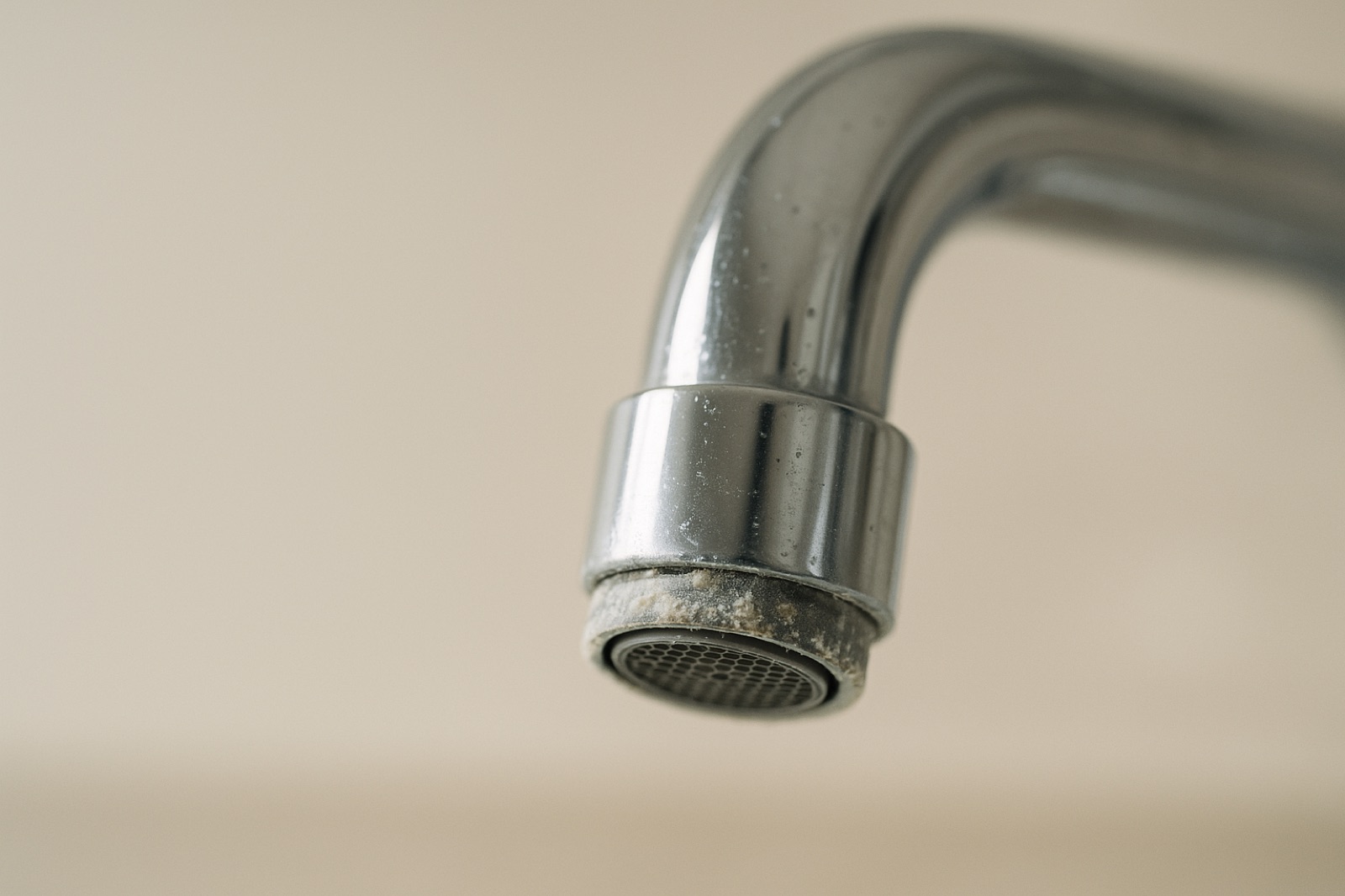
Scale carries more weight when it repeatedly forms where water is heated or evaporates, including kettle walls, faucet aerators, and showerheads. Even then, appearance cannot tell you the hardness concentration. Some deposits are not primarily calcium or magnesium, so testing still matters.
Read the number in the right unit
A useful hardness result is usually reported as grains per gallon, abbreviated gpg, or milligrams per liter as calcium carbonate. One gpg equals about 17.1 mg/L. To convert mg/L to gpg, divide by 17.1. A result of 171 mg/L, for example, is about 10 gpg.
Check the unit before comparing a home test with a utility report or equipment setting. A reading of 10 gpg and one of 171 mg/L can describe essentially the same water. Also distinguish the measured hardness of your untreated water from the capacity rating printed on a softener. A 32,000-grain label describes nominal treatment capacity, not your tap's hardness.
Test strips are useful screening tools, especially when the result falls clearly within one color band. They are less persuasive when the color sits between bands, the strips are old, or you are trying to size equipment. A drop-count titration test offers a more specific result. For a private well, unexplained staining, or several water concerns at once, an appropriate laboratory test can separate hardness from iron, manganese, pH, and other issues.
Watch for false positives
A softener is not the first answer when only one faucet has low flow or crusting. Remove and clean that aerator, then compare it with other fixtures. A failing water heater, clogged screen, stuck valve, or old section of pipe is a repair problem.
Likewise, orange or black staining should not automatically be labeled hardness. Color, odor, sediment, and unpleasant taste can require different tests and different treatment. A standard sediment or carbon filter may address particles, chlorine taste, or certain odors, but ordinary filtration does not remove dissolved calcium and magnesium. Point-of-use reverse osmosis can reduce hardness at one drinking-water tap, yet it is not a substitute for whole-home softening when scale is affecting fixtures and appliances throughout the house.
Choose repair, filtration, or softening
Choose repair when the symptom is sudden, isolated, or tied to a malfunctioning fixture or appliance. Consider filtration when testing identifies particles, taste, odor, or another filter-targeted concern. Consider an ion-exchange softener when a reliable test confirms meaningful hardness and the symptoms are consistent across the home.
Softener sizing should use the measured hardness, household water demand, and any relevant iron adjustment. A unit that is poorly sized or programmed may regenerate too often, waste salt and water, or allow hardness through before regeneration. If you want an address-specific check, Lakeview readers can confirm hardness and size the right system before comparing equipment.
The interest in this question is real, but the available audience data has limits. TheHomeWaterReport.com recorded 3,210 page views, 1,068 visitors, 1,258 search crawls, and 2,876 AI crawls. The feed does not include query-level evidence or conversions, so those figures cannot tell us how many readers bought a softener or which symptom brought them here. Your own decision should rest on better evidence: repeated whole-home clues, a correctly interpreted hardness test, and a treatment matched to the result.