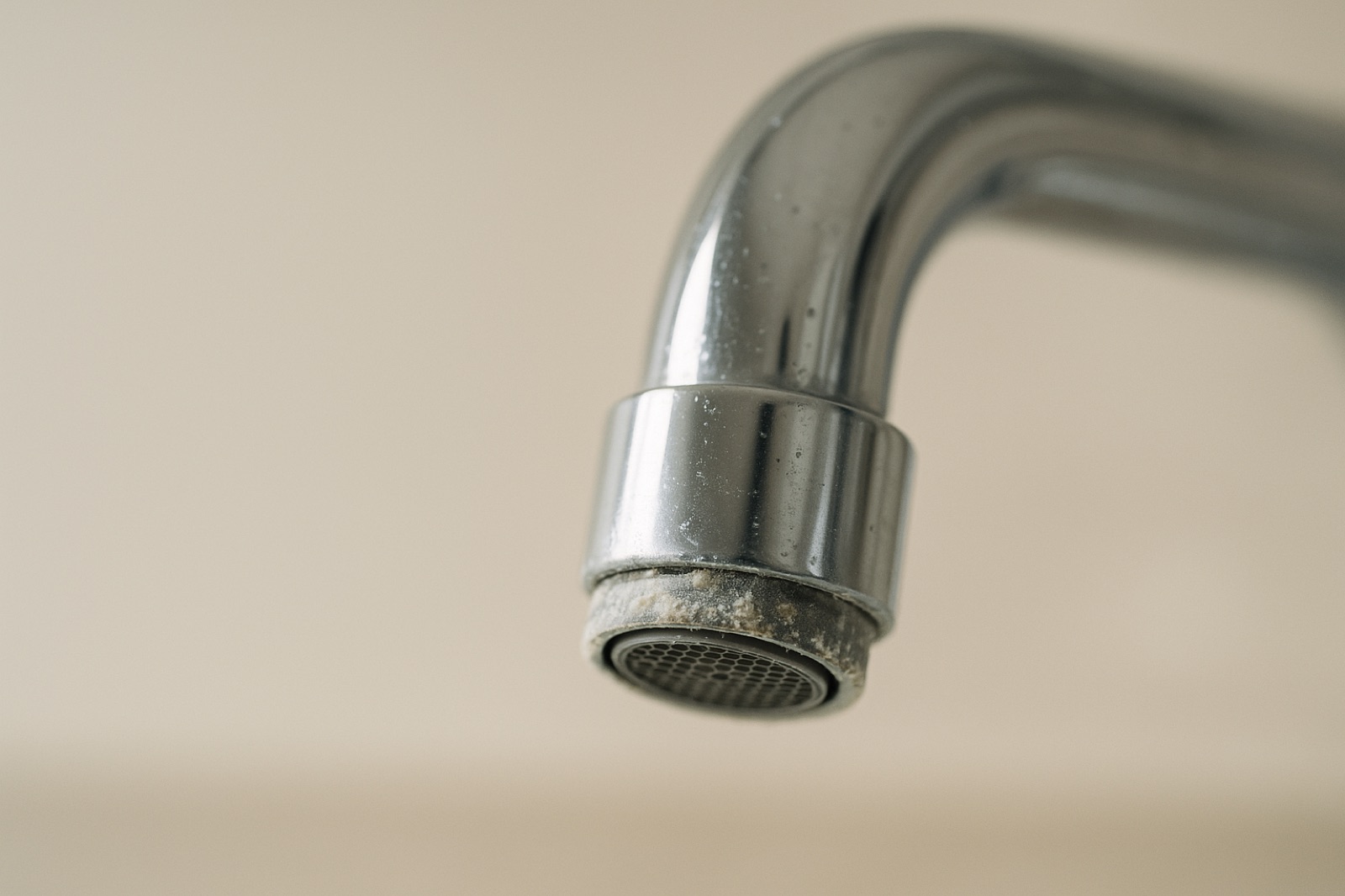
A troubling water headline can make almost any stain or spot around your home feel more significant. Circle of Blue reports that federal officials are expanding a scientific review of glyphosate, a widely used weed killer, in its coverage of the EPA and HHS review. That is a real chemical-safety story, but it does not turn cloudy glassware, weak suds, or a crusty showerhead into evidence that glyphosate is in your water.
Those household symptoms can help you diagnose a water problem, provided you ask the clues to do only what they can. Scale and soap performance may support a hard-water diagnosis. They cannot identify an agricultural chemical, establish whether water is safe to drink, or tell you which filter to buy.
Start with the deposits, but inspect their behavior
Hard-water scale is usually pale, chalky, and stubborn. It often collects where water is heated or evaporates, including faucet aerators, showerheads, kettle interiors, and the edges of humidifier reservoirs. If a deposit softens when treated with ordinary white vinegar, mineral scale becomes a stronger possibility.
Yet white spots alone are a weak test. Dishwasher detergent residue, excess rinse aid, dried salt spray from a malfunctioning softener, and minerals left behind by any evaporating droplet can look similar. Glass that remains cloudy after cleaning may also be etched, which a softener cannot reverse.
Look for repetition instead. Scale appearing at several hot-water fixtures is more persuasive than one spotted glass. A single troublesome faucet points first toward a dirty aerator, worn cartridge, or local plumbing issue.
Treat the soap test as supporting evidence
Hard water can make soap harder to lather and can leave a film on tubs, sinks, laundry, or skin. Even so, soap performance produces false positives. The amount of product, water temperature, detergent formulation, washing-machine settings, and buildup inside the appliance all affect what you see.
Run a modest comparison before blaming the water. Clean the fixture or appliance, use the recommended amount of detergent, and observe several wash cycles. If poor lather, mineral deposits, and a measured hardness result all point in the same direction, you have a much better case for softening.
Read hardness numbers in either common unit
A basic hardness test may report grains per gallon, abbreviated gpg, or milligrams per liter as calcium carbonate, written mg/L. Parts per million is commonly treated as equivalent to mg/L for this purpose. To convert gpg to mg/L, multiply by about 17.1. A result of 10 gpg is therefore about 171 mg/L.
Test cold water before any treatment equipment. If a softener is already installed, test a second sample from a softened tap. That comparison shows whether the incoming water is hard and whether the equipment is reducing that hardness. One strip can be useful for screening, but a laboratory test or a properly performed titration test offers a firmer basis for an expensive purchase.
If you use a private well, broader testing decisions should reflect the well, nearby land use, and the substances you actually need to investigate. A hardness test does not stand in for contaminant testing.
Choose the response that matches the finding
Repair comes first when the symptom is isolated, sudden, or tied to equipment. Check clogged aerators, a failing water-heater component, softener bypass settings, an empty brine tank, salt bridging, and unusual regeneration behavior. A working softener may simply need maintenance or corrected settings.
Softening is the logical category when confirmed calcium and magnesium hardness is causing recurring scale, soap inefficiency, or appliance buildup throughout the home. The test result, household water use, and plumbing layout help determine capacity. A local assessment can help you confirm hardness and size the right system without treating every water complaint as the same problem.
Filtration belongs in a different lane. Filters are selected for identified substances or specific taste, odor, sediment, or contaminant concerns. A conventional softener is not a universal contaminant filter, while many filters do not remove hardness. Some homes need both systems, but only when separate evidence supports each job.
The Home Water Report has recorded 3,210 page views, 1,068 visitors, 1,258 search crawls, and 2,876 AI crawls in the available reporting. Those totals show that the site is being visited and indexed, but the feed provides neither query-level evidence nor conversion data. It cannot tell us which symptom brought any individual homeowner here.
Your own decision can be more precise: confirm that the problem occurs across the house, rule out a repair, measure hardness in a useful unit, and reserve filtration for a separately defined concern. That sequence turns familiar clues into a defensible treatment choice.