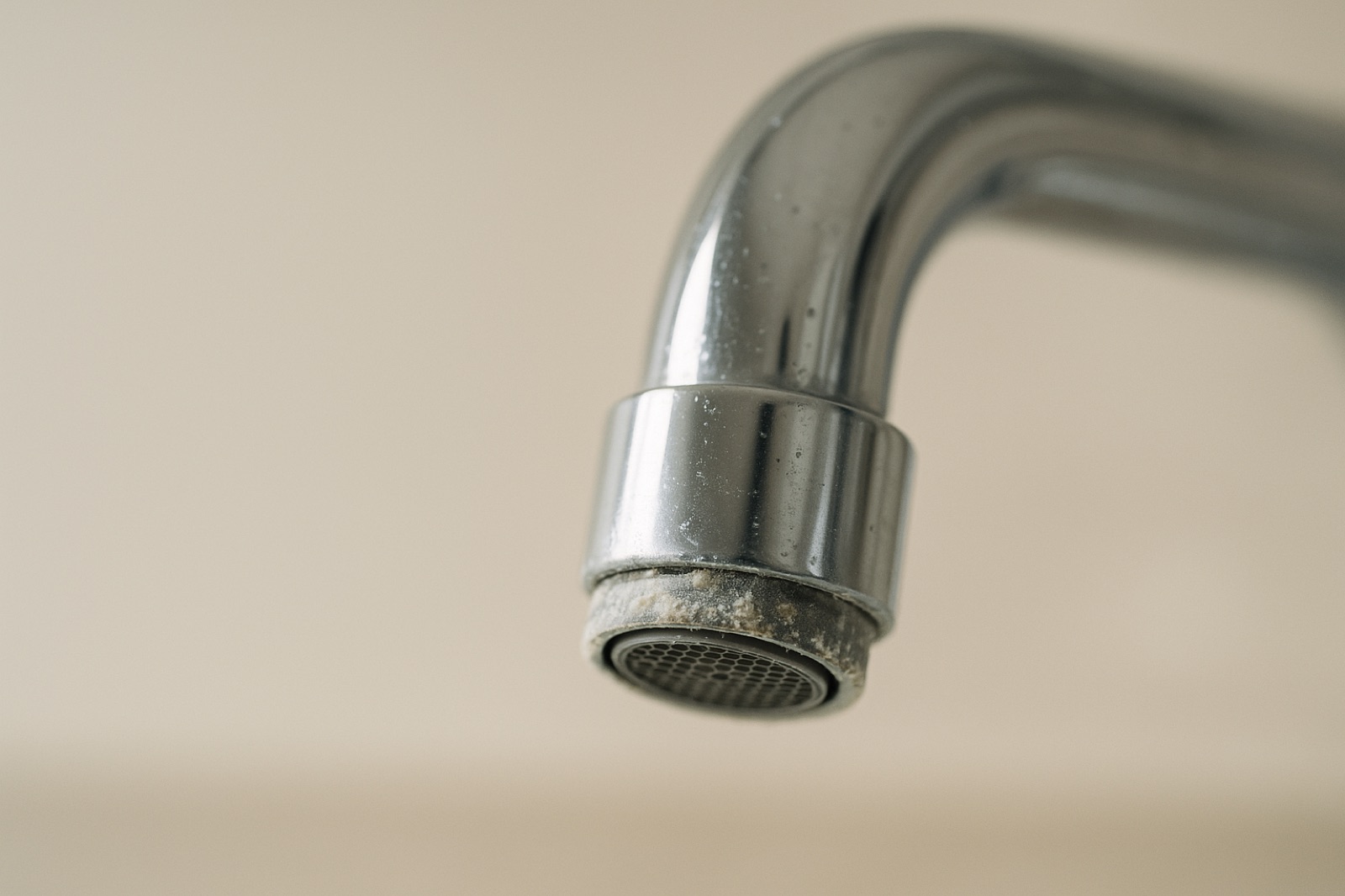
Your water leaves white crust on the showerhead, tastes unpleasant, smells strange, stains the sink, or raises a contaminant concern. Should you buy a softener, install a filter, or order testing?
The honest answer depends on which clue you have. Some household symptoms point fairly directly toward a treatment category. Others tell you almost nothing about what is actually in the water. The practical goal is not to diagnose water by sight or smell. It is to decide what you can reasonably do now and what evidence you still need.
The quick softener versus filter matrix
White scale on fixtures and heating elements: Start with a hardness test. If the result confirms hard water throughout the home, a softener is the treatment designed for that job. A typical drinking water filter is not a substitute for hardness removal.
Unpleasant taste: Check whether it occurs at one faucet or every faucet, and compare cold water with hot water. A filter may eventually be appropriate, but taste alone does not identify the substance causing it. Review your utility's water quality report if you receive public water, or test a private well before choosing media or a cartridge.
Odor: First determine whether the smell comes from cold water, hot water, or the drain rather than the water itself. A hot water only odor can send you toward the water heater, while a drain odor can call for plumbing cleanup. If the odor is present in water collected in a clean glass away from the sink, testing can help narrow the cause before you buy filtration.
Orange, brown, blue, or green staining: Test first. Color can suggest possible causes, but it cannot confirm them. Iron, manganese, corrosion, plumbing materials, and water chemistry may require different responses. A softener can address certain dissolved minerals under suitable conditions, while other problems need dedicated filtration or corrosion correction.
Concern about PFAS or another invisible contaminant: Skip symptom hunting. You cannot use scale, taste, odor, or staining to rule an invisible contaminant in or out. Testing and source specific information must lead the decision.
Why contaminant concerns belong in a separate lane
The Guardian reported on September 18, 2026, that new peer reviewed research found many US military veterans had higher PFAS levels in their blood than non-veterans. The story also noted elevated PFAS pollution in soil and water around military bases linked to chemicals used in firefighting foam. Read The Guardian's report by Tom Perkins on PFAS and veterans.
That story does not establish what is in your household water, even if you live near a military site or have a veteran in your family. It does reinforce an important buying rule: exposure concerns require relevant evidence. A water softener is built to exchange hardness minerals. It should not be treated as a general contaminant shield. Filtration must be selected for the particular substance, concentration, flow rate, and use point involved.
Your testing checklist before requesting estimates
Write down where each problem appears, when it started, and whether it affects hot water, cold water, or both. Photograph stains and scale before cleaning them. If you use public water, obtain the current utility report and note that it describes the system, not necessarily every condition inside your plumbing. If you use a private well, choose a qualified laboratory and testing panel appropriate to your location and concern.
For hardness complaints, get a numerical hardness result rather than relying on soap feel alone. For staining, ask for measurements related to the suspected cause instead of ordering only a basic hardness test. For a named contaminant such as PFAS, confirm that the laboratory method and sample instructions cover that contaminant. Avoid collecting samples after an existing treatment device unless your purpose is specifically to evaluate that device.
If the symptoms overlap or you are unsure where to sample, schedule a professional water assessment before comparing equipment proposals.
Turn the evidence into one of three decisions
Choose a softener when confirmed hardness is the household problem you want to solve. Choose filtration when testing or reliable source information identifies a substance and a suitable treatment has been matched to it. Choose testing first when the complaint is taste, odor, colored staining, a sudden change, or an invisible contaminant concern.
The Home Water Report's available audience figures show 3,226 page views, 1,068 visitors, 1,265 search crawls, and 2,891 AI crawls. No assist or CRM data was supplied, so those numbers indicate interest in the information, not completed purchases or treatment outcomes.
Your best shopping list may include both softening and filtration, but each piece of equipment should have a clearly defined job. If a seller cannot connect the proposed system to a symptom, a measurement, and a realistic maintenance plan, you do not yet have enough information to buy.