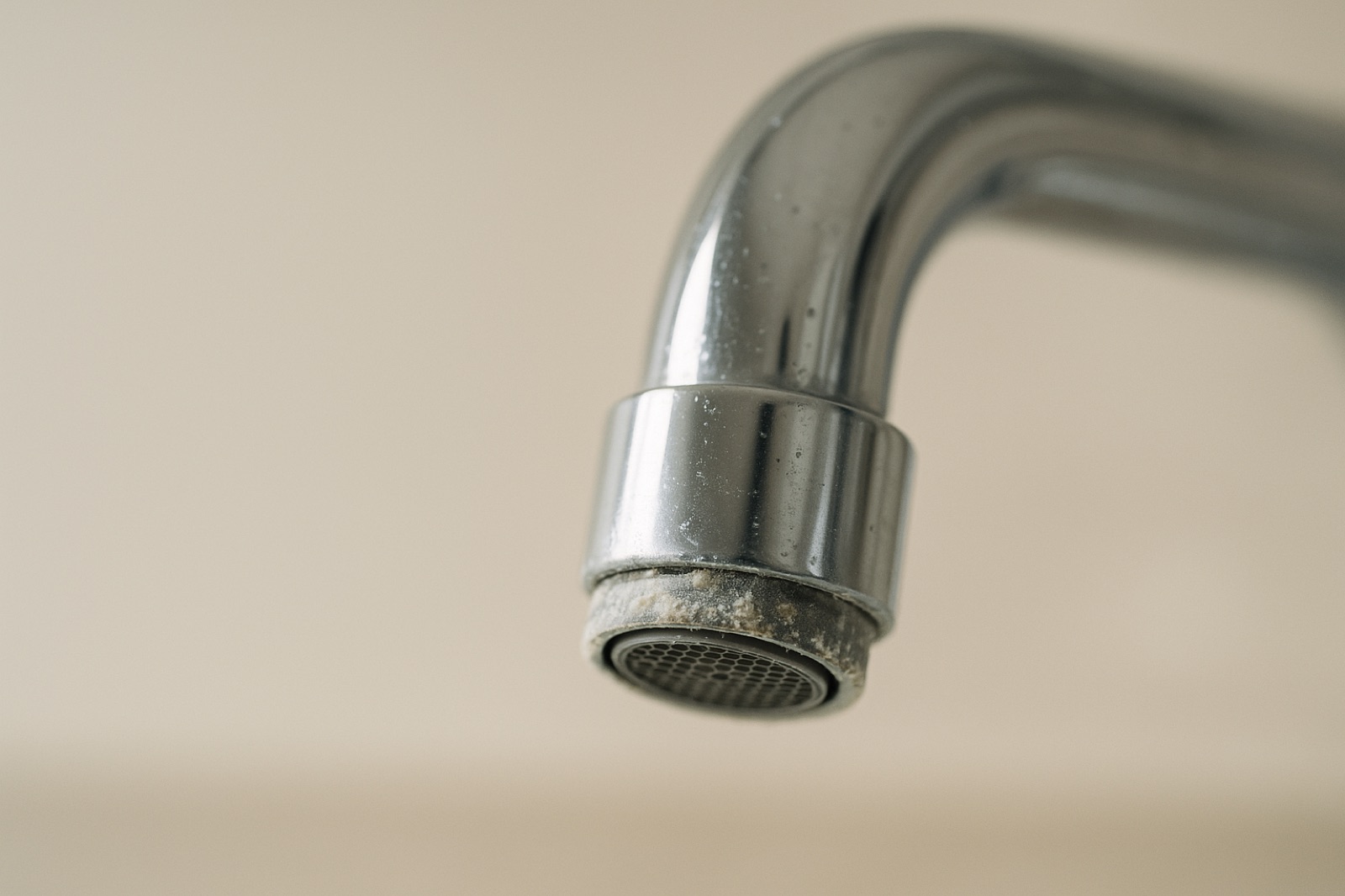
You turn on the shower and get a disappointing stream. The kitchen faucet has lost some force, too. Then you notice white crust around an aerator and wonder whether hard water is clogging the entire house.
It might be contributing, but weak flow alone does not make the case for a water softener. A shutoff valve, clogged aerator, failing pressure regulator, old pipe, well equipment problem, or sediment can produce a similar symptom. Your job is to separate a plumbing restriction from a mineral problem before choosing equipment.
Changing conditions outside the home make that distinction worth respecting. In October 2026, Circle of Blue described scientists studying what wildfires can mean for lakes after fires swept through a California research area in the summer of 2020. The report on wildfire impacts in lakes is a reminder that source-water conditions can change. It does not prove that wildfire, hardness, or any particular contaminant is causing a problem at your house.
Start with the pattern of weak flow
If only one faucet is weak, remove and inspect its aerator. Mineral crust, pipe debris, or sediment may be trapped there. Clean or replace the small part before treating every gallon entering the house.
If hot water is weaker than cold water at several fixtures, the restriction may be associated with the water heater or hot-water piping. If hot and cold flow are weak throughout the house, check whether the main shutoff is fully open and whether a pressure regulator, cartridge filter, well pressure tank, or existing treatment system needs service.
A sudden pressure change deserves plumbing diagnosis. Hardness scale usually accumulates rather than announcing itself through one abrupt household-wide drop.
Build a real hardness case
Scale becomes more persuasive when it appears with other clues. Look for a hard, chalky deposit on showerheads, faucet outlets, kettles, or heating surfaces. Notice whether soap is difficult to lather and whether rinsing seems to require more effort. Repeated spotting on glassware can support the pattern, but spotting is a weak clue by itself.
Dishwasher detergent, excess rinse aid, evaporation, salty spray, silica, and incomplete cleaning can all leave marks. A film that wipes away easily may be soap or detergent residue rather than mineral scale. That is why a photograph of one spotted glass should not be your softener diagnosis.
Test untreated cold water near the point where it enters the home. Do not sample from a softened tap when you are trying to measure incoming hardness. If you already own a softener, compare water before and after the unit. Hardness after treatment can point to depleted salt, a bypass valve left open, incorrect settings, worn resin, or another service issue.
Read the units before reading the sales pitch
Hardness results are commonly reported as milligrams per liter, parts per million, or grains per gallon. For typical household interpretation, milligrams per liter and parts per million are treated as equivalent. One grain per gallon is about 17.1 milligrams per liter.
That conversion matters when a test report and a softener proposal use different units. Divide milligrams per liter by 17.1 to estimate grains per gallon. For example, 171 milligrams per liter is about 10 grains per gallon. Classification labels can vary, so keep the actual number instead of relying only on words such as moderately hard or very hard.
Also watch for false positives. Test strips can be affected by storage, timing, lighting, and color matching. A total dissolved solids meter does not measure hardness specifically. If a borderline result would determine whether you spend thousands of dollars, confirm it with a more precise hardness test.
Choose the response that matches the finding
Choose repair when the problem is isolated, pressure changed suddenly, or an existing device is restricting flow. Choose filtration when testing identifies sediment, taste, odor, or a specific substance that the selected filter is designed to reduce. A standard sediment or carbon filter does not soften water.
Consider softening when measured calcium and magnesium hardness aligns with recurring scale and soap-performance problems across the home. Sizing should account for measured hardness, household demand, peak flow, and any iron or manganese that the proposed equipment is expected to handle. Lakeview homeowners can confirm hardness and size the right system instead of treating weak flow as the deciding evidence.
Why answer this question now? The Home Water Report recorded 3,210 page views, 1,068 visitors, 1,258 search crawls, and 2,876 AI crawls. Those totals show attention around the site, but the feed lacks query-level evidence and conversions. They cannot tell us that every reader needs a softener, just as weak flow cannot tell you what your house needs. The useful answer still comes from the symptom pattern, a sound test, and the right unit conversion.