Water quality professionals are gathering in New Orleans as homeowners face a much smaller version of the same challenge: identifying the actual water problem before choosing equipment. Water Finance and Management reports that WEFTEC returns to New Orleans from September 26 through September 30, 2026, with more than 23,000 registrants and 1,000 exhibitors expected. The scale is enormous, but the useful lesson for your house is simple. A symptom is a starting point, not a diagnosis.
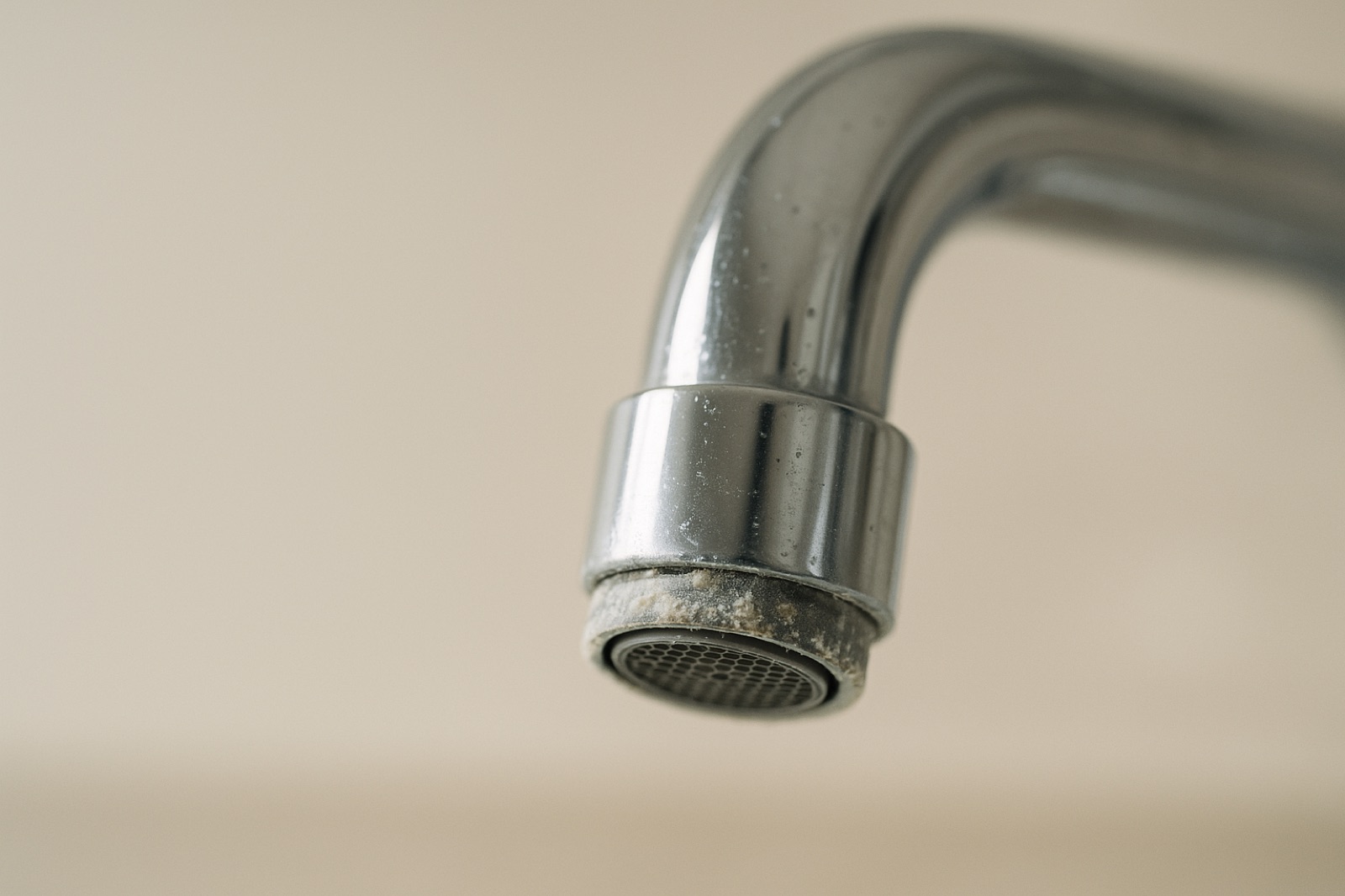
If you are seeing white spots, crusty faucet deposits, poor soap performance, or scale around heating elements, hard water is a reasonable suspect. It is not the only suspect. Here is how to sort the evidence before you buy a softener.
Read the location of the scale
Hardness deposits usually appear where water is heated, sprayed, or allowed to evaporate. Check the showerhead, faucet aerators, glass shower doors, coffee maker, dishwasher interior, and the rim of a frequently used pot. Chalky buildup across several locations is stronger evidence than one dirty fixture.
A deposit limited to one faucet may point to a worn aerator, a slow leak, or residue from a cleaning product. Cloudiness on glassware can also be detergent film or permanent etching. Try soaking one affected glass in plain white vinegar. If the film loosens, mineral scale is likely involved. If it remains, the surface may be etched.
Treat spotting as a clue, not a verdict
Any water can leave spots because dissolved material remains after droplets dry. Hard water often produces obvious pale mineral marks, but spotting alone does not tell you how hard the water is. Dishwasher settings, rinse aid, drying temperature, and detergent dose can change what you see.
Soap behavior is similarly imperfect. Calcium and magnesium react with soap and can create curd or residue, so hard water may require more product to produce satisfactory lather. Yet low-lather detergent, cold water, or an oversized dose of modern concentrated cleaner can confuse this informal test. Slippery skin does not prove that water is over-softened, either. Soft water lets soap rinse differently, and leftover soap can create a similar sensation.
Get a number you can use
For a buying decision, test total hardness at an untreated cold-water tap. If you already own a softener, test both before and after the unit. A liquid drop kit usually gives a clearer endpoint than broad-range strips, while a certified laboratory is appropriate when you also need information about iron, manganese, pH, bacteria, or other concerns.
Hardness may be reported as milligrams per liter, parts per million, or grains per gallon. For practical household calculations, milligrams per liter and parts per million are treated as equivalent. One grain per gallon equals about 17.1 milligrams per liter. Divide a result in milligrams per liter by 17.1 to estimate grains per gallon.
A total dissolved solids meter is a common source of false positives. It measures the water's overall ability to conduct electricity, not calcium and magnesium specifically. Salt, bicarbonate, and other dissolved ions affect the reading. That means a high reading does not prove hard water, while softened water can still show substantial total dissolved solids.
Match the fix to the evidence
Choose repair when untreated water tests hard but water leaving an existing softener also tests hard. First check for an open bypass, an empty or bridged salt tank, incorrect programming, a failed regeneration cycle, or exhausted resin. Replacing the entire unit should not be the automatic first move.
Choose softening when a repeatable hardness result lines up with widespread scale and soap problems. Household size, peak flow, hardness, iron, and expected water use all affect capacity and regeneration settings. Lakeview homeowners can use a local assessment to confirm hardness and size the right system.
Choose filtration when the complaint is primarily chlorine taste, odor, sediment, discoloration, or a contaminant identified by suitable testing. A conventional ion-exchange softener is designed mainly to remove hardness minerals. It should not be treated as a universal contaminant filter. Some homes need both technologies, but each unit should have a defined job.
Do not let attention substitute for evidence
The Home Water Report recorded 3,210 page views, 1,068 visitors, 1,258 search crawls, and 2,876 AI crawls in the available reporting. Those totals show that the site's information is being discovered, but the feed contains neither query-level evidence nor conversion data. It cannot show which symptom brought a homeowner here or whether a reader later purchased treatment.
Your household decision deserves firmer evidence. Photograph the deposits, note where they occur, test untreated water, and compare the result with water after any existing equipment. When symptoms and measurements agree, a softener may be justified. When they do not, pause. A small plumbing repair, a filtration problem, or a change in cleaning routine may be the more accurate and less expensive answer.