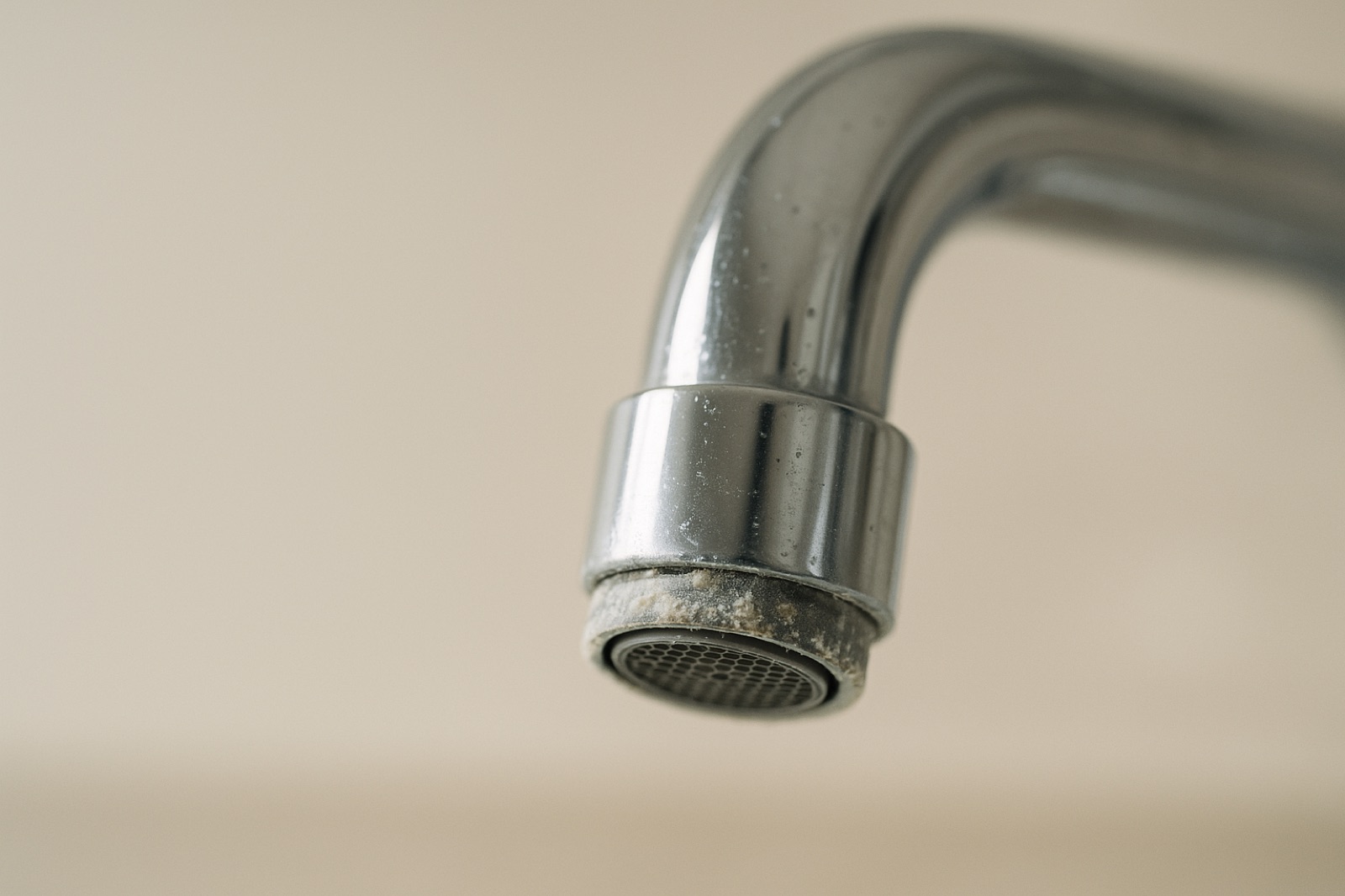
Your water leaves white crust on the showerhead, tastes unpleasant at the kitchen sink, and occasionally stains a freshly washed shirt. Do you need a softener, a filter, or one large system promising to handle everything?
Start by resisting the urge to treat those clues as one problem. They may involve different substances, different parts of the plumbing, and different treatment methods. The useful first question is not, “Which system should I buy?” It is, “Which water sample can confirm what is causing each complaint?”
This principle also appears at a much larger scale. A current Water Finance and Management article about matching valve technology to wastewater treatment conditions explains that a treatment plant has four distinct process environments and that the characteristics of the material change at each stage. Your house is not a treatment plant, but the practical lesson travels well: equipment should match the water condition and the job it must perform.
Use the symptom to choose the first test
Scale and stubborn white deposits: Request a hardness test. Hardness measures primarily dissolved calcium and magnesium. If the result confirms hard water throughout the house, a conventional ion exchange softener is the device designed for that job. A sediment or carbon filter does not remove hardness in the same way.
Chlorine taste or odor: First determine whether the issue appears at every cold water tap or only at one fixture. A carbon filter may improve chlorine-related taste and odor, but its size and placement depend on whether you want better drinking water at one sink or treatment throughout the home.
Rotten egg odor: Note whether it occurs in hot water, cold water, or both. An odor limited to hot water can point you toward the water heater rather than the incoming supply. If both sides are affected, testing should be selected for the source water and likely odor-causing compounds. Do not assume a generic carbon cartridge will solve an unidentified cause.
Orange, reddish, blue-green, or dark stains: Record the color and location before cleaning. Iron, manganese, corrosion, and plumbing materials can create different patterns. A hardness result alone will not settle the question. The testing plan may need metals, pH, and other source-specific measurements.
A contaminant concern: Name the contaminant before shopping. Lead, nitrate, arsenic, microorganisms, and industrial chemicals are not interchangeable categories. Each requires an appropriate laboratory method, careful sampling, and treatment certified or otherwise demonstrated for the specific substance. Taste, odor, and appearance cannot establish that water is safe.
Softener versus filter matrix
| Household complaint | Confirm with | Likely equipment category |
|---|---|---|
| Scale, soap scum, poor lather | Hardness test | Softener if hardness is confirmed |
| Chlorine taste or odor | Source review and targeted water test | Carbon filtration |
| Visible grit or particles | Particle inspection and source assessment | Sediment filtration |
| Orange or dark staining | Iron, manganese, pH, and related tests | Contaminant-specific treatment, sometimes paired with softening |
| Named contaminant | Certified laboratory analysis | A filter or treatment method proven for that contaminant |
| Hardness plus a separate taste issue | Hardness and targeted taste testing | Softener and filter, each assigned a defined job |
“Filter” is a broad label, not a single technology. Carbon, sediment media, reverse osmosis membranes, and specialty media do different work. Likewise, a softener is highly useful for hardness but should not be treated as a universal contaminant barrier.
Your testing checklist
Before collecting a sample, write down whether you use municipal water or a private well. Note which taps are affected, whether the issue appears in hot or cold water, when it started, and whether neighboring homes notice it. Photograph stains and deposits in place. Gather any utility water quality report and previous laboratory results.
Then ask the laboratory or water professional about the correct container, sampling location, flushing instructions, preservation requirements, and delivery deadline. Poor collection can make an otherwise suitable test less useful. If several symptoms overlap or you are unsure which panel fits, schedule a professional water assessment before pricing equipment.
The Home Water Report recorded 3,226 page views, 1,068 visitors, 1,265 search crawls, and 2,891 AI crawls in the supplied reporting period. No assist or CRM data was supplied, so those figures cannot show how many readers later tested their water or bought treatment. They do show why a clear decision path matters: many people and automated systems encounter water guidance, but only a properly chosen test can describe the water in your home.
For Erica and any homeowner facing several clues at once, the sensible purchase may be a softener, a filter, both, or no new equipment yet. Let the sample answer that question. A symptom starts the investigation, but the verified cause should choose the system.