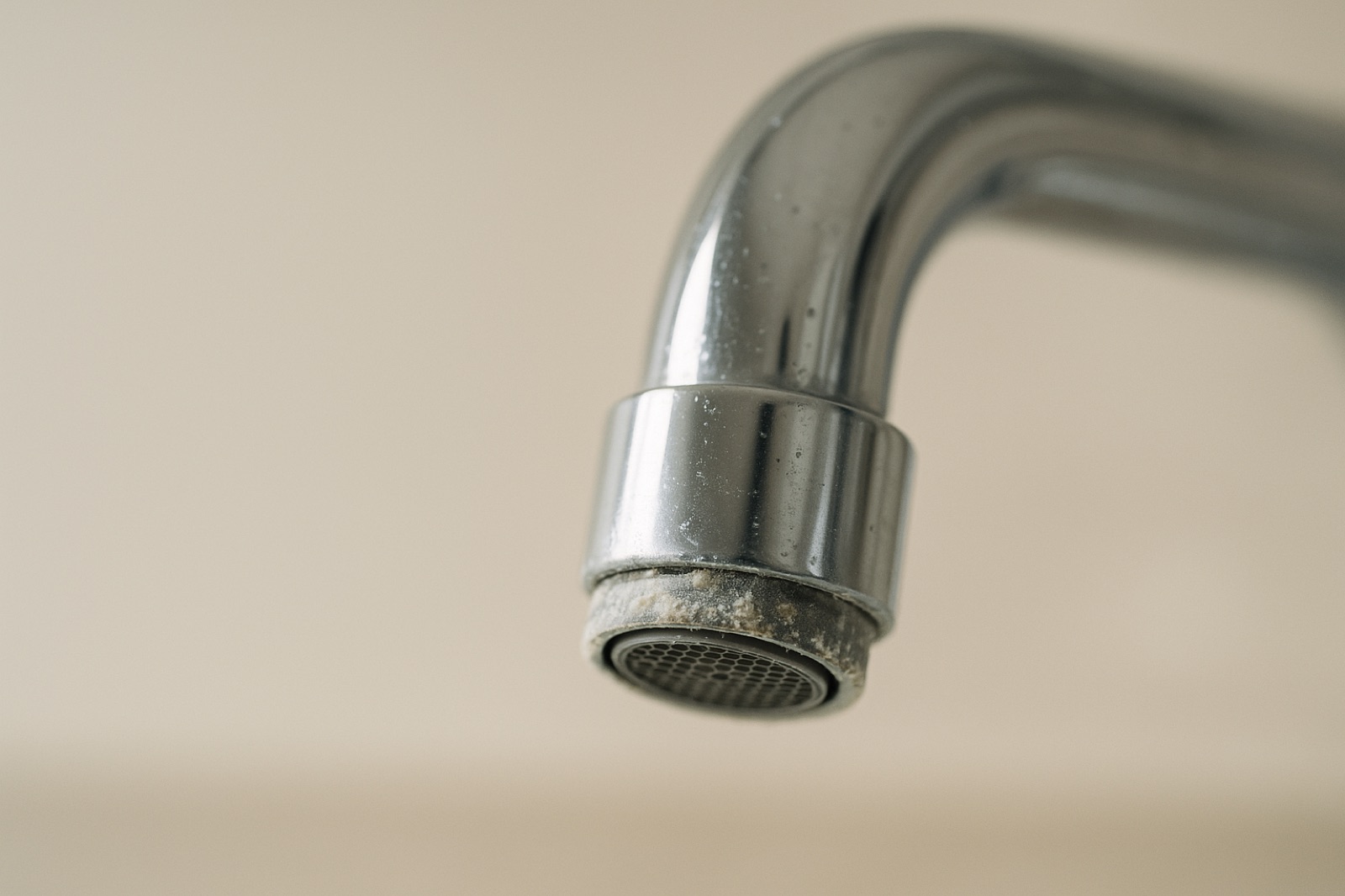
A white crust on the showerhead points in one direction. A metallic taste at one faucet points in another. An odor that appears only when you run hot water may send you somewhere else entirely.
Before you choose between a water softener and a filter, find out where the symptom occurs. This simple location check cannot identify every contaminant, but it can prevent you from asking whole-house equipment to solve a problem caused by one fixture, one pipe, or the water heater.
The distinction matters beyond your front door. Circle of Blue reports on drinking-water concerns in Fort Frances, Ontario, a town of about 7,500 where Rainy Lake empties into the Rainy River and a proposed U.S. mine has prompted preparation for a possible change in the community's water supply. That story concerns a source-water question affecting a community. Your household investigation should begin by determining whether your clue is similarly broad or limited to one part of the home.
Run the three-location check
First, compare a cold-water tap near the point where water enters the house with a cold-water tap farther away. Then compare cold and hot water at the same sink. Finally, check another room.
Use clean glasses for taste, odor, and visible-particle comparisons. Let each tap run briefly after it has been sitting. Record whether the problem appears at one tap, on one temperature setting, or throughout the house. Do not taste water when contamination is suspected.
If the symptom occurs at only one faucet, inspect that faucet's aerator, supply line, and nearby plumbing before pricing whole-house treatment. If it occurs only in hot water, the water heater and hot-water plumbing belong on your inspection list. If it appears at multiple cold and hot taps, testing the incoming water becomes more useful.
Match the clue to the next decision
| What you notice | What to check | Likely treatment category |
|---|---|---|
| Crusty scale on several fixtures | Test hardness in incoming cold water and compare it with hot water | A softener may fit if hardness is confirmed |
| Unwanted taste or odor throughout the house | Identify whether it affects cold water, hot water, or both, then test for likely causes | A filter may fit, but the filter media must match the cause |
| Orange, brown, blue, or green staining | Test the water and inspect plumbing rather than choosing by stain color alone | Filtration, corrosion control, plumbing work, or a combination may be needed |
| A symptom at one faucet only | Clean the aerator and inspect the fixture and local supply line | Local maintenance may solve it without whole-house equipment |
| A contaminant detected by a laboratory | Confirm the result, concentration, sampling location, and treatment certification | Choose a system specifically rated for that contaminant |
A softener primarily addresses hardness minerals through ion exchange. It is not a general-purpose contaminant remover. A filter targets particular substances according to its media and design. Some households need both, but two devices are justified only when the evidence shows two separate jobs.
Build a useful testing checklist
Write down the symptom, affected taps, water temperature, timing, and any recent plumbing or water-supply changes. If you use municipal water, review the utility's available water-quality information. If you use a private well, select testing based on the well, local conditions, and changes you have observed.
For laboratory sampling, follow the lab's container, handling, and delivery instructions. Sampling before existing treatment shows what enters the home. Sampling after treatment shows what the equipment is delivering. Clearly label each location so the results remain meaningful.
If you want help choosing samples or interpreting the treatment decision, schedule a professional water assessment. Ask the provider to connect every recommended device to a measured result or a clearly documented household objective.
The Home Water Report's current audience snapshot includes 3,226 page views, 1,068 visitors, 1,265 search crawls, and 2,891 AI crawls. No assist or customer relationship management data was supplied. Those figures show attention, not whether any particular household needs equipment. Your own tap locations, observations, and test results remain the numbers that should drive your purchase.
Start small: one cold tap, one hot tap, and one tap in another room. Where the problem appears can be as useful as what the problem looks, smells, or tastes like.